

- Contributed by
- IRWinter
- People in story:
- Ivan, Paul and Brian Winter.
- Location of story:
- Landford Wilts
- Background to story:
- Civilian
- Article ID:
- A8418503
- Contributed on:
- 10 January 2006
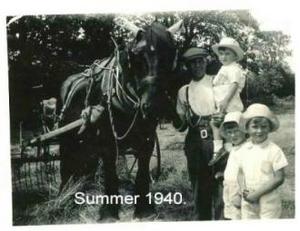
Haymaking 1940
Settling in at Forest View.
Obviously the trauma of the first few months was overcome by the twins who not only missed their Mum and Brian but also had to get used to new guardians. It is to Gran and Aunty Dorothy’s credit that we did settle in and the years at Landford came to be treasured in later life.
Gran had brought up a family of four on a farm and considered Pauline’s efforts at feeding us as inadequate. To be fair to our Mum she had a poor teacher in her own mum, who’s idea of living, all her life, was to have a good time, often at the expense of her family.
Mum told me that she was often left to look after the Tobins with little money as her mum had disappeared to Margate with the family cash.
For the duration of the war we were fed on good wholesome country food, which was always, adequate and included favourites such as apple pie or pudding, jam rolly poly, baked apple, stewed rabbit caught locally and non favourites sago and tapioca.
Both Gran and Dorothy were good cooks; in fact Dorothy later earned her living at this task in a local factory canteen and then the Gadaulphin School in Salisbury.
Although there was rationing during and after the war we never went without the basics of life. No sweets or exotic fruit such as bananas, figs or dates. Only brown bread as this was considered healthy by the government as it contained all of the grain. It was long after the war before white bread made a reappearance.
Forest View stood on one third of an acre of land, which included a large garden at the rear with several apple trees. The only useful ones being the two Bramley trees the rest being poor eaters. A large rhubarb patch contributed to our diet. The soil was poor being thinly spread over sand formations. Uncle Les reckoned that it needed a shower of rain every week and a shower of manure every other week, I think he said manure.
Pal was not a great lover of meat and tells the story now of hiding meat in his pocket and getting rid of it later. I can’t imagine him doing this often, as he would not have escaped the eagle eye of Gran.
Photos taken during this first Winter show us nicely togged up in a blue outfit complete with hat and leggings and looking very healthy
I know our parents contributed to our upkeep but I am just as certain that our new surrogate parents also supported us.
In the spring of 1940 Gran was asked if another one would make any difference and so Brian joined us twins, he was just two years old.
Now we know that Mum was again pregnant with Diana who was born in September 1940, but we weren’t to find out about her until 1945.
The three of us settled down to a happy period of our lives although the disappearance of our parents did affect us all in different ways.
Brian was small for his age and looked like his dad, who had been his mums favourite, so he naturally was spoilt by the two ladies. He would of course deny that vigorously, but we all have memories of his show off Billy the Bull act.
The Early War years.
It is strange to say that the agony the country was going through with defeat in France and the Battle of Britain did not register to me at the time. Maybe it was because we were to young to worry about it or maybe the dramatic changes in our lives transcended all else.
Memories are vague at this age but I can remember standing at the pound, on Pound hill, waiting for the bus and German bombers flying over going north.
Southampton had many Barrage balloons flying in the sky and these were visible from the hill on which the bungalow stood, although I can’t be sure at which point of the war I noticed them.
Only one bomb fell on Landford and this was while we were in bed during the evening of Nov 17th 1940 at 6.15 pm.
Us three lads were in the large brass bed in the back bedroom as the bomb could be heard descending. Uncle Les who was on leave from Portsmouth at the time came into our room and threw himself across the bed.
Fortunately it landed in a field to the south of Rose cottage near the A36 making a large crater.
It caused minor damage to the bathroom ceiling but was a major sensation and was much visited by local folk. Now you would probably need detection equipment to find its impact spot. At this stage in the war I can recall very few incidents. The adults would rely on the radio for their news and Nine o’clock in the evening was sacrosanct.
We did have one relative who was worried about the household of two women and three children and that was Dorothy’s cousin Uncle Vic Winter.
Vic lived in Fritham where he had a small holding and every night all through the winter of the Blitz he would cycle down from Fritham to Forest View to make sure we had a man in the house. He would check on the black out curtains, which had to cover every window and sit with Alice and Dorothy by the light of the Aladdin lamp until he felt it was safe to cycle home. Although Landford was never attacked we did spend some time in the underground shelter constructed by Mr Bowden next door. It was a very well made shelter warm and dry and hidden behind a row of fir bushes, Mr Bowden was a very cautious man.
Vic said a long time after the war that his journeys across the plain at Fritham gave him a frightening view of the raids on the docks in Southampton.
In October 1942 Albert had to move out of his home, at the farm opposite Northlands, Wickets Green and with no where else to go to his family moved into Forest View. The army had taken over the top floor earlier and now they wanted the whole house. The family were Albert, May his wife their sons Peter and Michael. It was a tight squeeze with Albert’s family having the front room, which was normally the unused parlour.
Their was friction, which was to be expected especially when Dolly banked up the lounge fire one day after May had put her washing in the oven to dry. Result scorched clothes and a bit of a tiff. With Michael a baby there was a lot of washing.
They stayed for six months, leaving in March 1943 moving into the far right cottage of the group by the bakery and stayed there the rest of their days. May only moved out in her nineties.
Neighbours.
My grandfather Edwin Winter had owned Glebe Farm from 1916 until 1939 when it was sold to Bill Grayer, my grandfather having died on the 3rd of December 1938 after a long illness caused by gallstones.
When Edwin bought the farm it consisted of an old thatched farmhouse, the tithe barn and outbuildings. They’re being no other buildings on his land, which stretched from Glebe lane to the pound at Pound hill and land the other side of glebe lane to the river Blackwater and the other side of the A36.
He probably sold the lots at Pound hill in the 1920s and kept one to build a bungalow for his daughter Dorothy, who was courting a man called Jim. I have a document that shows a completion of conveyance for a new house dated 20th September 1932, cost £11.2.0.
On this lot of 1/3 of an acre he built Forest View to his own design. It was not well built; needing constant repointing and the toilet in the centre of the bungalow and larder on the hottest south corner were not well placed. It even appeared to have second hand timber over some doors. It did however have fantastic views to the Forest and telegraph hill and enough land to grow your own vegetables.
After ten years of courtship Dorothy decided Jim and marriage were not for her and she jilted him, an old fashioned word that needed a lot of thinking about in those days and some courage to carry out.
So in 1938 on the death of her husband Alice and Dorothy moved into Forest View, Alice living there until her death in 1963 and Dorothy until she was 83 in 1988.
It was to this home we moved into on the 3rd September 1939.
Our immediate neighbours were the Bowdens, they had moved to Landford on his retirement from Southampton docks. They had two daughters Marjorie and Winnie who seemed quite old to us but were probably in their late twenties.
The Bowdens had built a single storey home of wood raised about two feet above ground level and facing the Lyndhurst road. The fact that you could see under it was a constant source of fun to us kids.
Mrs Bowden, a stout lady, was very friendly and a particular friend of Gran. Mrs Bowden would visit every morning for a chat and paper swop. One Christmas they gave us three boys a special little chair each. They were all different and surely not an easy gift to find at that time of utility furniture. They were not best pleased when later the Scottie dog Susan took over one of them.
We did not see a lot of Mr Bowden who seemed to be very reserved, however we all made good use of his Anderson shelter built close to the house and very cosy.
The two girls we saw even less of. Marjorie was married and Winnie married Eddie Pennall during the war but didn’t move out until he returned from Malaya and left the RAF, they moved into the thatched cottage just past the school. She did have a son called Martin towards the end of the war.
One bungalow nearer the Pound lived the Roberts family, Jack his wife Phyllis and the twins Sally and John. This bungalow was always a hive of activity as the hard working Jack, who was as thin and fit as a whippet, worked at his milk delivery business always with a whistled tune on his lips.
He collected the milk from the farms with the Jersey and Guernsey herds and did all the work necessary prior to delivery to his customers. Later they also had a small shop selling bits and pieces.
Now you would think that as we were the same age as the twins and Alice had need of milk that we would have made use of their dairy and been friends with Sally and John.
Not a bit of it, at some time their had been an altercation between Dorothy and Phyllis and we neither shopped there or played with their children. In fact we were warned off of any such activity and only met up with Sally and John when we went to school.
Even as teenagers, with minds of our own, Dorothy would not be pleased if we used the Roberts shop. It was a trait in Dorothy’s character that she could easily fall out with close neighbours, as she did over the years.
To the West of Forest View stood another shack like building, the other side of a high hedge. I don’t know who lived there as I can remember no contact however after the war I can remember meeting a stout middle-aged lady with some very attractive nieces. But who was she?
At the bottom of the field in front of Forest View there were two attached cottages owned by the Lord of the Manor. In the one nearest to the A36 lived the Shears; Mr Shears was the chauffer to Sir Frederic Preston. Again to me he seemed a very elderly man who had a consuming interest in his garden and often complemented Dorothy on her show of Lupins.
I think that they were childless but this could not be said of their neighbours the Costellos.
Mr Costello was the Butler at the Manor House and a Catholic. His family in the war consisted of Mary, Pauline and Terry with two more to follow later.
The last actually killed the poor woman who suffered a well-warned thrombosis. The treatment at that time being stay in bed, which is, I believe the opposite of today’s advice. Her death, as he put it removed the sun from Mr Costello’s life.
Naturally Terry was are best friend and we spent many happy hours together playing in the field between our homes.
About half way down the field was an old tree stump, a legacy from the days when our grandfather farmed glebe farm. He cut down many of the trees on his property, old oaks that had been there for years and worth good money.
This particular tree stump provided the focal point for building dens and climbing the surrounding trees, alternate lime and silver birch planted in the 1930s by Sir Frederic Preston were not too high.
His younger sister Valerie sometimes joined us in play but girls were not encouraged to join us as we played manly games ploughing fields and other tasks we saw about us. We also visited the Costello home but my memories of it are ones of constant work by Mrs Costello particularly on Mondays washing day when the outhouse would be enveloped in clouds of steam and the washing lines would be full.
One task she delegated to Dorothy was the job of removing loose teeth in young children’s jaws. Terry would appear on the doorstep with a wobbling tooth, which would soon be removed by Dorothy in a pain free manner. A small gift from the tooth fairy helped to ease any discomfort.
We liked to play on the lawn in front of Forest View and many photos show us playing with a wheelbarrow, small trike and a boat on sleds. Toys were in short supply and ours were usually made by local folk. One gentleman, Mr Hatch, who had his eye on Dorothy, was particularly keen on making things for us. He was I think a carpenter and would arrive on a motorcycle combination. He had no chance in his ambitions being small and with one shortened leg, thus walking with a pronounced limp. One day he arrived to take Dorothy and us kids to Salisbury museum. He took us lads but the lady of his attention opted out, how cruel.
Other neighbours to us three year old seemed more distant, the back road to Lyndhurst seeming to be very remote again we really only got to know them as we started school and would walk that way to St Andrews school.
© Copyright of content contributed to this Archive rests with the author. Find out how you can use this.


 Recommended story
 Story with photo