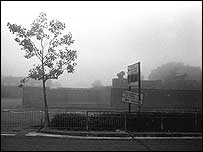
Local photographer CJ Clarke has a selection of work on display, from a project entitled 'Magic Party Place: Fragments of a New Town'. The project is about contemporary England as glimpsed through the lives, habits and environment of Basildon. 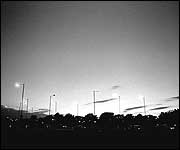 | | Street lights in Basildon |
The photos are also concerned with the architecture of new towns and how it affects the lives of the towns residents. It was inspired by the way Basildon is perceived in the media as a "barometre for the mood of the nation." This was as a result of the elections in 1992 when the town re-elected a Conservative MP. Photographer CJ Clarke answers our questions.Why did you want to do a photographic exhibition of Basildon?As a new town Basildon, in its social, political and architectural make up, provides an incredibly good portrait of post-war Britain. As with other new towns there is relatively little visible history pre-1945 therefore, everything in the towns pretty much relatives to contemporary Britain as it is today: as a piece of social history the new towns are invaluable. Basildon is one of the most prominent; the town is seen as important bell-weather district and statistics show that the town, demographically and socially, is totally in line with the national average. Indeed, the town wide split of votes in general elections pretty much mirrors the national average. In this way Basildon is unique in its averageness. I wanted to do a project about contemporary Britain that somehow related to the experience of a majority of the urban population either totally or, hopefully, partially: given the reputation of the town it seemed the obvious choice. Add to this that Basildon is my home town and therefore something which I know well and care deeply about. Describe the photos you tookMy photographs of Basildon cannot claim to be a definitive portrait of the town but they are a record of the places I went and the people I met whilst working on the project which, principally was between July and September 2005. Ultimately they aim to communicate something about how it feels to live in Britain today for a certain part of the population. How were you hoping to represent Basildon in your pictures?The pictures hopefully represent Basildon how it is or, at least how it is at certain times and how it I felt when I was taking the pictures. I have tried to present the people with warmth but I have been quietly critical of the architecture which I think works against the creation of a coherent community. Ultimately, however, the question of representation lies in the hands of the people who view the pictures and how they choose to interpret or relate to the images. As a new town how would you describe the architecture in Basildon?As with many areas in Britain I think the predominately concrete post-war architecture is socially divisive. Although designed and constructed with the public good in mind in actuality it works against it. In many ways the town is a large suburb. It lacks a definable cultural, social and political civic centre, a community focal point. As a result any civic communities that exist are formed around housing estates and are focused inwards. This is not a good thing when trying to build a strong civic identity - the architecture is not socially hospitable and designed to inspire pride in the town or being people together. The focus of the town is a shopping centre – essentially sopping is an individual action: shopping is never going to bring people together. Largely the architecture is too utilitarian, it does not inspire. Bad architecture has a lot to answer for and, as far as I see, as a society, we keep on making the architectural same mistakes. How have you portrayed the people of Basildon in your photos?As they are. People in Basildon are amongst the friendliest and most open I’ve ever encountered. I have tried to be true to this. But I have tried to photograph the people as they presented themselves to me. What does Basildon mean to you?Basildon means many things to me. As I mentioned earlier I am interested in the unique piece of social history that the town is – in the idea of ‘Basildon Man’ the phrase/perception of the town made popular by the media after the 1992 general election. But, ultimately Basildon is my home-town and something that I have tremendous affection for. What is your favourite part of the town?I like it all – every last piece of concrete. |