


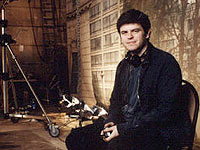
Interview with Director Toby MacDonald
Writer Mark Chappell caught up with the director of My Life in Film recently at the Cinematheque Francaise in Paris. Over several espressos and a pack of filterless Gauloises, they discussed their series.
What first attracted you to My Life in Film?
The title. I thought it was an adaptation of the Ingmar Bergman memoirs. It wasn't, but I liked it anyway. It was a lot funnier than the book. And I really liked the idea...
...for each episode to rework the plot of a classic film?
No, I like this too, but I don't think it's the idea. It's the natural extension of the idea, but it's not the idea.
What is the idea?
Our hero has watched so many films that he now thinks life is like a film, in that the same logic applies. He lives life in the same way we watch a film. So for example, in the Rear Window episode, Art watches a couple in the flat opposite argue. And then the next day the woman isn't there. His first thought is murder. And if we saw this in a film, we would think so too. But not in real life.
So for Art, a man in a trenchcoat...?
...is a private eye, exactly. He's such a great character for a director because everything he sees, he sees cinematically. And so my job is to make everything look and feel cinematic. Sitcoms aren't usually like this. And if they are, it's often gratuitous. Here, the character motivates it - and the more cinematic we make it, the better we serve the character.
How do you make it look and film cinematic?
Every little helps, and every department! It helps to shoot on film, as we were able to do on three episodes. Music plays an important part, especially the original Andy Blaney scores. The actors, obviously. But I suppose the main one is to tell the story visually, not verbally. Show not tell, as they say.
And what do they mean when they say this?
Okay, so for example, rather than have a dull scene in which Art says a propos of nothing "I love film" we have instead a shot of Art at work in the cinema, where he just watches films all day. And we let the audience figure it out for themselves.
Oh right, I wondered why you cut that scene...
And of course another fun way to reinforce the cinematic look and feel of MLiF is to reference other films. It makes perfect sense. After all, these are the films that have shaped the way Art sees the world.
Why does every episode look and feel so different?
The idea was to make each episode as different as the original films. To film each episode in the relevant style yet develop and maintain our own MLiF style too. Not just visually, with the cinematography and the costume design etc., but in the storytelling too. And the comedy. So for example, the comedy in the TOP GUN episode is like the film - big, silly and over-blown.
And in the Rear Window episode is it more refined?
Yes, well. In places. Art still falls over a lot... The performances are different too, from episode to episode, but Kris and Andrew never lose sight of their MLiF characters. Art is still Art and Jones is still Jones whether they're in the world of THE SHINING or EIGHT AND A HALF. This is very important.
Because?
Well, if the characters aren't there, then all we're left with is parody. A series of jokes that are totally dependent on the original film. Funny for a time, if you've seen the film, but with nowhere to go. I don't think MLiF is like this. Every scene is there for a MLiF reason first. The story never stops for a reference: the references grow organically out of the MLiF story and the characters. The TOP GUN episode is closest to parody, mainly because the film is so ludicrous, but even if you haven't seen the film, I think the story of a man trying to pass his driving test still holds. There are genuine moments of suspense, horror, romance and intrigue in MLiF that I don't think would survive in straightforward parody.
But if you haven't seen Rear Window?
It doesn't matter. You still get that Art thinks there's been a murder. We know what he's thinking because we know the way these kind of films work. We've seen so many of them. A modern audience is very film literate. They speak the language of cinema fluently.
OK then, what if you have seen the film?
There are a lot of free gifts. And hopefully the episode will trigger some kind of emotional recall. You'll remember what you felt the first time you saw the film. A friend of mine watched THE SHINING episode recently. It reminded her of the original film so much, she had to put all the lights on in the house. She couldn't sleep. She still can't.
So if it's not spoof or parody, what is it?
Neither. It's playful. MLiF plays with flim references because it's fun and because the character demands it, and not because it's clever. Like Art, its love of cinema is innocent. I would say MLiF is an affectionately irreverent homage.
