| 28 October 2014 |

| |
| BBC Homepage | | |
| |||
| Contact Us | | |
ProfilesYou are in: Bradford and West Yorkshire > People > Profiles > West Yorkshire Confidential? 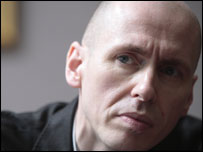 In search of hidden history: David Peace West Yorkshire Confidential?By Chris Verguson There must be few authors who've been described as the 'best' when it comes to novels about both crime AND sport but it's certainly true of Dewsbury author (and Terriers fan) David Peace. We've been talking to David about his most recent work... [Photo: Naoya Sanuki} When we last spoke to David Peace in 2004, he'd recently been named as one of the Best of British Young Novelists by Granta magazine and he had just published a novel on the 1984-85 Miners' Strike told through the eyes of those involved. Since then he's won a major literary award, filming has now started on The Damned United - about Brian Clough's troubled time as Leeds United manager - and he's been the subject of a TV documentary. Although almost all of David's work is very much rooted here in West Yorkshire, his most recent novel is set in Tokyo, the city which has been David's home for the last 14 years. His earlier Red Riding Quartet was set against the hunt for the Yorkshire Ripper, and Tokyo Year Zero is concerned with the investigation into the rape and murder of a number of young women in August 1946. Not only has the novel been highly praised in the UK but James Ellroy, the American crime writer with whom David Peace is most often compared, describes the picture the novel paints of war-ravaged Tokyo as "peerless"... 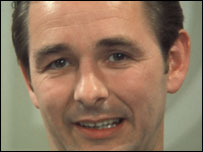 Brian Clough, 'hero' of The Damned Utd... Since we last talked to you in 2004, you've published two more books: The Damned United, which is now being made into a film, and Tokyo Year Zero. On the face of it these seem very different in subject matter to the Red Riding Quartet and to GB 84 but would you say there are any themes which are common to all your work?"Well, I think all the books I've written have been about people and places in times of defeat and the same goes for The Damned Utd (with Brian Clough at Elland Road in 1974) and, very obviously, Tokyo Year Zero (and the people of Japan in 1945 and 1946). So 'defeat' would be the common theme." It's not unusual to find that people, while praising your work, frequently describe it as shocking. Could you point to anything in your experience back here in West Yorkshire that might help explain the interest in the dark side of human nature reflected in your work? I'm not just thinking about events at that time but influences like books, films and music."Unfortunately, I grew up in what I think was a dark period in the history of West Yorkshire. I'm not only thinking here of the Ripper, but also the economic, political and social climate of the period as I feel West Yorkshire suffered a great deal under the Thatcher government. So that obviously has 'coloured' my writing. And perhaps that is also why I've always been drawn to 'darker' or more 'extreme' art such as the paintings of Francis Bacon and Anselm Kiefer, or the music of Throbbing Gristle and Joy Division, among many others. And, in terms of books, I'm inspired by writers who I feel push writing to its limits eg B.S Johnson in Christie Malry's Own Double-Entry, Derek Raymond in I was Dora Suarez, or James Ellroy in White Jazz."
How far do you think The Damned Utd has provided you with a wider audience?"It's always difficult to tell, especially living here in Tokyo, but that book has certainly sold a lot more than the others! But, honestly, I'm just grateful that they're even published in the first place." The Damned United has been described as the best sports novel ever written. Did you have any interest in the world of football before you came to write the novel, or did you come to it as a character study?"Yep, my dad and my grandad are/were big sports fans and, from about the age of seven, I've followed football (as a Huddersfield Town fan). Actually, the very first game my dad took me to was Brian Clough's first game in charge at Leeds in July 1974, which was a pre-season friendly against Town, and so that's definitely where that book came from." Have you ever thought in terms of the possibility of your work being made into films while you are writing them?"No, not at all. Books and films are completely different art-forms and so I think it would be dangerous and distracting to think about a film while writing a book." When I read your novels I'm reminded of reading poetry. The way phrases are used, and what we should be hearing as well as seeing in a scene is depicted. Are you always conscious of sound when you write?"Thank you for that! I probably read more poetry than I do literature and if I could be, I'd be a poet! And I do check the manuscripts by reading them aloud (to the consternation of my family and neighbours). So yes, I'm very conscious of 'the sound of the book' and that's especially true, I hope, of Tokyo Year Zero. 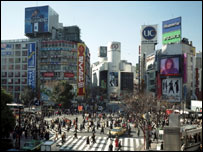 Tokyo in the 21st century When you talked to us about GB 84 you described it as being an "occult" or hidden history of the Miners' Strike. Although it has a very different setting would you say the same is true of Tokyo Year Zero?"Yes. Hidden, or Occult Histories - along with defeat - are what continues to interest me. And I do think this may come from having been born in West Yorkshire as I think, historically, West Yorkshire is very much a place of defeat and hidden histories (from William and the Harrowing of the North to the Wars of the Roses etc). I think, more than anywhere else in England, people in West Yorkshire know that Official History is only ever written by the winners and that it's always/usually a lie (Richard III, for example). And so Tokyo Year Zero was very much an attempt to write a history of Tokyo in 1946 from the perspective of the losers." If so, would you say this is to some extent still reflected in Japanese society today?"That post-war period of the US Occupation continues to have a huge influence on contemporary Japanese society. For example, the political constitution of Japan was drawn up by the Americans and that is still the constitution of Japan, though attempts are being made to change it (for the worse, actually). I also think - in my opinion and for many complex reasons - that Japan has still not really come to terms with the War and the Defeat in the way that, say, Germany seems to have done. So much here in Japan does remain hidden." Your previous novels have been very rooted in Yorkshire? How difficult was it to write about Japan and to get inside the minds of your Japanese characters?"Very difficult because we (in the West) have so many preconceptions and stereotypes (many often encouraged by the Japanese government and media) about 'the Japanese'. And so, for a long time, this prevented me from beginning to work on the book. But, for better or worse, people are people." Do you think you will be writing any more novels set in Yorkshire?"Yes. The Geoffrey Boycott novel is coming!" Take a look back at our past interviews with David Peace to find out more about his previous novels and West Yorkshire roots! last updated: 03/06/2008 at 11:14 You are in: Bradford and West Yorkshire > People > Profiles > West Yorkshire Confidential? |
| | About the BBC | Help | Terms of Use | Privacy & Cookies Policy |