| 28 October 2014 |

| |
| BBC Homepage | | |
| |||
| Contact Us | | |
ProfilesYou are in: Bradford and West Yorkshire > People > Profiles > David Peace: West Yorkshire Noir? 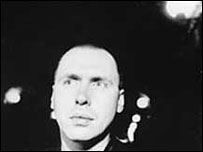 David Peace: Bleak outlook? David Peace: West Yorkshire Noir?Whether it's the Miners' Strike, the Yorkshire Ripper or Brian Clough's tumultuous time as Leeds United boss, Dewsbury author David Peace never shies away from the tough subjects - and has never forgotten his West Yorkshire roots. With David's latest book, Tokyo Year Zero, on bookshelves across the UK and a film of The Damned United - his fictional account of Brian Clough's stint at Leeds United - about to be made into a film, we thought it was the perfect opportunity to take a look back at our favourite past interviews with him to find out more about what makes this West Yorkshire author who now lives in Japan tick! 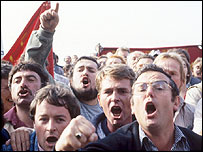 Scene from the '84-'85 picket lines When we spoke to David Peace in 2004, he'd recently been named as one of the Best Young Novelists by Granta magazine and he'd had just published a hard-hitting new novel recreating the 1984-85 Miners' Strike through the eyes of its protagonists... When we've spoken before, you've said that the 1984-85 Miners' Strike left its mark on you. Why do you think that was?The Miners' Strike was one of the two events which towered above all else, growing up as and when I did in West Yorkshire - the other being the hunt for the Ripper. But while the Ripper terrified me, the strike eventually bored me. That guilt, that failure at 17 and 18 to understand the enormity and importance of events on my own doorstep, in my own county, that guilt was what drove me to write GB84. Do you think the strike could be described as a civil war?Unfortunately not. Had the TUC given the NUM the support that they had promised, then perhaps civil war might have come a step closer. However, given the lengths, tricks and expense that the Thatcher government went to in order to crush just the NUM - it would have been a very short civil war.
How do you think the strike changed lives and mining communities in West Yorkshire?It wasn't the strike that changed lives and communities, it was the government policy and the forces they brought to bear upon pits and communities in order to close pits that changed lives. I think it's hard for people in 2004, especially younger people, to understand the levels of sacrifice that people underwent in mining communities during 1984/85; the loss of, on average, 9000 pounds per miner, 11,000 arrested, 7000 injured, two men dead - that men and their families did this in order to defend not only their own jobs and communities, but also those of other men in other pits and communities. Those pits and communities are gone, organised labour is gone, socialism is gone and with it the heritage and culture that held people and places together. That government and their policies changed everybody's lives, not only the ones that had the courage to at least stand and fight. You describe GB84 as an 'occult history'. It's a history because it based on real events and experiences, but what do you mean by occult?I use the word 'occult' to mean hidden - but also as a play on the more grotesque aspects of the word. Events like the hunt for the Yorkshire Ripper and the Miners' Strike have add an impact on many people's lives. How far is it the novelist's job to reinterpret such events?Anybody who writes anything - fact or fiction - about real events has a responsibility to the people who lived through them. In writing about the strike, my main motive and responsibility was to stop people forgetting what happened. Especially younger people. Your novels have been described as 'brutal' and you have often been compared to James Ellroy. How far do you think this is the case?Both Ellroy and myself have written about people and places from our pasts; the people we grew up with and the places we lived in. It's hard to write honestly about the Ripper and the Strike and for it not to be brutal. 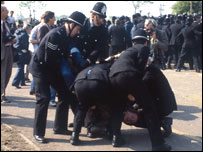 Scene from the '84-'85 picket lines You also use the testimony of people involved in the strike. Do you feel the novelist's voice is not enough?As I say, any writing, fact or fiction, is through the voice of the writer - the material they chose and the material they don't, which bit goes here, which bit there etc, but I wanted the testimony of the people who actually lived through the strike to be as raw and honest as possible. I met with people and also used the oral accounts from the books listed at the back of GB84 - and the things I heard and the things I read needed no fictionalising; they were powerful enough. How important do you think music is in recreating the period? Do you have your own soundtrack for the novel/strike?For me, music is a way of recreating the backdrop to a period; lost associations re-surface, images and words that have fallen out of usage come back. It also insulates me against the present. With GB84, as with the other books, I listened to as much of the music from the time as I could. Some of the albums are listed in the back of the book. Your next book is about Brian Clough's 44 days at Leeds United. This seems like a radical departure?I actually worry it won't be any departure at all; 1974, Leeds - sounds very familiar. You have also said you are going to write another book about the Yorkshire Ripper so presumably you think there is still more to be said on the subject?Unfortunately, yes. I don't think I will ever forget that voice on that tape and the effect it had on me and everyone in West Yorkshire at that time. And, until the police reverse their present policy of not investigating the hoaxer, the case will always be open. [NOTE: In 2006, a 50-year-old man finally admitted being the notorious Yorkshire Ripper hoaxer known as Wearside Jack. John Humble was jailed for eight years in 2006] Want to find out more about Dewsbury-born author David Peace? Click on 'next' below to read another of our favourite interviews with the man himself!last updated: 19/05/2008 at 16:27 You are in: Bradford and West Yorkshire > People > Profiles > David Peace: West Yorkshire Noir? |
| | About the BBC | Help | Terms of Use | Privacy & Cookies Policy |