


Apple's 'Big Brother' sequel
- 30 Sep 09, 10:29 GMT
Apple's iconic "Big Brother" advert is one of the most famous commercials in the business. Its prime-time airing took place on 22 January 1984 in the middle of the Super Bowl.
 With more than a nod to George Orwell's novel 1984, the advert warned of a future where soulless drones unquestionably soak up the words of their dictator who speaks to them from a large screen. Moments later a gorgeous nameless heroine in red shorts and a white tank top comes running down the aisle with a hammer in her hands while apparently being chased by the thought police.
She hurls the hammer at the screen just as "Big Brother" is telling the faithful "we shall prevail." The screen is destroyed in a shock of bright light and the commercial ends with text which reads "On January 26th, Apple Computer will introduce Macintosh. And you'll see why 1984 won't be like '1984'."
Well now get set for the sequel on YouTube.com and you will see why 1984 is so not like 2009. And I think it is fairly safe to say that this follow-up does not have the approval of Apple co-founder and CEO Steve Jobs.
For 1984 take two, a Silicon Valley start-up called doubleTwist is sending Apple a very pointed message. Monique Farantzos, one of its co-founders and a former physicist told me why:
"For many back then, Apple symbolised the rebel and that whole 'think different' attitude but honestly I don't think they can say that anymore.""I see Apple as the new Microsoft and so it felt natural to do this advert this way."
Let me give you a bit of background on doubleTwist.
As you will see from stories here on the BBC, the company is big into reverse engineering which is something the likes of Apple are not terribly keen on. The aim is to let users take their digital media like songs, movies and other files and transfer them easily between say cell phones, cameras, laptops and iPods.
DoubleTwist might have a thing about Apple because this is its second go at the company. Back in June, they took out a massive billboard advert next to the Apple store in San Francisco offering "the cure for iPhone envy." It was of course a free doubleTwist download.
 In the latest version of the advert, the drones in the video are wearing white ear buds and round white spectacles. Their master tells them "no other choices shall detract from our glory and our domination will be complete." As he utters his prevailing words at the end, the heroine does her damage and the video closes by saying "On October 6th, doubleTwist brings you... choice."
"Our billboard was brought down after pressure from Apple so it kind of felt that Apple is not just about shiny new gadgets," Mr Farantzos told me.
"There is a darker side as they become more powerful. That includes where iPhone applications are getting rejected, where Google voice is turned down, the FCC (Federal Communications Commission) investigaton or the Palm Pre being blocked. There are many of these examples and we wanted to point out that the emperor has no clothes."
Ms Farantzos said the video was two and a half months in the making and came about during a visit to Tokyo. It was her idea to use the white ear buds in the advert because it suggested conformity.
She admitted that she isn't sure if Mr Jobs will take too kindly to their re-working of the advert and their message, but she hopes on one level he gets it.
"I hope he will see the parallels of this small company going after the status quo. He used to be there 25 years ago and now it is a very different story," said Ms Farantzos.

Who will ride Google's Wave?
- 30 Sep 09, 09:22 GMT
Earlier this week, I spent an hour inside Google's London headquarters chatting to two developers, swapping photos, editing documents - and playing a bit of sudoku. What was unusual was that Lars Rasmussen and Stephanie Hannon were joining the conversation from Sydney in Australia.
That is where the Google Wave development team is based and they were demonstrating the search firm's hottest new application, which is now being made available to around 100,000 trial users.
I knew that Wave was a collaborative tool that had caused a great deal of excitement when it was demonstrated at a Google developers conference in May. But it took me some time to puzzle out what makes it really different - and, despite its sheer cleverness, I'm still not entirely sure that it will take off.
In order to see this content you need to have both Javascript enabled and Flash installed. Visit BBC Webwise for full instructions. If you're reading via RSS, you'll need to visit the blog to access this content.
Lars and Stephanie started the demo by launching a "wave" - much like starting a conversation - and inviting me to join (I was using the login of a London-based Googler). Then we began exchanging messages - rather as you would in any instant messaging application. The only difference seemed to be that we each could see what the others were writing even before they had sent their messages, which meant that even before I had completed "how is the weather in Sydney?", Lars was typing back that it was sunny.
When I suggested that this appeared to be little more than a combination of e-mail and instant messaging on steroids, they said that was not a bad description but there was a lot more. Collaborative editing, for instance, which allows you to alter documents or messages sent by others in the wave, as well as your own. Then there is the ability to post photos into the wave and let others share them, or edit them. But it's also a new platform open to developers - Lars and Stephanie showed me a sudoku game, which is one of a number of Wave plugins already available, even before the launch.
They described a few user cases - you might want to plan a trip, swapping maps, editing schedules, and then posting photos to the wave afterwards. Or perhaps you might be working with a team on a major report for your employer, using Wave to write, discuss and edit the document.
But surely the kind of people who want to plan a trip together will use the likes of Facebook to do that? And there are already tools which let colleagues collaborate on work projects. I use Google Docs, although I often find it difficult to persuade others to join up - they usually prefer to have the document e-mailed to them.
And that's the big question: will Google Wave achieve the network effect it needs to be a real winner?
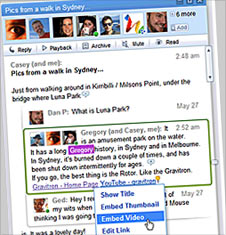 I can see that it's a useful way of bringing together the best aspects of e-mail, instant messaging and social networking sites in one browser-based application. It's been developed by people for whom it is natural to collaborate online - but is there a critical mass of users like that out there?
I asked a friend who often works on big reports with a team of people scattered around the world whether Google Wave might be the answer for her.
Right now, she tends to e-mail reports in Microsoft Word format, back and forth, with changes clearly visible simply by the date-stamp on each version. She had immediate questions about Wave.
For example, could one person be in charge of editing? And could you work offline, so that you could read your Wave document on, say, a plane and then upload the changes when you landed?
Google says that there is a playback function which allows you to remove or edit contributions, and it's working on an offline version. My friend still seemed dubious, and she's reasonably open-minded - so maybe getting the network effect going will prove a challenge.
It's worth remembering too that not every Google product is a winner - for every Gmail, there's a Google Answers languishing in the outer reaches of cyberspace. Still, the proof of the pudding will be in what those 100,000 test users find to do with their waves. I hope to be among them, so will report back when I've given the tyres a good kicking.
The BBC is not responsible for the content of external internet sites
This is dot.life - a blog about technology from BBC News.
Rory Cellan-Jones is the BBC's technology correspondent.
Maggie Shiels is the BBC's tech reporter based in Silicon Valley.
Archive
« January 2010
| Sun | Mon | Tue | Wed | Thu | Fri | Sat |
|---|---|---|---|---|---|---|
| 1 | 2 | |||||
| 3 | 4 | 5 | 6 | 7 | 8 | 9 |
| 10 | 11 | 12 | 13 | 14 | 15 | 16 |
| 17 | 18 | 19 | 20 | 21 | 22 | 23 |
| 24 | 25 | 26 | 27 | 28 |
Being Discussed Now
- Logging out... and straight back in(3)
- Gadgets of the Noughties(20)
- Plastic Logic's long journey to Vegas(21)
- Sexting teens(17)
- Wikipedia on the wane?(49)
- 'Cooling-off' for mobile phones? Not on the High Street(37)
- 2009 - the social year(36)
- Twitter, Iran and #uksnow(25)
- Broadband Britain - how far down the league?(55)
- Microsoft and Murdoch: Teaming up to bash Google?(34)
BBC Technology Headlines
- %28none%29
%28none%29 - %28none%29
%28none%29 - %28none%29
%28none%29
Visit the Technology index
Visit the BBC News website
Rory's TV/Radio reports
- Residents block Google car
Broadcast: 3 April 2009 - New adverts to tackle film piracy
Broadcast: 2 April 2009 - Call to scrap 'illegal databases'
Broadcast: 23 March 2009 - Female robot takes to the catwalk
Broadcast: 16 March 2009 - Super-charged battery breakthrough
Broadcast: 12 March 2009

- News Editors
- Sport Editors
- Journalism Labs
- BBC Internet Blog
- Radio 4 Blog
- Peston's Picks
- Nick Robinson's Newslog
- Stephanomics
- Mark Easton's UK
- Mark Mardell's America
- Nick Bryant's Australia
- Andrew Harding on Africa
- Gavin Hewitt's Europe
- Soutik Biswas' India
- dot.Rory
- Science: Jonathan Amos
- Richard Black on environment
- Today: Tom Feilden
- Fergus Walsh's medical files
- Newsnight: Paul Mason
- Newsnight: Mark Urban
- Torin Douglas
- Will Gompertz's arts
- Phil Coomes on photojournalism
- Magazine Monitor
- Mark D'Arcy in Westminster
- NI: Mark Devenport
- Scotland: Brian Taylor
- Scotland: Douglas Fraser
- Wales: Betsan Powys
- Martin Rosenbaum on FOI
- 5 Live Breakfast
- Newsnight
- PM programme (iPM)
- World Tonight: Robin Lustig
