


Gov 2.0 in action
- 29 Sep 09, 11:42 GMT
"Unleash the data." It has become a virtual mantra in Washington since President Barack Obama pledged to open up a treasure trove of information locked away in files, computer systems and cardboard boxes.
 Government 2.0 as a concept is not new, but the present administration has put its weight behind it like no other - and that has been getting entrepreneurs and the technology industry excited.
In an earlier post on the subject (The new tech start-up: US government), Anil Dash of Six Apart told me that the government's innovations represent the "most promising start-up of 2009 (and) one of the least likely" because it is allowing third parties to take all that information and to mash it up into useful applications and tools for the public and for agencies to use.
The effort is being largely led by the US tech gang of chief technology officer Aneesh Chopra, chief information officer Vivek Kundra, Federal Communications Commission chair Julius Genachowski and director of new media Macon Phillips.
But at ground level, it is the likes of Greg Whisenant - the founder and chief executive officer of Crime Reports - who are trying to do useful things with the data.
CrimeReports.com actually started three years ago; Mr Whisenant says that the company got off the ground thanks to progressive views at a local level among law enforcement agencies.
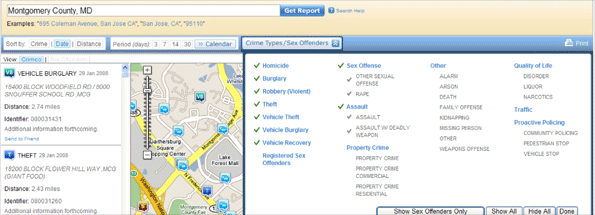
Washington DC and San Jose police forces were the first to sign up to let Mr Whisenant and his cohorts develop software tools to help these agencies understand crime trends and share information with the public in "an immediate or near-immediate timeframe and at a street level."
The lightbulb moment for Mr Whisenant came a few years previously when he was working on Capitol Hill as a lobbyist and accidentally let a burglar into his apartment building. He told me that the surveillance tape clearly showed him going through the door first and holding the door open for the burglar.
"This just showed me the chasm that existed between the public and law enforcement.
"It's certainly beneficial to get the public thinking about this in the context of where you live. If I don't know what is happening around me, I can't make better decisions or change my behaviour to accommodate what's going on around me."
In other words: had Mr Whisenant known there was a spate of local burglaries, he might have questioned the guy before practically ushering him through the door.
Soon after, Crime Reports was born. In simple terms, it overlays police reports onto maps so that users can type in an address and find out where arrests have been made and what kinds of cases police have been called out on. Users can also configure e-mail alerts to notify them of crimes in places they are interested in.
Mr Whisenant says his service really took off when Google Maps came along and allowed companies like his to plot crime.
This Utah-based company boasts of being "the world leader in online crime mapping". It has over 500 law enforcement partners across North America and is in the middle of signing up its first UK police force.
San Jose now claims to be the first police department in the nation to let residents find out where, when and why police were called to a particular area. Police chief Rob Davis says it helps police officers see trends in crime in particular areas instantaneously:
"It's Monday and I come in and I go, 'what's being going on in the last three days?' I can click on this link and put in the last three days' dates and see what has been going on in my beat. Before we used to get these updates on a six-month basis."
 And what he hopes will happen next is local people reacting by helping officers do their job more effectively:
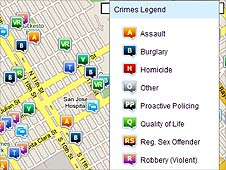
"If, all of a sudden, there's a bunch of icons showing drug activity, the residents are going to see that as well. What are they going to start looking for? Suspected drug activity. And where are they going to go as a result? Call us when they see a suspicious person."
Mr Whisenant says the number of agencies taking up his service is growing by about 50 a month, and in large part he credits that to President Obama and his desire to open up as much data as possible.
"We have this radical shift that is going on and that will reverberate not just at the federal level, but at state and local level as well. Government 2.0 as we see it now emerging would not be happening under another president."
Plans for Crime Reports include releasing an application programming interface (API) for developers to build on, an iPhone application and a way for local people to set up neighbourhood watch schemes.
Mr Whisenant also warns that there will be many stumbling blocks for Gov 2.0 - not least the problem of how to make much of the data relevant and useful.
"I feel the driving parameters for success are time- and location-aware based apps. Local is the piece of this puzzle that will make the big difference, giving people something that is personally relevant to their life.
"It's a case of letting a thousand flowers bloom. It will take some time and some experimentation - but in the immediate future, there will be a lot of innovation."

Paying for politics: The Spectator app
- 29 Sep 09, 10:10 GMT
The search for ways that news organisations can make money online is gathering pace, with Rupert Murdoch's pledge to start charging for online content spurring others into action.
 So far, there's not much evidence that readers are willing to pay for journalism on the web, unless it's very specialised - so the digital strategy of one venerable British publication will be examined very carefully by media owners.
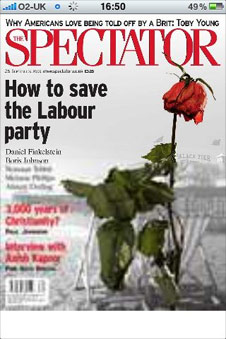
The Spectator, the weekly political magazine first published in 1828, has just launched an iPhone app. Nothing particularly interesting about that, you may say. After all plenty of other news organisations, from the New York Times to Sky News to the Telegraph, have already launched applications allowing access to their content on the iPhone and other smartphones.
But all those apps are free, while the Spectator asks iPhone users to pay. The app only costs 59p - and for that you get access to that week's issue plus a searchable archive of 200 older editions. But next week you'll have to pay another 59p for your next Spectator, or £2.36 for thirty days.
The publishers hope that as well as generating subscription revenue, the app will make the magazine more attractive to advertisers - there is an innovative feature which allows you to tap on a phone number in an ad and have yourself put through. Shocking news, then - here's a publication which believes that readers will pay, and pay again, to get access to its content on their phones.
It's prepared the way by starting to restrict how much of the magazine's content you can get on its website for free. That has apparently sparked a leap in the number of digital subscribers who pay around half the price of an "analogue" reader for a year's access. The website acts as a shop window for the product, with a few free samples - but to read much of the content on any platform - paper, web or phone - you need to show the colour of your money.
So it begins to look as though the Spectator has come up with a compelling new digital business model. Until, that is, you actually try the iPhone app, which is a complete dud.
First of all, you need to be online every time you want to look at the magazine. You may think you've downloaded this week's edition but if you switch to another app, then return to the Spectator, you have to wait for the page you were reading to download all over again. It's pitifully slow on a 3g network and not that much better on wi-fi.
Worse, it's just a facsimile of the paper version, and there's no easy way to search it or to jump to a particular article. After half an hour of trying to make it work, I gave up without having read a single article.
The Spectator deserves credit for trying to transform the economics of online journalism. But on the iPhone at least, it needs to go back to the drawing board.
The BBC is not responsible for the content of external internet sites
This is dot.life - a blog about technology from BBC News.
Rory Cellan-Jones is the BBC's technology correspondent.
Maggie Shiels is the BBC's tech reporter based in Silicon Valley.
Archive
« January 2010
| Sun | Mon | Tue | Wed | Thu | Fri | Sat |
|---|---|---|---|---|---|---|
| 1 | 2 | |||||
| 3 | 4 | 5 | 6 | 7 | 8 | 9 |
| 10 | 11 | 12 | 13 | 14 | 15 | 16 |
| 17 | 18 | 19 | 20 | 21 | 22 | 23 |
| 24 | 25 | 26 | 27 | 28 |
Being Discussed Now
- Logging out... and straight back in(3)
- Gadgets of the Noughties(20)
- Plastic Logic's long journey to Vegas(21)
- Sexting teens(17)
- Wikipedia on the wane?(49)
- 'Cooling-off' for mobile phones? Not on the High Street(37)
- 2009 - the social year(36)
- Twitter, Iran and #uksnow(25)
- Broadband Britain - how far down the league?(55)
- Microsoft and Murdoch: Teaming up to bash Google?(34)
BBC Technology Headlines
- %28none%29
%28none%29 - %28none%29
%28none%29 - %28none%29
%28none%29
Visit the Technology index
Visit the BBC News website
Rory's TV/Radio reports
- Residents block Google car
Broadcast: 3 April 2009 - New adverts to tackle film piracy
Broadcast: 2 April 2009 - Call to scrap 'illegal databases'
Broadcast: 23 March 2009 - Female robot takes to the catwalk
Broadcast: 16 March 2009 - Super-charged battery breakthrough
Broadcast: 12 March 2009

- News Editors
- Sport Editors
- Journalism Labs
- BBC Internet Blog
- Radio 4 Blog
- Peston's Picks
- Nick Robinson's Newslog
- Stephanomics
- Mark Easton's UK
- Mark Mardell's America
- Nick Bryant's Australia
- Andrew Harding on Africa
- Gavin Hewitt's Europe
- Soutik Biswas' India
- dot.Rory
- Science: Jonathan Amos
- Richard Black on environment
- Today: Tom Feilden
- Fergus Walsh's medical files
- Newsnight: Paul Mason
- Newsnight: Mark Urban
- Torin Douglas
- Will Gompertz's arts
- Phil Coomes on photojournalism
- Magazine Monitor
- Mark D'Arcy in Westminster
- NI: Mark Devenport
- Scotland: Brian Taylor
- Scotland: Douglas Fraser
- Wales: Betsan Powys
- Martin Rosenbaum on FOI
- 5 Live Breakfast
- Newsnight
- PM programme (iPM)
- World Tonight: Robin Lustig
