


The Twitter hack and the cloud
- 15 Jul 09, 12:57 GMT
A leading technology blog Techcrunch said last night that it had been forwarded hundreds of confidential corporate and personal documents belonging to Twitter and its employees.
The information, obtained by a hacker calling himself Hacker Croll, was first mentioned on this French blog.
It apparently includes the names and food preferences of all employees, records of internal meetings, names of job applicants, confidential contracts with companies like Nokia and Microsoft, and details of staff salaries.
In other words, just about everything that Twitter would like to keep secret - and that rivals, and journalists, would love to get their hands on. The post on Techcrunch immediately provoked a firestorm, with many expressing outrage that the blog should even consider publishing this material, which appears to have been obtained by illicit means.
I spoke to the French blogger Manuel Dorne, who was the first to receive the file from "Hacker Croll" - who's apparently based in France. He told me the documents included credit card numbers and personal account details from Apple's Mobile Me service.
There were also details of plans for the French president to acquire a Twitter account - under the name @NicolasSarkozy. But Manuel Dorne said he'd made a different decision from Techcrunch, opting just to show a few screenshots of the material rather than publish more. "I don't want to cause damage to Twitter or to help their rivals," he told me.
Beyond the issue of journalistic ethics, the whole incident also raises interesting questions about the security of cloud computing. Much of the information appears to have been obtained by the hacker gaining access to Gmail accounts. So it appears that Twitter, like an increasing number of young businesses, was storing lots of corporate information on the servers in Google's vast data centres.
Now Google is stressing that there's no suggestion that its systems have been hacked - merely that someone has somehow guessed the Gmail passwords of various Twitter employees.
As a spokesman explained it to me, you'd feel furious at your bank if their servers had been hacked allowing someone to get access to your account, but furious with yourself if you'd given away your online banking details - or chosen a very weak password.
That's obviously true. But companies thinking of migrating all of their e-mail into the cloud might consider what Hacker Croll told Manuel Dorne about the motivation behind his Twitter hack:
"J'espere que mon intervention leur fera prendre conscience que nul n'est a l'abri sur le net."
In other words, he hopes his "intervention" will make Twitter wake up to the fact that nothing is secure on the net. Companies promoting cloud computing - from Google to Amazon to Microsoft - are all confident that their systems just cannot be hacked.
But if you allow your employees - including very senior members of staff - to send confidential information on cloud-based e-mail then you'd better make sure their passwords are super secure.

Google's playground grows up
- 15 Jul 09, 09:57 GMT
For the last three years Gmail labs has been a playground for the company's engineers to float new ideas and see how users respond to them.
Everything about the project has been experimental with no promises made to users that any of these features would become permanent and enter the mainstream of the Gmail front page.
Gmail's product manager Keith Coleman told me:
"On launch day we had 12 things in labs and didn't really know if any of them would be popular or whether or not users would really use them.
"In the past we would have tested these features inside the company but Labs brought that to the rest of the world and let all users have input into which ideas are the best and which really work."
In Google speak this is called "dog fooding". I prefer "people power".
Today there are 48 labs features and they range from letting you customise keyboard shortcuts to translating messages and from seeing your e-mail offline to getting alerts to tell you take a break from e-mail and step away from the computer.
While Keith said it's not a popularity contest, the users have spoken and "tasks" is the first lab project to graduate to the Gmail shop floor.
It can be found on the left hand side under contacts and is a nifty wee application that lets you keep a tab on everything from drinks with the girls to your shopping list to a visit to the dentist. I haven't had long to play with it, but now I have even less excuse for forgetting stuff.
Google have cooked up a video to show off some of its capabilities.
Other features that look set to graduate include pictures in chat that shows the photograph of the person you are chatting to and something else called undo send, that I think might save a few blushes here and there. That functions allows you to basically unsend an e-mail.
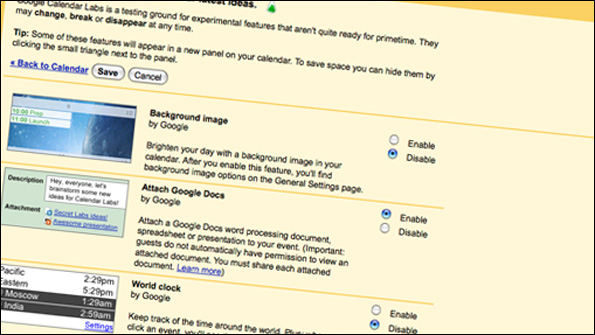
At the same time Google has also announced that it is opening up Labs for its Calendar product.
There are only a handful of offerings there but at first glance they seem pretty useful in helping organise ones life...and boy one needs it!
The world clock will be really useful for me working on the west coast eight hours behind my London bosses and three behind my Washington editors.
As Google looks more and more to cater to its enterprise customers, Calendar product manager Ken Norton told me that "the other interesting news is that Calendar Labs will come with a set of APIs for customers to add their own features that are important to them but not to the wider user."
He talked of one customer who wanted to be able to know when he books a conference room if that room had a microscope in it. Obviously not a vital piece of information for all users and as Ken said it's something Google wouldn't build so it said "here are a set of APIs so you can create a calendar for your own unique needs."
Naturally enough I quizzed both men on the fact that they were making their announcements at the same time as Microsoft was telling its partner conference in New Orleans about its new free web-based version of its Office software.
While neither gent wanted to take that issue head on, Mr Norton pointed out that:
"The first thing that Labs speaks to is how quickly you can innovate in the cloud. In the desktop software world you have to ship updates.
"You can't put new features in front of users when you like. You are subject to the software distribution model. Our products were built in the cloud and we are always releasing new features to users on a rapid basis."
Last year I was one of a few journalists who were allowed inside the hallowed halls of the Gmail team to see what they were working on and hear the history of how the product came to pass.
The BBC is not responsible for the content of external internet sites
This is dot.life - a blog about technology from BBC News.
Rory Cellan-Jones is the BBC's technology correspondent.
Maggie Shiels is the BBC's tech reporter based in Silicon Valley.
Archive
« January 2010
| Sun | Mon | Tue | Wed | Thu | Fri | Sat |
|---|---|---|---|---|---|---|
| 1 | 2 | |||||
| 3 | 4 | 5 | 6 | 7 | 8 | 9 |
| 10 | 11 | 12 | 13 | 14 | 15 | 16 |
| 17 | 18 | 19 | 20 | 21 | 22 | 23 |
| 24 | 25 | 26 | 27 | 28 |
Being Discussed Now
- Logging out... and straight back in(3)
- Gadgets of the Noughties(20)
- Plastic Logic's long journey to Vegas(21)
- Sexting teens(17)
- Wikipedia on the wane?(49)
- 'Cooling-off' for mobile phones? Not on the High Street(37)
- 2009 - the social year(36)
- Twitter, Iran and #uksnow(25)
- Broadband Britain - how far down the league?(55)
- Microsoft and Murdoch: Teaming up to bash Google?(34)
BBC Technology Headlines
- %28none%29
%28none%29 - %28none%29
%28none%29 - %28none%29
%28none%29
Visit the Technology index
Visit the BBC News website
Rory's TV/Radio reports
- Residents block Google car
Broadcast: 3 April 2009 - New adverts to tackle film piracy
Broadcast: 2 April 2009 - Call to scrap 'illegal databases'
Broadcast: 23 March 2009 - Female robot takes to the catwalk
Broadcast: 16 March 2009 - Super-charged battery breakthrough
Broadcast: 12 March 2009

- News Editors
- Sport Editors
- Journalism Labs
- BBC Internet Blog
- Radio 4 Blog
- Peston's Picks
- Nick Robinson's Newslog
- Stephanomics
- Mark Easton's UK
- Mark Mardell's America
- Nick Bryant's Australia
- Andrew Harding on Africa
- Gavin Hewitt's Europe
- Soutik Biswas' India
- dot.Rory
- Science: Jonathan Amos
- Richard Black on environment
- Today: Tom Feilden
- Fergus Walsh's medical files
- Newsnight: Paul Mason
- Newsnight: Mark Urban
- Torin Douglas
- Will Gompertz's arts
- Phil Coomes on photojournalism
- Magazine Monitor
- Mark D'Arcy in Westminster
- NI: Mark Devenport
- Scotland: Brian Taylor
- Scotland: Douglas Fraser
- Wales: Betsan Powys
- Martin Rosenbaum on FOI
- 5 Live Breakfast
- Newsnight
- PM programme (iPM)
- World Tonight: Robin Lustig
