


118800 and a web revolution
- 14 Jul 09, 12:23 GMT
Has a popular revolt done for 118800? The controversial mobile phone directory launched last month, but has struggled to convince the great British public that it's a good idea to have your mobile number available for people to look up.
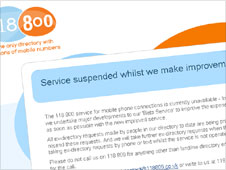 For days now the website has been down, and the service has been unavailable. And that's apparently all due to people power - a wave of angry users trying to get their numbers removed from the site has been too big for the company's systems to cope.
After the BBC's excellent Working Lunch programme gave prolonged coverage to the story before the launch, various e-mails began circulating, warning people about it.
Here's one:
"Maybe you have heard about this but early next week all UK mobiles will be on a directory which will mean that anyone will be able to access the numbers. It is easy to unsubscribe but it must be done before the beginning of next week to make sure that you are ex directory. We have all unsubscribed and you may want to suggest it to all your friends and family who have UK mobiles or they could be swamped by unsolicited messages and calls. Removal is recommended by the BBC - see link below. https://news.bbc.co.uk/1/hi/programmes/working_lunch/8091621.stm
The Directory of Mobile Phone numbers goes live next week.
All numbers including those belonging to children will be open to cold calling and the general abuse that less scrupulous tele-sales people subject us too.
Now there are a number of inaccuracies in this and other e-mails warning about 118800. For one thing, "all UK mobiles" are not on the directory - when the service was live I found it just about impossible to find anyone, and even the company behind it only claims it has around a third of all UK mobile numbers.
For another, the service involves sending texts to people whose numbers are sought out by users, asking whether they want to take a call, rather than "cold calling".
And the BBC is not recommending removal - that's not our job - though we have told people how to get their names deleted if they so wish.
Still, the campaign against the service has apparently gone viral, and that makes it very difficult for the business to get any more positive marketing message out - especially when its website is down.
But what's interesting is how violently people now feel about their privacy. In an age when many are apparently happy to share intimate details of their lives on social networks - even shots of their husbands in their swimming trunks - it seems that we feel our mobile numbers are uniquely private.
You can see the change in attitudes reflected in what's happened with the fixed line directory. Twenty years ago, being "ex-directory" meant being part of a rather exclusive club, but BT tells me that around 50% of people now choose not to have their numbers listed.
Why? Well maybe it's not paranoia about privacy, but sheer irritation at the wave of tele-marketing - callers telling you "we are in your area fitting PVC windows - would you like a free trial", or cold calls from automated systems telling you that you've won a cruise.
It's the direct marketing industry which has been the source of many of the numbers on the lists acquired by Connectivity, 118800's owners. But maybe it's their tactics that have made the idea of the service so unattractive to so many users.
The BBC is not responsible for the content of external internet sites
This is dot.life - a blog about technology from BBC News.
Rory Cellan-Jones is the BBC's technology correspondent.
Maggie Shiels is the BBC's tech reporter based in Silicon Valley.
Archive
« January 2010
| Sun | Mon | Tue | Wed | Thu | Fri | Sat |
|---|---|---|---|---|---|---|
| 1 | 2 | |||||
| 3 | 4 | 5 | 6 | 7 | 8 | 9 |
| 10 | 11 | 12 | 13 | 14 | 15 | 16 |
| 17 | 18 | 19 | 20 | 21 | 22 | 23 |
| 24 | 25 | 26 | 27 | 28 |
Being Discussed Now
- Logging out... and straight back in(3)
- Gadgets of the Noughties(20)
- Plastic Logic's long journey to Vegas(21)
- Sexting teens(17)
- Wikipedia on the wane?(49)
- 'Cooling-off' for mobile phones? Not on the High Street(37)
- 2009 - the social year(36)
- Twitter, Iran and #uksnow(25)
- Broadband Britain - how far down the league?(55)
- Microsoft and Murdoch: Teaming up to bash Google?(34)
BBC Technology Headlines
- %28none%29
%28none%29 - %28none%29
%28none%29 - %28none%29
%28none%29
Visit the Technology index
Visit the BBC News website
Rory's TV/Radio reports
- Residents block Google car
Broadcast: 3 April 2009 - New adverts to tackle film piracy
Broadcast: 2 April 2009 - Call to scrap 'illegal databases'
Broadcast: 23 March 2009 - Female robot takes to the catwalk
Broadcast: 16 March 2009 - Super-charged battery breakthrough
Broadcast: 12 March 2009

- News Editors
- Sport Editors
- Journalism Labs
- BBC Internet Blog
- Radio 4 Blog
- Peston's Picks
- Nick Robinson's Newslog
- Stephanomics
- Mark Easton's UK
- Mark Mardell's America
- Nick Bryant's Australia
- Andrew Harding on Africa
- Gavin Hewitt's Europe
- Soutik Biswas' India
- dot.Rory
- Science: Jonathan Amos
- Richard Black on environment
- Today: Tom Feilden
- Fergus Walsh's medical files
- Newsnight: Paul Mason
- Newsnight: Mark Urban
- Torin Douglas
- Will Gompertz's arts
- Phil Coomes on photojournalism
- Magazine Monitor
- Mark D'Arcy in Westminster
- NI: Mark Devenport
- Scotland: Brian Taylor
- Scotland: Douglas Fraser
- Wales: Betsan Powys
- Martin Rosenbaum on FOI
- 5 Live Breakfast
- Newsnight
- PM programme (iPM)
- World Tonight: Robin Lustig
