


Winners and losers in a tech recession
- 24 Apr 09, 12:48 GMT
So how's the recession going for you? We now appear to be in the very eye of the economic storm - but in the technology world there are a few winners as well as losers.
It's been a week of results from the tech giants - Microsoft, Yahoo, Amazon and Apple are among those who've given us updates about their finances. So what have we learned?
Mournful Microsoft
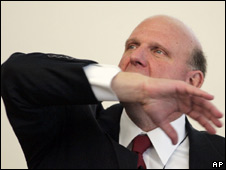 The biggest noise in software has suffered its first fall in sales since it floated as a public company in 1986.
A quick scan of the results shows revenue falling in most divisions - but it's the core Windows business which has suffered the biggest fall, with revenue down from $4bn to $3.4bn. So Vista has very quickly stopped being the money-spinner that was promised - no wonder Microsoft is keen to create a buzz around Windows 7.
Last October, when I interviewed the chief executive Steve Ballmer in London, he was already gloomy about the prospects for technology spending. Now those fears have been realised - and Microsoft's Chief Financial Officer Chris Liddell seemed almost to revel in the gloom: "We remain more cautious than most," he said. "While we'd all like to hope that the recovery will be short and painless, we unfortunately think it will be slow and difficult."
Upbeat Amazon
By contrast, the online retailer seems incapable of putting a foot wrong right now, except for the odd row over a "cataloging error".
Consumers may have taken fright on the high street - though rather less than some retailers have claimed - but they're still spending freely online, or at least at Amazon. Sales for the quarter rose by 18% compared to a year ago.
The big rise was not in Amazon's old core business - books, music, DVDs - where sales were only up 7%, but in sales of what is classified as "electronics and other general merchandise", which were up 38%.
In other words, Jeff Bezos' mission to become the world's online shopkeeper seems to be proceeding according to plan. The company has also being making much of its electronic book Kindle 2 and its cloud computing initiative - but it's the millions of shoppers buying everything from lawn-mowers to leisurewear who are providing the profits.
Yahoo Still Struggling
But if online retailing seems to be weathering the recession quite well, the online advertising market appears to have stalled. Yahoo's earnings press release was headlined "Company Exceeds Midpoint of Operating Cash Flow Outlook Range" - a classic case of burying some pretty poor news under a piece of gobbledegook.
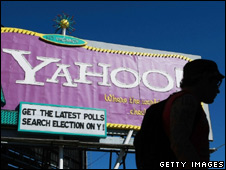 Further down, you find that search advertising revenue was down 3% and display advertising down 13%. Now, it was only a couple of months ago that internet advertising types were telling me that their industry was going to keep on growing through the recession, as companies sought the better value that the web could offer. While Yahoo has its own particular problems, it's not the only firm finding that those rosy predictions are not being borne out.
Oh, and another embarrassment for Yahoo today with the closure of Geocities, the free homepage service it paid more than $4bn for at the height of the dot com boom.
Apple Advances
It was Apple which produced the week's most sparkling results, with sales of iPhones and iPods both beating expectations. Even a fall in Mac sales - down 3% - didn't depress the Wall Street analysts, who rushed to upgrade Apple shares. In a home computer market forecast to fall 11.9% in 2009 - its worst ever decline - it looks as though Apple may increase its market share.
I keep expecting the high price of its products to deter cash-strapped consumers - especially now that you can get a netbook for about a third the price of Apple's cheapest laptop. But so far, that hasn't happened.
And with Steve Jobs' stand-in Tim Cook describing netbooks this week as having "cramped keyboards, terrible software, junky hardware, and very small screens", it seems that the company is determined to stick to its premium pricing policy.
So the recession is hitting corporate technology spending and online advertising hard. But a few companies are showing that hard times are the best time to steal a march on your rivals.
The BBC is not responsible for the content of external internet sites
This is dot.life - a blog about technology from BBC News.
Rory Cellan-Jones is the BBC's technology correspondent.
Maggie Shiels is the BBC's tech reporter based in Silicon Valley.
Archive
« January 2010
| Sun | Mon | Tue | Wed | Thu | Fri | Sat |
|---|---|---|---|---|---|---|
| 1 | 2 | |||||
| 3 | 4 | 5 | 6 | 7 | 8 | 9 |
| 10 | 11 | 12 | 13 | 14 | 15 | 16 |
| 17 | 18 | 19 | 20 | 21 | 22 | 23 |
| 24 | 25 | 26 | 27 | 28 |
Being Discussed Now
- Logging out... and straight back in(3)
- Gadgets of the Noughties(20)
- Plastic Logic's long journey to Vegas(21)
- Sexting teens(17)
- Wikipedia on the wane?(49)
- 'Cooling-off' for mobile phones? Not on the High Street(37)
- 2009 - the social year(36)
- Twitter, Iran and #uksnow(25)
- Broadband Britain - how far down the league?(55)
- Microsoft and Murdoch: Teaming up to bash Google?(34)
BBC Technology Headlines
- %28none%29
%28none%29 - %28none%29
%28none%29 - %28none%29
%28none%29
Visit the Technology index
Visit the BBC News website
Rory's TV/Radio reports
- Residents block Google car
Broadcast: 3 April 2009 - New adverts to tackle film piracy
Broadcast: 2 April 2009 - Call to scrap 'illegal databases'
Broadcast: 23 March 2009 - Female robot takes to the catwalk
Broadcast: 16 March 2009 - Super-charged battery breakthrough
Broadcast: 12 March 2009

- News Editors
- Sport Editors
- Journalism Labs
- BBC Internet Blog
- Radio 4 Blog
- Peston's Picks
- Nick Robinson's Newslog
- Stephanomics
- Mark Easton's UK
- Mark Mardell's America
- Nick Bryant's Australia
- Andrew Harding on Africa
- Gavin Hewitt's Europe
- Soutik Biswas' India
- dot.Rory
- Science: Jonathan Amos
- Richard Black on environment
- Today: Tom Feilden
- Fergus Walsh's medical files
- Newsnight: Paul Mason
- Newsnight: Mark Urban
- Torin Douglas
- Will Gompertz's arts
- Phil Coomes on photojournalism
- Magazine Monitor
- Mark D'Arcy in Westminster
- NI: Mark Devenport
- Scotland: Brian Taylor
- Scotland: Douglas Fraser
- Wales: Betsan Powys
- Martin Rosenbaum on FOI
- 5 Live Breakfast
- Newsnight
- PM programme (iPM)
- World Tonight: Robin Lustig
