


Making apps for Android
- 12 Mar 09, 09:15 GMT
Is Android (Google's open operating system for mobile phones) finally stirring from its torpor and becoming a force to challenge Apple's App Store in the world of mobile applications?
I ask after spending a morning with a group of keen Android developers, who were enthusiastic about the potential of Google's open source operating system. No wonder, really, as they'd been invited along by T-Mobile, which has been heavily promoting the only Android phone on sale so far, the G1.
But they had some impressive stuff to show off. Most eye-catching was Wikitude, described by its creators as the first "augmented-reality" application.
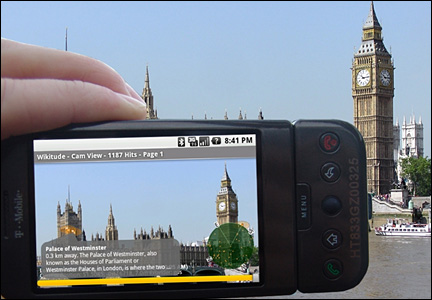
It uses an Android phone's GPS and compass capabilities to map information about places of interest. The clever thing, though, is that as well as seeing the information plotted on a map you can turn on the phone's camera, point it at a building and see information on the screen.
Mobilizy, the firm behind Wikitude, is now launching another app called Zenith, which takes the same idea into the skies. You point your camera at the night sky - and get a star map.
Two other applications were more mundane. A company called Skycoders has developed Cabs4Me - again, it's a location-based service, enabling you to find a local cab service in a hurry. It has apparently been downloaded 56,000 times.
Then there is the Telegraph's mobile news service, developed by Mike Jennings - poached from Google where he was an Android developer. It apparently has 36,000 active Android users, checking out much of the paper's content - and it has also put the same app on the iPhone.
What all the developers had in common was enthusiasm about the process of producing Android applications in comparison with working on something for Apple's App Store. "Apple has an approval process which can take days or weeks - with Android you decide when it goes live," explained one. "It took us four times as long to get the app onto iTunes as to get it onto Android," said another.
With Microsoft and Nokia also now opening application stores, Apple may find it needs to streamline its process to keep developers on board. I notice that Microsoft is boasting that its Windows Marketplace will offer a "simple and transparent publishing policy."
But what the developers at the T-Mobile forum also shared, as far as I could see, was uncertainty about whether the whole game was worth the candle - in other words, is there any money in it?
From today, Android's Market will feature paid apps - so alongside the free stuff will be games like Guitar Hero. But these will generally be the work of big developers, who may in any case see this sort of work as a marketing tool rather than a profit centre.
When I asked about revenue, the Telegraph team told me that their app is sponsored - and leads users to videos with pre-roll ads. But sponsorship can come and go, and I wonder how much revenue those adverts generate?
Still, for a business like the Telegraph, it can't be too expensive to reprocess all that content and make it available to a growing crowd of mobile readers.
The Cabs4me firm hoped to make revenue from mini-cab firms, and the Wikitude people were looking at the possibility of selling location-based advertising - which conjures up the terrifying prospect of burger chain ads posted on a virtual Taj Mahal. But everyone at the forum admitted these were early days - and that many small developers may struggle to get their applications heard above all the noise. "It's like the early days of the dot com boom all over again." said one. "Everyone's trying stuff out, but nobody is quite sure what will work."
But the clear winners from the battle between Android and Apple, Nokia and Windows, are the consumers. If, that is, you have a hunger to do anything with your phone but make a simple call.

Silicon Valley decamps to Austin, Texas
- 12 Mar 09, 08:55 GMT
Over the next seven days the streets of San Francisco, of Palo Alto, of Mountain View and any number of other Silicon Valley towns will be much quieter than usual.
The cream of the web and mobile web industry has decamped to Austin, a small, unassuming outpost in Texas for the South by South West Interactive Festival (SXSWi).
More than 10,000 web developers, bloggers, digital gurus and self-confessed geeks will descend on the small town to talk, listen and learn.
It's one of the defining characteristics of the digital space: communication.
"It's all about meeting people, sharing ideas and making connections," Hugh Forrest, director of SXSWi told me.
"We are lucky enough to be this place that has attracted all these innovators in this industry. We are the beneficiary of a very vibrant, innovative and creative community."
Forrest's mantra, and one that holds true for many people who attend SXSWi is: "The more we listen and communicate the stronger we become."
People come for the panels but they return for the conversations between the sessions.
This year the range of talks, keynotes and panels is as diverse as ever.
I've picked out a few highlights that I'll be attending.
They include a look at the next round of browser wars, the growth in micro-blogging, the rise and rise of casual gaming online, the future of user experiences and user interfaces, as well as focussing on the UK talent on display, and the hotly tipped web products just waiting to break through.
I'll be reporting on the festival here on Dot.Life, as well as on the main news pages of the technology section. You can also follow my more granular updates on Twitter.
For first-timers like myself there is plenty of advice out there:
ZDnet has a guide to the festival and the key events it is looking at.
CNet has a series about what to expect at SXSWi.
Here's a rather helpful survival guide from Jeremy Wright.
And after the controversy surrounding Sarah Lacey's interview with Mark Zuckerberg last year, there is even advice from Jeremiah Owyang on how to be a panellist or moderator.
For those really wanting the up-to-the-minute updates on EVERYTHING SXSWi, then check out Search.Twitter.com.
The BBC is not responsible for the content of external internet sites
This is dot.life - a blog about technology from BBC News.
Rory Cellan-Jones is the BBC's technology correspondent.
Maggie Shiels is the BBC's tech reporter based in Silicon Valley.
Archive
« January 2010
| Sun | Mon | Tue | Wed | Thu | Fri | Sat |
|---|---|---|---|---|---|---|
| 1 | 2 | |||||
| 3 | 4 | 5 | 6 | 7 | 8 | 9 |
| 10 | 11 | 12 | 13 | 14 | 15 | 16 |
| 17 | 18 | 19 | 20 | 21 | 22 | 23 |
| 24 | 25 | 26 | 27 | 28 |
Being Discussed Now
- Logging out... and straight back in(3)
- Gadgets of the Noughties(20)
- Plastic Logic's long journey to Vegas(21)
- Sexting teens(17)
- Wikipedia on the wane?(49)
- 'Cooling-off' for mobile phones? Not on the High Street(37)
- 2009 - the social year(36)
- Twitter, Iran and #uksnow(25)
- Broadband Britain - how far down the league?(55)
- Microsoft and Murdoch: Teaming up to bash Google?(34)
BBC Technology Headlines
- %28none%29
%28none%29 - %28none%29
%28none%29 - %28none%29
%28none%29
Visit the Technology index
Visit the BBC News website
Rory's TV/Radio reports
- Residents block Google car
Broadcast: 3 April 2009 - New adverts to tackle film piracy
Broadcast: 2 April 2009 - Call to scrap 'illegal databases'
Broadcast: 23 March 2009 - Female robot takes to the catwalk
Broadcast: 16 March 2009 - Super-charged battery breakthrough
Broadcast: 12 March 2009

- News Editors
- Sport Editors
- Journalism Labs
- BBC Internet Blog
- Radio 4 Blog
- Peston's Picks
- Nick Robinson's Newslog
- Stephanomics
- Mark Easton's UK
- Mark Mardell's America
- Nick Bryant's Australia
- Andrew Harding on Africa
- Gavin Hewitt's Europe
- Soutik Biswas' India
- dot.Rory
- Science: Jonathan Amos
- Richard Black on environment
- Today: Tom Feilden
- Fergus Walsh's medical files
- Newsnight: Paul Mason
- Newsnight: Mark Urban
- Torin Douglas
- Will Gompertz's arts
- Phil Coomes on photojournalism
- Magazine Monitor
- Mark D'Arcy in Westminster
- NI: Mark Devenport
- Scotland: Brian Taylor
- Scotland: Douglas Fraser
- Wales: Betsan Powys
- Martin Rosenbaum on FOI
- 5 Live Breakfast
- Newsnight
- PM programme (iPM)
- World Tonight: Robin Lustig
