


Causing offence by accident
- 11 Mar 09, 14:26 GMT
I had one of the biggest shocks of my journalistic career the other evening - though I speak as someone who has led an unusually sheltered life - and my experience raises a few issues about the trust we put in new web services. I'd been touring various BBC studios, talking about a breaking story, the YouTube row with songwriters which led to the blocking of music videos. In each studio, I took a picture on my phone - and then uploaded it to Twitter using a service called Twitpic. An activity that some of you, no doubt, will regard as fatuous - but part of the way I keep a record of my daily activities and share it with anyone who is interested.
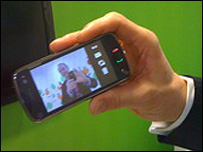 All went well, until I uploaded a third picture - of the BBC news channel set - and returned to my desk to find various startled messages on Twitter:
"Think that might be a wrong picture Rory and you might want to look at it ASAP." "Are you really sure about that photo?" "Please tell me twitpic has confused your photo with someone else's?" "You might want to check that last link!"
So I did check that last link - and instead of an inoffensive picture of a BBC studio, it was a shot of a young woman wearing nothing but a smile, in a pose that can only be described as extremely post-watershed. I let out a startled yelp, and went into a flurry of action, deleting the "Tweet", and the offending "Twitpic", and changing my passwords, assuming I'd been hacked. Then I set off to find out what had happened.
A number of other people contacted me to say they too had uploaded pictures to Twitpic, only to find that someone's else's shot had appeared - though they had all been innocuous images. Twitpic, it turns out, is nothing to do with Twitter - it's a third party application which has latched onto the expanding population of Twitterers, giving them a quick and easy way to link to photos. It's integrated into various "tweeting" applications, like Tweetie and Twhirl, which makes it all the more popular. It was used to upload the most famous Twitter picture to date, the shot taken by Janis Krums of the plane which landed on the Hudson.
I managed to track down the man behind Twitpic, Noah Everett. He was, as you'd expect, extremely apologetic. He explained that I hadn't, as I'd feared, been hacked - but instead had been the victim of what he described as "a random bug" that sometimes gets a user's photo mixed up with someone else's.
I hope the bugs get sorted out. I had been planning to use it to raise money in the Red Nose Day appeal, taking shaky phone pictures of various BBC personalities, and getting Twitter and Facebook users to guess who they are. In the circumstances I'm using another application - mobypicture - to upload the pictures. (Head here if you're interested).
But yet again I'm putting my trust in a social web application, which is obviously a risky thing to do. I've long realised that social networking is a public activity and you can't put anything online - thoughts, images, jokes - without assuming that you are giving that data to the entire world. What I hadn't realised is that you could be at risk of showing someone else's data, however offensive, on the web in your name. And that is really very frightening.
The BBC is not responsible for the content of external internet sites
This is dot.life - a blog about technology from BBC News.
Rory Cellan-Jones is the BBC's technology correspondent.
Maggie Shiels is the BBC's tech reporter based in Silicon Valley.
Archive
« January 2010
| Sun | Mon | Tue | Wed | Thu | Fri | Sat |
|---|---|---|---|---|---|---|
| 1 | 2 | |||||
| 3 | 4 | 5 | 6 | 7 | 8 | 9 |
| 10 | 11 | 12 | 13 | 14 | 15 | 16 |
| 17 | 18 | 19 | 20 | 21 | 22 | 23 |
| 24 | 25 | 26 | 27 | 28 |
Being Discussed Now
- Logging out... and straight back in(3)
- Gadgets of the Noughties(20)
- Plastic Logic's long journey to Vegas(21)
- Sexting teens(17)
- Wikipedia on the wane?(49)
- 'Cooling-off' for mobile phones? Not on the High Street(37)
- 2009 - the social year(36)
- Twitter, Iran and #uksnow(25)
- Broadband Britain - how far down the league?(55)
- Microsoft and Murdoch: Teaming up to bash Google?(34)
BBC Technology Headlines
- %28none%29
%28none%29 - %28none%29
%28none%29 - %28none%29
%28none%29
Visit the Technology index
Visit the BBC News website
Rory's TV/Radio reports
- Residents block Google car
Broadcast: 3 April 2009 - New adverts to tackle film piracy
Broadcast: 2 April 2009 - Call to scrap 'illegal databases'
Broadcast: 23 March 2009 - Female robot takes to the catwalk
Broadcast: 16 March 2009 - Super-charged battery breakthrough
Broadcast: 12 March 2009

- News Editors
- Sport Editors
- Journalism Labs
- BBC Internet Blog
- Radio 4 Blog
- Peston's Picks
- Nick Robinson's Newslog
- Stephanomics
- Mark Easton's UK
- Mark Mardell's America
- Nick Bryant's Australia
- Andrew Harding on Africa
- Gavin Hewitt's Europe
- Soutik Biswas' India
- dot.Rory
- Science: Jonathan Amos
- Richard Black on environment
- Today: Tom Feilden
- Fergus Walsh's medical files
- Newsnight: Paul Mason
- Newsnight: Mark Urban
- Torin Douglas
- Will Gompertz's arts
- Phil Coomes on photojournalism
- Magazine Monitor
- Mark D'Arcy in Westminster
- NI: Mark Devenport
- Scotland: Brian Taylor
- Scotland: Douglas Fraser
- Wales: Betsan Powys
- Martin Rosenbaum on FOI
- 5 Live Breakfast
- Newsnight
- PM programme (iPM)
- World Tonight: Robin Lustig
