


Google 'puts spy in your pocket'
- 5 Feb 09, 13:16 GMT
It's a great headline, made all the more punchy by its place on the front page of yesterday's Metro newspaper.
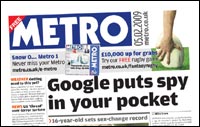 But is Google really putting a "spy in your pocket"?
The search giant has long been a soft target for journalists keen to warn about Big Brother culture, and every step it takes is closely monitored by those who are concerned that the firm has too much of a stranglehold on our data.
So what has Google done this time? Quite simply, it's joined a growing number of firms that offer geolocation services using a combination of GPS and user input.
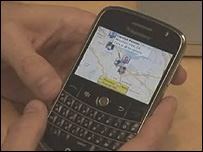
Latitude is a service that allows you to share your location with friends using your computer, or the GPS that comes built in with many of today's smartphones. It can also triangulate using mobile phone towers, and using wi-fi hotspots.
You can see the location of your friends that have opted in, while they can see yours, using Google Maps on your phone or on your computer.
Other firms are doing something similar. Fire Eagle is Yahoo's cross-platform geo-service (developed, incidentally, by ex-BBC man Tom Coates), while you can also use BrightKite or Loopt to do something similar.
Advocates of these tools see them as a natural extension of services like Twitter, or social networking.
So Google is not exactly breaking new ground here - just joining a growing number of companies trying to exploit the combination of mobile computing power and location-aware devices.
Metro quotes a well-respected privacy expert - Simon Davies of Privacy International.
Mr Davies has long voiced his concerns about what he sees as a lack of rigour in Google's security systems and the danger of its near-monopolistic position in some markets.
He shrugs off Google's defence that Latitude is opt-in - it's up to you whether you want to share your location - by saying that peer pressure will force many to join.
I don't think that Google can be blamed necessarily for peer pressure, however.
But Privacy International also says it has identified a security flaw in Latitude.
It says: "After studying the system documentation, PI has determined that the Google system lacks adequate safeguards to protect users from covert opt-in to Latitude's tracking technology. While it is clear that Google has made at least some effort to embed privacy protections, Latitude appears to present an immediate privacy threat."
 It says there are clear scenarios when the reciprocal authorisation system employed by Google's Latitude (eg I want to share my location data with you, and you want to share your location data with me, and we both agree to do so) can be exploited:
• An employer provides staff with Latitude-enabled phones on which a reciprocal sharing agreement has been enabled, but does not inform staff of this action or that their movements will be tracked.
• A parent gifts a mobile phone to a child without disclosing that the phone has been Latitude-enabled.
• A partner, friend or other person gains access to an unattended phone (left on a bar or in the house) and enables Latitude without the other person's knowledge.
• A Latitude-enabled phone is given as a gift.
• A phone left unattended, for example with security personnel or a repair shop, is covertly enabled.
These are, of course, human failings rather than technological. Privacy International is seeking a further layer of technological security to the authorisation process.
Fire Eagle, for example, can be set up to be re-authorised every few months or so.
Latitude does also allow users to mask their location, and even control how accurate it is.
The story here is less about Google, to my mind, and more about the imperative for everyone in society to grapple with the implications surrounding technology and privacy, especially when it is moving so quickly.
And I've been trying out services like BrightKite for a while now to try and get my head around those implications.
I can be found - quite literally - on BrightKite here.
PS: In the video below, you can see a Google product manager demonstrating Latitude.
In order to see this content you need to have both Javascript enabled and Flash installed. Visit BBC Webwise for full instructions. If you're reading via RSS, you'll need to visit the blog to access this content.
PPS: In case anyone was wondering why my posting to dot.life has been so dismal of late, I've actually been away from Technology for almost six months on a few side projects with the BBC. I'm back in the wi-fi-enabled saddle from the middle of this month. My thanks to Rory and Maggie for doing such an excellent job with the blog in my absence.
The BBC is not responsible for the content of external internet sites
This is dot.life - a blog about technology from BBC News.
Rory Cellan-Jones is the BBC's technology correspondent.
Maggie Shiels is the BBC's tech reporter based in Silicon Valley.
Archive
« January 2010
| Sun | Mon | Tue | Wed | Thu | Fri | Sat |
|---|---|---|---|---|---|---|
| 1 | 2 | |||||
| 3 | 4 | 5 | 6 | 7 | 8 | 9 |
| 10 | 11 | 12 | 13 | 14 | 15 | 16 |
| 17 | 18 | 19 | 20 | 21 | 22 | 23 |
| 24 | 25 | 26 | 27 | 28 |
Being Discussed Now
- Logging out... and straight back in(3)
- Gadgets of the Noughties(20)
- Plastic Logic's long journey to Vegas(21)
- Sexting teens(17)
- Wikipedia on the wane?(49)
- 'Cooling-off' for mobile phones? Not on the High Street(37)
- 2009 - the social year(36)
- Twitter, Iran and #uksnow(25)
- Broadband Britain - how far down the league?(55)
- Microsoft and Murdoch: Teaming up to bash Google?(34)
BBC Technology Headlines
- %28none%29
%28none%29 - %28none%29
%28none%29 - %28none%29
%28none%29
Visit the Technology index
Visit the BBC News website
Rory's TV/Radio reports
- Residents block Google car
Broadcast: 3 April 2009 - New adverts to tackle film piracy
Broadcast: 2 April 2009 - Call to scrap 'illegal databases'
Broadcast: 23 March 2009 - Female robot takes to the catwalk
Broadcast: 16 March 2009 - Super-charged battery breakthrough
Broadcast: 12 March 2009

- News Editors
- Sport Editors
- Journalism Labs
- BBC Internet Blog
- Radio 4 Blog
- Peston's Picks
- Nick Robinson's Newslog
- Stephanomics
- Mark Easton's UK
- Mark Mardell's America
- Nick Bryant's Australia
- Andrew Harding on Africa
- Gavin Hewitt's Europe
- Soutik Biswas' India
- dot.Rory
- Science: Jonathan Amos
- Richard Black on environment
- Today: Tom Feilden
- Fergus Walsh's medical files
- Newsnight: Paul Mason
- Newsnight: Mark Urban
- Torin Douglas
- Will Gompertz's arts
- Phil Coomes on photojournalism
- Magazine Monitor
- Mark D'Arcy in Westminster
- NI: Mark Devenport
- Scotland: Brian Taylor
- Scotland: Douglas Fraser
- Wales: Betsan Powys
- Martin Rosenbaum on FOI
- 5 Live Breakfast
- Newsnight
- PM programme (iPM)
- World Tonight: Robin Lustig
