


Macworld - what's new?
- 6 Jan 09, 22:07 GMT
The crowd was expectant, the media throng hurtled into the hall at the Moscone Centre and fought for the best camera position, and the audience gave the speaker the usual warm welcome accorded to the keynote presenter at Macworld.
So why did an hour and a half spent listening to details of Apple's shiny new products leave me just slightly underwhelmed - at least until the last five minutes? I don't think it was entirely the fault of Steve Jobs' less than charismatic stand-in Phil Schiller. Sure, he didn't pepper his keynote with as many "awesomes" and "really cools" as his boss. But then he didn't have anything really awesome to unveil.
When he started with a slide promising Three New Things, I was mildly excited. An iPhone nano? A tiny notebook computer? A big price cut? Err, no.
First, we had nearly an hour on an upgrade to the iLife suite of software. Sure, the upgrades to iMovie and iPhoto looked great. Facial recognition and geo-tagging is a clever way or organising your photos, and iMovie's latest incarnation seriously impressed my cameraman who uses far more expensive professional video editing software. But, hey, we get an upgrade to iLife every year, don't we? Hardly really new, and we didn't need all the wearisome details.
Then another twenty minutes on an upgrade to iWork, Apple's productivity software. But does anyone really use this rival to Microsoft Office, apart from hardcore Mac devotees who wouldn't sully their hands with anything emanating from Redmond? Ah, but here was something really revolutionary - iwork.com. So Apple will now allow you to put your documents online in the "cloud" so that they can be accessed anywhere by anyone. But even though it will start off as a free beta, it will eventually become a paid-for service. Just a minute - Google offers something similar , if less sophisticated, for nothing. So is this really going to change the world.
The final "new" thing was a 17" Macbook Pro. So does an extra two inches really count as novel? Phil Schiller made great play of a battery life of up to eight hours. That sounds great - but it's achieved by embedding the battery in the laptop. So in the unlikely event that the power supply fails, you will end up being without your computer for days while it is repaired.
That was the point I got up and headed for the exit to tell my bosses in London that Macworld had produced nothing new. But luckily there was One More Thing - and it was pretty good.
The deal with the big four record labels to make every track on iTunes DRM-free may well be the day that marks the demise of the copy-protection software for music. It's also an important moment in the fractious relationship between Apple and the music industry. Each side has got a bit of what it wanted - Apple has the DRM-free music Steve Jobs called for nearly two years ago, while the labels have got some wriggle room on pricing, with three different prices for tracks.
So we were relieved to emerge at last with a story. But for me the highlight was the show's finale, Tony Bennett singing "The Best is Yet To Come." The only problem was that the Apple faithful emerged from the Moscone Centre wondering whether that was really true.

Trouble in Twitterland
- 6 Jan 09, 17:12 GMT
You know you've reached a tipping point when people try to take you down.
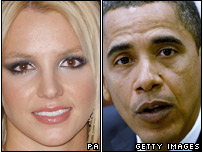 That is what has been happening to the popular microblogging service Twitter. The company's blog revealed that "33 Twitter accounts had been 'hacked' including prominent Twitter-ers like Rick Sanchez" (who is an anchor on CNN) "and Barack Obama" (who we all know as the president-elect).
The person who took over and sent fake messages from Rick Sanchez's account tweeted that "I am high on crack right now might not be coming into work today".
It might seem funny on the surface - but not if it's happening to you.
I can almost imagine pre-pubescent teenagers snorting with laughter behind their hands, but these attacks are no joke. People's reputations are being messed around with. So too is the credibility of a service that is growing in popularity and has proved its value in breaking news stories like the recent Mumbai bombing.
Another attack concerned Bill O' Reilly, the tv host of tv's The O'Reilly Factor. The official Fox News Twitter account posted the message "Breaking: Bill ORiley is gay". (Their spelling mistake, not mine.)
And Britney Spears had her account hijacked by someone writing lewd messages concerning certain parts of her body. Barack Obama's account, which was last used in November on election day, posted a link to a third party survey with the lure of $500 in free gas.
Biz Stone, Twitter's co founder, has said the company immediately locked down the accounts and investigated the issue. On the Twitter blog, he said the accounts are now back in the right hands.
Mr Stone wrote that the "accounts were compromised by an individual who hacked into some of the tools our support team uses. We considered this a very serious breach of security and immediately took the support tools offline".
It was a double whammy for the service which also got hit by phishing attacks.
Mr Stone added: "In addition to this Monday morning madness, we're coming off a wacky weekend where lots of folks were tricked into participating in a Phishing scam aimed at Twitter users."
There is little doubt that this is a sign of the times for Twitter and as it continues to grow in popularity, there will be more attacks. Mr Stone admitted as much and said "Twitter has gotten a lot of attention recently, which could be reason enough for an attack."
It doesn't help that the service is a darling of Silicon Valley and of many bloggers and journalists alike. Having such fans makes it more of an attractive target to hackers who get to see their attempts written up. But it also puts Twitter in the hot seat with the onus resting firmly with the company to do more to strengthen security and maintain the credibility of the service.
The BBC is not responsible for the content of external internet sites
This is dot.life - a blog about technology from BBC News.
Rory Cellan-Jones is the BBC's technology correspondent.
Maggie Shiels is the BBC's tech reporter based in Silicon Valley.
Archive
« January 2010
| Sun | Mon | Tue | Wed | Thu | Fri | Sat |
|---|---|---|---|---|---|---|
| 1 | 2 | |||||
| 3 | 4 | 5 | 6 | 7 | 8 | 9 |
| 10 | 11 | 12 | 13 | 14 | 15 | 16 |
| 17 | 18 | 19 | 20 | 21 | 22 | 23 |
| 24 | 25 | 26 | 27 | 28 |
Being Discussed Now
- Logging out... and straight back in(3)
- Gadgets of the Noughties(20)
- Plastic Logic's long journey to Vegas(21)
- Sexting teens(17)
- Wikipedia on the wane?(49)
- 'Cooling-off' for mobile phones? Not on the High Street(37)
- 2009 - the social year(36)
- Twitter, Iran and #uksnow(25)
- Broadband Britain - how far down the league?(55)
- Microsoft and Murdoch: Teaming up to bash Google?(34)
BBC Technology Headlines
- %28none%29
%28none%29 - %28none%29
%28none%29 - %28none%29
%28none%29
Visit the Technology index
Visit the BBC News website
Rory's TV/Radio reports
- Residents block Google car
Broadcast: 3 April 2009 - New adverts to tackle film piracy
Broadcast: 2 April 2009 - Call to scrap 'illegal databases'
Broadcast: 23 March 2009 - Female robot takes to the catwalk
Broadcast: 16 March 2009 - Super-charged battery breakthrough
Broadcast: 12 March 2009

- News Editors
- Sport Editors
- Journalism Labs
- BBC Internet Blog
- Radio 4 Blog
- Peston's Picks
- Nick Robinson's Newslog
- Stephanomics
- Mark Easton's UK
- Mark Mardell's America
- Nick Bryant's Australia
- Andrew Harding on Africa
- Gavin Hewitt's Europe
- Soutik Biswas' India
- dot.Rory
- Science: Jonathan Amos
- Richard Black on environment
- Today: Tom Feilden
- Fergus Walsh's medical files
- Newsnight: Paul Mason
- Newsnight: Mark Urban
- Torin Douglas
- Will Gompertz's arts
- Phil Coomes on photojournalism
- Magazine Monitor
- Mark D'Arcy in Westminster
- NI: Mark Devenport
- Scotland: Brian Taylor
- Scotland: Douglas Fraser
- Wales: Betsan Powys
- Martin Rosenbaum on FOI
- 5 Live Breakfast
- Newsnight
- PM programme (iPM)
- World Tonight: Robin Lustig
