


Steve Jobs goes public
- 5 Jan 09, 16:52 GMT
It seems the cat and mouse game between Apple boss Steve Jobs and the press and blogosphere has ended ... for the moment.
This morning he sent out an email that said "I've decided to share something very personal with the Apple community". As you may have read in our news story, Mr Jobs has admitted to being ill these past few months but not knowing the reason why until recently. He has now said it is due to "a hormone imbalance that has been 'robbing' me of the proteins my body needs to be healthy".
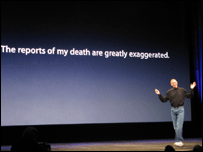 Certainly his appearance at last year's World Wide Developers Conference in San Francisco set off a storm of rumour and counter-rumour. Even amid that hurricane of supposition, Mr Jobs refused to discuss the issue of his health publicly and Apple answered questions by simply saying it was a "private matter".
The only journalist Mr Jobs talked to about the issue was the columnist Joe Nocera of the New York Times, but he swore him to secrecy. That was despite Mr Nocera's attempts to try and persuade him otherwise, especially given that he was the CEO of a publicly traded company with investors and shareholders. What Mr Nocera did write at the time was that Mr Jobs did not have a life-threatening illness. It seemed to calm the waters, a little.
But when Apple announced just a couple of weeks ago that Mr Jobs would not be taking centre stage at the Macworld Expo which starts this morning, the rumour mill got back in full swing.
As we all know, a story loves a vacuum. I am just as guilty as everyone else in being too willing to repeat the chatter going on out there just in case some of it was right. I certainly know some colleagues in the industry who have been preparing obits on Mr Jobs.
Now it seems the very public discussion about his health this time was too hard for even Mr Jobs to ignore, and he himself said in his email that "stories of me on my deathbed" are premature. He also stated "I have given my all to Apple for the past 11 years" and that he will be staying on as CEO.
That will be news to gladden many at this week's Macworld as well as investors and shareholders. The markets certainly reacted well to the announcement and AFP reported that Apple's share price jumped by nearly 4% in pre-market trading.
The Twittersphere is already alight with comment as is the blogosphere. There is no doubt that in the coming months there will be a constant clamour for updates on Mr Jobs' health. One thing I can predict with some certainty is that he will be unwilling to give them.
The notoriously private Mr Jobs has said as much himself in his email: "I've said more than I wanted to say, and all that I am going to say, about this." Mr Jobs might hope this will close the chapter on the issue. Alas I don't think that will be the case.
And while it is good to know he is on the mend, I think the future will be very much about what the company does to find and groom Mr Jobs' successor.

Brown and fast broadband
- 5 Jan 09, 15:21 GMT
So Gordon Brown's plan to create 100,000 jobs might well involve massive public investment in next-generation broadband. The Prime Minister told the Observer that such a project could be the modern equivalent of the huge programme of public works undertaken by the Roosevelt administration as it tried to lift the USA out of the depression in the 1930s. Here's the key quote:
"When we talk about the roads and the bridges and the railways that were built in previous times - and those were anti-recession measures taken to help people through difficult times - you could [by comparison] talk about the digital infrastructure and that form of communications revolution at a period when we want to stimulate the economy. It's a very important thing."
It may be very important, but what is far from clear is just how much public money for a new fast broadband network the PM is talking about - and who would get it.
 There is now widespread agreement that the route to a high-speed, future-proof network is through fibre - and that means putting fibre-optic cables right into homes across Britain. The cost? Well it depends who you believe, but the Broadband Stakeholder Group reckoned it could be as much as £29 billion.
There are plenty of small-scale fibre projects up and running - from plans to run fibre through the sewers to community broadband groups which are trying to make sure remote parts of Britain are not left out. Perhaps they will find it easier to get grants.
But it looks as though there are only two companies with the scale to take a fibre network right across the UK - BT and the cable firm Vigin Media. Here is where any public sector involvement gets devilishly tricky. I am sure BT and Virgin would be very happy to accept a few billion from the government, but BT in particular might well prefer another option - light-touch regulation. After all, the firm has already hinted that it would be happy to pour billions into a next-generation network if only Ofcom would be somewhat more relaxed about letting it make a return on that investment. BT's rivals, however, will be warning against the dangers of using government money to give even more muscle to the biggest player in the market.
Then there is the fact that once you declare that the "digital infrastructure" is a vital public service, everyone will want an equal stake in it. When broadband is a purely commercial service, companies can argue that they would love to deliver it to every nook and cranny in Britain - but their shareholders won't stand for it. Once the public sector is involved, every household may come to see fast broadband - like free healthcare - as a right, not a privilege. In short, then, finding the public money to pump into fast broadband might be the easy bit. Designing the pumping mechanism will be a lot harder.
Meanwhile, a cautionary tale about promises of publicy-funded broadband. I'm writing this in San Francisco, where I'm covering Macworld. As a broadband addict, keen to update my status on various social networks and send the odd blog post, I've been roaming the streets in search of wifi. It is less easily available and more expensive in this high-tech city than you might think. San Francisco's mayor came up with a plan back in 2004 to provide free wifi to the whole city. But, after a lot of ins and outs, that plan was scrapped in 2007 amid doubts about its financial viability. So the Prime Minister might do worse than give Mayor Gavin Newsom a call to see if he has any tips on the economics of public broadband.
America's first CTO to be named
- 5 Jan 09, 08:13 GMT
Following the American election, a favourite parlour games in the living rooms of Silicon Valley has been asking: Just who will land the job of America's first ever chief technology officer? Well, the wait will soon be over because an announcement is expected on Wednesday.
There has been some concern that the person who will take up the post has not yet been named, given the president-elect's penchant for using technology to get his message out on the campaign trail and now as he waits in the wings at 1600 Pennsylvania Avenue.
With just over two weeks to go, the role of CTO is one of the few senior appointments that remains unfilled. Many expected an announcement around the same time Mr Obama named his science and technology team just before Christmas. But it was not to be.
 Whoever lands the job, they will have no shortage of help in working out what they should tackle first. As I have written previously, there is a specific website that has been set up where ordinary citizens can vote on the CTO's main priorities. And of course there is the transition team's own site which has been encouraging people to do the same.
On obamacto.uservoice.com, the number one priority with nearly 13,000 votes is "ensuring the interent is widely accessible and network neutral." That is followed by nearly 10,000 people voting for the future CTO to "ensure privacy and repeal the patriot act."
While the appointee will undoubtedly have to be someone who can straddle over the worlds of Washington's political power brokering and Silicon Valley's high geekdom, a range of names has already been doing the rounds. They include Google's Eric Schmidt, who helped advise Mr Obama and has himself said several times that he wasn't interested in the job and Vint Cerf, the so-called "father of the internet" (who's also a Google exec and Chief Internet Evangelist").
Other names that have been talked up include Amazon CEO Jeff Bezos and even, believe it or not, Apple boss Steve Jobs who will not be appearing at this year's Macworld in his usual capacity as chief Mac cheerleader, be that for health reasons or not.
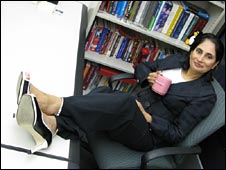 Amid all the names, I note few women mentioned. And that's despite some strong contenders like Anne Mulcahy, the boss at Xerox, her CTO Sophie Vandebroek, Cisco's CTO Padma Warrior, Meg Whitman formerly of eBay, Anne Livermore of HP or Safra Catz who is president and former CFO at Oracle.
There, now: that wasn't so hard.
All of course is set to be revealed this Wednesday. Place your bets now, please.
The BBC is not responsible for the content of external internet sites
This is dot.life - a blog about technology from BBC News.
Rory Cellan-Jones is the BBC's technology correspondent.
Maggie Shiels is the BBC's tech reporter based in Silicon Valley.
Archive
« January 2010
| Sun | Mon | Tue | Wed | Thu | Fri | Sat |
|---|---|---|---|---|---|---|
| 1 | 2 | |||||
| 3 | 4 | 5 | 6 | 7 | 8 | 9 |
| 10 | 11 | 12 | 13 | 14 | 15 | 16 |
| 17 | 18 | 19 | 20 | 21 | 22 | 23 |
| 24 | 25 | 26 | 27 | 28 |
Being Discussed Now
- Logging out... and straight back in(3)
- Gadgets of the Noughties(20)
- Plastic Logic's long journey to Vegas(21)
- Sexting teens(17)
- Wikipedia on the wane?(49)
- 'Cooling-off' for mobile phones? Not on the High Street(37)
- 2009 - the social year(36)
- Twitter, Iran and #uksnow(25)
- Broadband Britain - how far down the league?(55)
- Microsoft and Murdoch: Teaming up to bash Google?(34)
BBC Technology Headlines
- %28none%29
%28none%29 - %28none%29
%28none%29 - %28none%29
%28none%29
Visit the Technology index
Visit the BBC News website
Rory's TV/Radio reports
- Residents block Google car
Broadcast: 3 April 2009 - New adverts to tackle film piracy
Broadcast: 2 April 2009 - Call to scrap 'illegal databases'
Broadcast: 23 March 2009 - Female robot takes to the catwalk
Broadcast: 16 March 2009 - Super-charged battery breakthrough
Broadcast: 12 March 2009

- News Editors
- Sport Editors
- Journalism Labs
- BBC Internet Blog
- Radio 4 Blog
- Peston's Picks
- Nick Robinson's Newslog
- Stephanomics
- Mark Easton's UK
- Mark Mardell's America
- Nick Bryant's Australia
- Andrew Harding on Africa
- Gavin Hewitt's Europe
- Soutik Biswas' India
- dot.Rory
- Science: Jonathan Amos
- Richard Black on environment
- Today: Tom Feilden
- Fergus Walsh's medical files
- Newsnight: Paul Mason
- Newsnight: Mark Urban
- Torin Douglas
- Will Gompertz's arts
- Phil Coomes on photojournalism
- Magazine Monitor
- Mark D'Arcy in Westminster
- NI: Mark Devenport
- Scotland: Brian Taylor
- Scotland: Douglas Fraser
- Wales: Betsan Powys
- Martin Rosenbaum on FOI
- 5 Live Breakfast
- Newsnight
- PM programme (iPM)
- World Tonight: Robin Lustig
