


Nintendo lead from the front
- 16 Jul 08, 13:02 GMT
The last time Nintendo had such domination of the games business Sony was focusing on Walkmans and Microsoft had just released a minor product, called Windows.
 Twenty three years later and the three heavy weights go into the crucial period before Christmas knowing full well who will emerge as the victor.
Sony can, and does, point to its success as the only firm with three simultaneous platforms - the PS3, PSP and PS2, which continues to do remarkable business.
Part of the great optimism within Sony's ranks stems from the fact they know many millions of PlayStation 2 owners have yet to buy a next generation console.
But Nintendo's dominance is not just based on the impressive sales figures for the Wii and DS, which stand at more than 10m and 70m respectively.
In order to see this content you need to have both Javascript enabled and Flash installed. Visit BBC Webwise for full instructions
It comes from knowing that the Wii and DS have sparked a revolution in the industry, one which Sony and Microsoft are only beginning to react to.
At the Nintendo press conference, American boss Reggie Fils-Aime uttered the word that many people have used to describe the firm's success - "fad".
He said: "Fad is no longer operable. It's inevitable when the paradigm shifts, imitation is just around the corner."
Nintendo has always been a humble company - but they haven't been able to restrain themselves from a few choice remarks.
The company's global president Satoru Iwata said of the Wii's success: "Even if it is a revolution sooner or later people will become tired of a new form of entertainment.
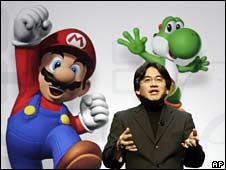 "This happens faster when others try and reproduce the initial change. What seemed fresh, will inevitably be lost."
Which explains Nintendo's insatiable appetite for peripherals: No sooner had the balance board arrived, but now we have the MotionPlus, a highly sensitive motion controller which attaches to the Wiimote.
Nintendo is desperate to convince people it is not a one-trick pony. And while it wheels out the WiiSports Resort and WiiMusic, the firm's highly loyal fans are left waiting on news of the company's legacy titles, Zelda and Mario.
But there was no news at all; not even a teaser trailer. A lot of people left the Kodak Theatre muttering a little.
And what about Sony? Their staging was certainly the most dramatic of the big three and their message to consumers and analysts was just as subtle.
Sony Computer Entertainment America boss went to great lengths to point out that some of the biggest ever releases on the PS2 did not see the light of day until two, three, four and five years into its lifespan.
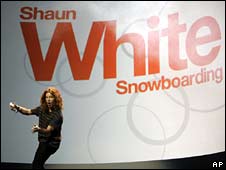 What he's really trying to say is: Be patient PlayStation fans, the best is yet to come.
For the last two years PlayStation devotees who invested in a PS3 in truth invested in a promise; that the potential of the console would be realised with outstanding games.
Despite the hyperbole, there is not a single game, in my opinion, on the PS3 that truly looks like it surpasses the technical limitations of the Xbox 360.
Sony is desperate to put clear blue water between itself and the Xbox 360, and reeled off a roster of game developers who wanted to wax lyrical about the power of the Cell processor.
But no-one has played or experience anything tangible that backs these claims up. And that's not to say it won't ever happen.
For me, the most impressive aspect of the PlayStation 3's development is in the online space. The original PlayStation Network was a clumsy, ill-conceived attempt at community through connectivity, and digital experiences through downloads.
But in the US, at least, it is getting its act together, with a movie and film download store, and great use of the PSP as a satellite device.
It is just frustrating that European gamers cannot enjoy the same level of service.
So what did we learn from the two press conferences today?
One:
Nintendo still looks a little shocked to be ahead of the pack.
Two:
Sony is asking for just a little bit more time to deliver on the many promises of PlayStation 3.
The BBC is not responsible for the content of external internet sites
This is dot.life - a blog about technology from BBC News.
Rory Cellan-Jones is the BBC's technology correspondent.
Maggie Shiels is the BBC's tech reporter based in Silicon Valley.
Archive
« January 2010
| Sun | Mon | Tue | Wed | Thu | Fri | Sat |
|---|---|---|---|---|---|---|
| 1 | 2 | |||||
| 3 | 4 | 5 | 6 | 7 | 8 | 9 |
| 10 | 11 | 12 | 13 | 14 | 15 | 16 |
| 17 | 18 | 19 | 20 | 21 | 22 | 23 |
| 24 | 25 | 26 | 27 | 28 |
Being Discussed Now
- Logging out... and straight back in(3)
- Gadgets of the Noughties(20)
- Plastic Logic's long journey to Vegas(21)
- Sexting teens(17)
- Wikipedia on the wane?(49)
- 'Cooling-off' for mobile phones? Not on the High Street(37)
- 2009 - the social year(36)
- Twitter, Iran and #uksnow(25)
- Broadband Britain - how far down the league?(55)
- Microsoft and Murdoch: Teaming up to bash Google?(34)
BBC Technology Headlines
- %28none%29
%28none%29 - %28none%29
%28none%29 - %28none%29
%28none%29
Visit the Technology index
Visit the BBC News website
Rory's TV/Radio reports
- Residents block Google car
Broadcast: 3 April 2009 - New adverts to tackle film piracy
Broadcast: 2 April 2009 - Call to scrap 'illegal databases'
Broadcast: 23 March 2009 - Female robot takes to the catwalk
Broadcast: 16 March 2009 - Super-charged battery breakthrough
Broadcast: 12 March 2009

- News Editors
- Sport Editors
- Journalism Labs
- BBC Internet Blog
- Radio 4 Blog
- Peston's Picks
- Nick Robinson's Newslog
- Stephanomics
- Mark Easton's UK
- Mark Mardell's America
- Nick Bryant's Australia
- Andrew Harding on Africa
- Gavin Hewitt's Europe
- Soutik Biswas' India
- dot.Rory
- Science: Jonathan Amos
- Richard Black on environment
- Today: Tom Feilden
- Fergus Walsh's medical files
- Newsnight: Paul Mason
- Newsnight: Mark Urban
- Torin Douglas
- Will Gompertz's arts
- Phil Coomes on photojournalism
- Magazine Monitor
- Mark D'Arcy in Westminster
- NI: Mark Devenport
- Scotland: Brian Taylor
- Scotland: Douglas Fraser
- Wales: Betsan Powys
- Martin Rosenbaum on FOI
- 5 Live Breakfast
- Newsnight
- PM programme (iPM)
- World Tonight: Robin Lustig
