


Hands on with vintage gaming
- 15 Jul 08, 14:10 GMT
If you want to find some of the best video games during E3 then I would advise driving away from the convention centre north east to the suburb of Glendale.
 Hidden away in a work shed is the Vintage Arcade Superstore, a treasure trove of some of the greatest jewels in video game history. Retro-loving gamers can pick up a piece of history for as little as $1,500 (£750).
An original Williams' Defender machine, Ms Pacman, Battezone, Gauntlet, a classic Asteroids cabinet, Star Wars, Pinball Machines and hundreds of other gems fill the room.
There are dusty circuit boards, old cathode ray tube monitors, the empty housings of classic arcade games and row upon row of some of the greatest games ever made.
 The store is the property of Gene Lewin, who started the arcade superstore 31 years ago after falling in love with Pinball as a teenager.
"They are imaginative, creative, a lot of fun," he said of arcade machines.
But why arcade machines when you can play games in high definition on a game console for as little as $400 (£200)?
He said: "It's the real arcade experience; the original games, the original cabinets, the original artwork. You can get a piece of your childhood, a piece of history."
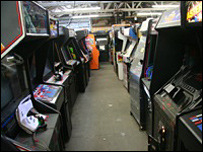 Gene and his team both sell and restore arcade games, from the monitors to the boards and cabinets.
And his most prized possession?
"I have the very first Asteroids Deluxe machine, serial number 001.
"It's one of a kind and the first off the assembly line."
So if you want this piece of history you can pick it up for only $2,495 (£1,500).
A tale of two Microsofts
- 15 Jul 08, 12:20 GMT
And so it was to a rather emasculated Los Angeles Convention Center for the first press conference and briefing of E3 2008.
In order to see this content you need to have both Javascript enabled and Flash installed. Visit BBC Webwise for full instructions
The E3s of old were colourful, brash affairs but there were no signs of the traditional giant posters on the convention windows and walls. The walls were bare and the hall had the air of an accountancy convention, rather than a games conference.
We'd been dragged from our beds for an early morning exclusive press briefing with Microsoft, ahead of the actual Xbox conference. We were promised a "major announcement".
On the way to the venue the journalists speculated about the announcement:
"A price cut!"
"A new Halo game"
"Bungie's new project"
So what was it? Well, it was Lips, a karaoke game that bears more than a passing resemblance to Singstar on the PlayStation 3.
A ripple of disinterest passed through the assembled media who half-heartedly asked some questions, most of which were batted away with a "we can't talk about that right now" response.
Microsoft brought on Welsh singer Duffy as the acceptable face of video games to plug the new title. Right on cue she admitted she didn't play video games because they were too violent.
 One of the journalists asked her about downloadable content for Lips. Unsurprisingly, she wasn't exactly that well versed with the digital distribution plans for Xbox Live titles.
And so on we trouped to the press briefing proper. And it was the usual slick Microsoft briefing.
We were expecting a radical new direction for the console. But the first half was dominated by the classic blockbuster franchises, Gears of War 2, Fable 2 and Fallout 3.
Just as we thought that Microsoft's attempt to become a more family-friendly console was an illusion, up stepped John Schappert and Shane Kim to reveal all.
A re-designed Xbox Live, coupled with plenty of social and casual games were paraded in front of us. But it felt like Microsoft had merely cherry picked some of the more successful aspects of the PlayStation and Wii, and created versions for the 360.
There was lots of news about new developments for Xbox Live content but most of them applied only to the North American market.
Bungie were due on stage to reveal a taster of their upcoming project their first title post Halo. But there was no sign of them.
I had been due to speak with them immediately after the briefing but that too was pulled with little explanation.
And so what impression am I left with? Well, Microsoft are clearly a company being pulled in two directions: it needs to satisfy the blood-thirsty needs of its core demographic, but can only triumph over Sony if it can attract more European gamers to the platform, and they tend to prefer more casual titles.
Microsoft can do both but the firm just looks uncomfortable trying to do casual and social: a demo session during the briefing of three Xbox senior playing a movie game was just painful to watch.

BT goes high fibre
- 15 Jul 08, 11:59 GMT
BT has announced a big investment this morning in fibre, promising to get Britain into the broadband fast lane. It's aiming to bring 10 million homes within reach of fibre-based broadband by 2012. That's going to cost a whopping one and a half billion pounds - though some of that cash was already in the investment pipeline.
 It looks as though this could be the moment broadband enthusiasts have been crying out for, when the UK starts catching up with countries who've already started the move to ultra-fast networks. BT was keen to celebrate. "This marks the beginning of a new chapter in Britain's broadband story," according to the new Chief Executive Ian Livingston.
But hold on a minute. We were told that digging up Britain to lay a fibre-to-the-home network would cost £15bn, ten times what BT is spending, so how can they do it for the money?
Well first of all the plan is to reach 40% of UK homes with fibre, with the rest served by the new ADSL2 network, which is going to offer up to 24Mbps. And then in most cases they're planning not fibre to the home, but "fibre to the cabinet" - in other words that box on the street where you sometimes see an engineer fiddling. That will deliver up to 40Mbps, with BT saying its technicians believe they can eventually get up to 60Mbps.
Some places - like the Ebbsfleet development in Kent - will get fibre right into the home, with the promise of up to 100Mbps soon, and 10 times that in the future. Who gets what will depend on an assessment of demand from both consumers and the retail broadband suppliers who will be using the BT fibre network.
And BT is making it clear that the regulator must play its part by allowing it to make a decent return on the cash. Within hours of the announcement, Ofcom had put out a press release welcoming BT's plans, and talking of providing "the right incentives for operators to invest" in fast broadband, so I think we can assume that the regulatory side will be sorted.
What we don't know yet is what this will cost consumers. But after a bitter price war which has left many broadband providers struggling to provide a decent service at a profit, there looks certain to be more mergers - and with fewer, bigger broadband players, that could mean we all end up paying a bit more to get the kind of speeds BT is now promising.
So this may not be quite the bold step into the future painted by BT - and remember the likes of Virgin Media are already promising ultra-fast broadband - but it is a sign that money is beginning to flow to fibre. And let's not underestimate the risk involved for a major telecoms business in promising extra expenditure in the current environment. Stockmarket analysts did not seem too surprised by the the BT announcement - but the share price was still down more than four percent the last time I looked.
The BBC is not responsible for the content of external internet sites
This is dot.life - a blog about technology from BBC News.
Rory Cellan-Jones is the BBC's technology correspondent.
Maggie Shiels is the BBC's tech reporter based in Silicon Valley.
Archive
« January 2010
| Sun | Mon | Tue | Wed | Thu | Fri | Sat |
|---|---|---|---|---|---|---|
| 1 | 2 | |||||
| 3 | 4 | 5 | 6 | 7 | 8 | 9 |
| 10 | 11 | 12 | 13 | 14 | 15 | 16 |
| 17 | 18 | 19 | 20 | 21 | 22 | 23 |
| 24 | 25 | 26 | 27 | 28 |
Being Discussed Now
- Logging out... and straight back in(3)
- Gadgets of the Noughties(20)
- Plastic Logic's long journey to Vegas(21)
- Sexting teens(17)
- Wikipedia on the wane?(49)
- 'Cooling-off' for mobile phones? Not on the High Street(37)
- 2009 - the social year(36)
- Twitter, Iran and #uksnow(25)
- Broadband Britain - how far down the league?(55)
- Microsoft and Murdoch: Teaming up to bash Google?(34)
BBC Technology Headlines
- %28none%29
%28none%29 - %28none%29
%28none%29 - %28none%29
%28none%29
Visit the Technology index
Visit the BBC News website
Rory's TV/Radio reports
- Residents block Google car
Broadcast: 3 April 2009 - New adverts to tackle film piracy
Broadcast: 2 April 2009 - Call to scrap 'illegal databases'
Broadcast: 23 March 2009 - Female robot takes to the catwalk
Broadcast: 16 March 2009 - Super-charged battery breakthrough
Broadcast: 12 March 2009

- News Editors
- Sport Editors
- Journalism Labs
- BBC Internet Blog
- Radio 4 Blog
- Peston's Picks
- Nick Robinson's Newslog
- Stephanomics
- Mark Easton's UK
- Mark Mardell's America
- Nick Bryant's Australia
- Andrew Harding on Africa
- Gavin Hewitt's Europe
- Soutik Biswas' India
- dot.Rory
- Science: Jonathan Amos
- Richard Black on environment
- Today: Tom Feilden
- Fergus Walsh's medical files
- Newsnight: Paul Mason
- Newsnight: Mark Urban
- Torin Douglas
- Will Gompertz's arts
- Phil Coomes on photojournalism
- Magazine Monitor
- Mark D'Arcy in Westminster
- NI: Mark Devenport
- Scotland: Brian Taylor
- Scotland: Douglas Fraser
- Wales: Betsan Powys
- Martin Rosenbaum on FOI
- 5 Live Breakfast
- Newsnight
- PM programme (iPM)
- World Tonight: Robin Lustig
