


Broadband ads - Virgin rapped
- 2 Jul 08, 00:00 GMT
Virgin Media has had its knuckles rapped by the Advertising Standards Authority over claims it made about its broadband service. Its Hate To Wait? advert sought to impress potential customers with the kind of speeds Virgin's different packages offer by explaining just how quickly you could download a song or a TV show.
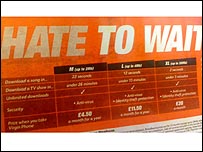 What it didn't mention was Virgin's traffic management policy which caps speeds during peak hours. So the claim that you could "download a TV show in under 26 minutes" on its "up to 2Mb" package didn't really stand up if you were a heavy user. Amusingly, Virgin also got its megabytes (MB) and megabits (Mb) mixed up when describing the size of the files which you could download so quickly - but then we've all made that mistake, haven't we? Oh, and guess where the one complaint about this advert came from? A company called BT...
Which all goes to show a couple of things. The ISPs are in a bitter fight to provide customers the speed and price they're demanding, while trying to avoid spending a fortune on new infrastructure. And the regulators are getting just a bit tougher on the way the companies advertise their products.
So Virgin needs to have a traffic management policy because its network still can't quite cope with the demands of "super-users" - the sort of people who may want to download an episode of Lost downstairs while their teenagers are upstairs playing Halo 3 online. Here's what its statement says:
"Our traffic management policy helps ensure the majority of customers receive the quality of service they expect from our fibre-optic broadband product by managing demand from the heaviest users at certain times of the day." In other words, our information superhighway is getting ever faster (up to 50Mbps soon), but the tiny minority of you who want to clog up the fast lane in the rush hour will find that we've applied the brakes.
Now Virgin isn't alone. All the big ISPs have traffic management policies, including BT, and the regulators are now putting pressure on the companies to come clean about them - it's one of the measures in Ofcom's new voluntary code. But does that mean we'll all be getting clearer information about exactly what speed our broadband lines will achieve?
The Advertising Standards Authority seemed a little hurt when I suggested that it had shied away from the broadband speed issue until now. It pointed me to a judgement from 2004 where it first made it clear that "1Mb broadband" was not acceptable, and would have to replaced by "up to 1Mb."
But since then the ASA has seemed content with the widespread use of "up to" in broadband advertising, despite the evidence that it doesn't tell the full story. "As long as people are getting close," a spokesman told me, "we think the 'up to' qualification is OK." But, as survey after survey has shown, most people aren't getting that close - and as "headline" speeds get faster, the gap with reality gets ever wider.
"We never get complaints from customers about speed - it's not an issue," an executive at one big ISP told me recently. Well that's not what we found during our Broadband Britain tour in June. As the broadband promises get more extravagant, the risk is that customers will get more and more disappointed with what is delivered.
The BBC is not responsible for the content of external internet sites
This is dot.life - a blog about technology from BBC News.
Rory Cellan-Jones is the BBC's technology correspondent.
Maggie Shiels is the BBC's tech reporter based in Silicon Valley.
Archive
« January 2010
| Sun | Mon | Tue | Wed | Thu | Fri | Sat |
|---|---|---|---|---|---|---|
| 1 | 2 | |||||
| 3 | 4 | 5 | 6 | 7 | 8 | 9 |
| 10 | 11 | 12 | 13 | 14 | 15 | 16 |
| 17 | 18 | 19 | 20 | 21 | 22 | 23 |
| 24 | 25 | 26 | 27 | 28 |
Being Discussed Now
- Logging out... and straight back in(3)
- Gadgets of the Noughties(20)
- Plastic Logic's long journey to Vegas(21)
- Sexting teens(17)
- Wikipedia on the wane?(49)
- 'Cooling-off' for mobile phones? Not on the High Street(37)
- 2009 - the social year(36)
- Twitter, Iran and #uksnow(25)
- Broadband Britain - how far down the league?(55)
- Microsoft and Murdoch: Teaming up to bash Google?(34)
BBC Technology Headlines
- %28none%29
%28none%29 - %28none%29
%28none%29 - %28none%29
%28none%29
Visit the Technology index
Visit the BBC News website
Rory's TV/Radio reports
- Residents block Google car
Broadcast: 3 April 2009 - New adverts to tackle film piracy
Broadcast: 2 April 2009 - Call to scrap 'illegal databases'
Broadcast: 23 March 2009 - Female robot takes to the catwalk
Broadcast: 16 March 2009 - Super-charged battery breakthrough
Broadcast: 12 March 2009

- News Editors
- Sport Editors
- Journalism Labs
- BBC Internet Blog
- Radio 4 Blog
- Peston's Picks
- Nick Robinson's Newslog
- Stephanomics
- Mark Easton's UK
- Mark Mardell's America
- Nick Bryant's Australia
- Andrew Harding on Africa
- Gavin Hewitt's Europe
- Soutik Biswas' India
- dot.Rory
- Science: Jonathan Amos
- Richard Black on environment
- Today: Tom Feilden
- Fergus Walsh's medical files
- Newsnight: Paul Mason
- Newsnight: Mark Urban
- Torin Douglas
- Will Gompertz's arts
- Phil Coomes on photojournalism
- Magazine Monitor
- Mark D'Arcy in Westminster
- NI: Mark Devenport
- Scotland: Brian Taylor
- Scotland: Douglas Fraser
- Wales: Betsan Powys
- Martin Rosenbaum on FOI
- 5 Live Breakfast
- Newsnight
- PM programme (iPM)
- World Tonight: Robin Lustig
