


PS3 owners delight at XMB
- 30 Jun 08, 14:38 GMT
As I stated back in May, the in-game Cross Media Bar (XMB) for PlayStation 3 will be a reality on 2 July.
The lack of in-game XMB - so that gamers can check friend requests, send messages while still playing a gamer - has been one of the biggest gripes of PS3 owners since it launched.
But the feature will be introduced in the next firmware upgrade to the PlayStation.
Perhaps more importantly, the PS3 is introducing the idea of virtual "trophies", which represent your success in different games. These trophies will be on display to your friends.
Sound familiar? They should; trophies are a lot like Achievements on the Xbox 360.
And it's no surprise that Sony is introducing this feature: Achievements have been one of their truly innovative features of Xbox Live.
Super Stardust HD is the first game to implement trophies, with first-party titles like Buzz, LittleBigPlanet, Motorstorm Pacific Rift and Resistance 2 to follow.

The man who inspired a generation
- 30 Jun 08, 11:41 GMT
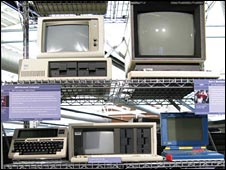
Chuck Thacker is something of a hero in the world of technology yet outside of it, he remains a virtual unknown.
Show people a photo of say Bill Gates and Steve Jobs and I bet quite a few people on the street will know who they are. Certainly they will have heard of them and probably have one or more of their products but Chuck Thacker is a different kettle of fish. And that's a shame given the influence he has had on so much of our lives.
In short, Chuck is the man who essentially gave us the personal computer. In 1974 he switched on the Xerox Alto, the first computer that looked and worked like the PCs we are all so familiar with today. Incidentially, it's first task was to display an image of Sesame Street's Cookie Monster.
While working at the famed Xerox Palo Alto Research Centre he also helped pioneer another major advance in the world of computing, namely the Ethernet LAN (Local Area Network). He has also been involved in a host of computer architecture advancements, the tablet PC and even did work on the X box.
Today Mr Thacker works for Microsoft . I met him recently at their Silicon Valley labs where the world's number one software company had thrown open their doors to the press and school kids to display what innovations they are working on.
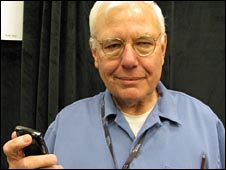
The white haired and bespectacled Mr Thacker is still getting his hands dirty. He was happily showing off his work on a hardware platform called the BEE3 which he hopes will return architechture to the cutting edge of computer science.
As well as being inundated by people interested in what he is doing today, there was a steady stream undeniably in awe of the man and his achievements.
He is quietly proud of his time at the PARC labs but it's not something he boasts about having to be prompted several times to talk to me about it.
"It was the most intensely creative period of my life that roughly 10 years between 1970 and 1980. More good stuff came out of that Lab than I ever thought possible. It was truly amazing."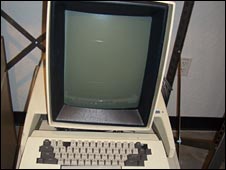
Legend has it that the Alto directly inspired Apple to build the Macintosh after Steve Jobs paid a friendly visit to the Xerox labs in 1979 where Chuck was working at the time.
Mr Thacker is a man of few words, most definitely not given to hyperbole. And even when he criticises he does it in a reasoned logical way.
Take his comments on the progress of the PC, the industry he paved the way for: "You have to make money, there is no doubt about that. But I think it is having a negative effect on innovation. If you look at the pc industry as a whole, the people that make the hardware do not have high margins. That's a very razor thin business.
"In the PC industry, not the computing industry in general, the margins are so low that innovation happens much more slowly."
And just in case that all sounded a bit too critical, Mr Thacker talked up the future of the PC and his vision for it. A vision that has been echoed by his retired boss Bill Gates who said he wanted to put a PC in every home.
"The PC has done an awful lot for improving people's lives, there is no doubt about that. I did envisage that.
"I used to say that the first revolution of computers was when scientists had them, the second was when business had them and the third revolution is when everyone has them. We haven't quite made that but I am optomistic that we will."
So what for Chuck Thacker is the indespensible gadget of the day? He reaches into his pocket and pulls out his smart phone.
"It weighs a mere 50 grams and can do everything I need it to do. The first computer I made probably weighed 30,000 pounds and was a couple of inches by a couple of inches.
"This phone is roughly 2,000 times the speed and has a thousand times the memory of that Alto. Plus this is just $400 and that thing back then was around $12,000."
And he adds wistfully: "That was back when a dollar was actually worth more than a dollar."

Bye-bye Bill
- 30 Jun 08, 10:50 GMT
As Bill Gates clears his desk, shuts down his computer for the last time and hands in his security pass, I've been reflecting on several encounters over the years with Microsoft's founder. I've interviewed him four or five times, and sat though a number of keynotes at Las Vegas conferences where he has been billed as the star speaker. But trying to pin down just what I think of him - and why he attracts such a mixture of adulation and scorn - has been tricky.
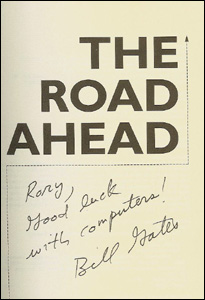 On a bookshelf at home is one of the better souvenirs of my career in journalism - "The Road Ahead", a 1995 vision of the internet future signed by the author with this slightly enigmatic inscription: "Rory, good luck with computers, Bill Gates".
It was presented to me in Washington DC after an interview in which the author was promoting his book. My first encounter with Mr Gates and the Microsoft machine was pretty typical. He was surrounded by all the apparatus now deemed essential for a titan of industry - the hired-in television crew, the flunkies and public relations advisors, the security, the bowl of fresh fruit. But Bill Gates, who even then was the world's richest man and commander of a corporate empire which struck fear into every other software business, did not fill the room.
Other self-made bosses of technology businesses have a more compelling presence. Steve Jobs comes across as a scary Zen master, all black polo neck and piercing blue eyes. Larry Ellison of Oracle is funny, bombastic and always on the verge of saying something defamatory. And Britain's Sir Alan Sugar, creator of the once mighty Amstrad? Just as warm and personable in real life as he is on The Apprentice.
Nobody could accuse Bill Gates, with his slightly squeaky voice and dressed in the chinos and polo-shirts favoured by software developers on a day out, of being charismatic. What's more, for a television reporter trying to reach a mass audience, he lacked the gift of presenting his subject in compelling sound-bites. Looking back at the interview when we edited it, we struggled to find three minutes of interesting material.
But he got a lot better in later interviews. And I realised that although he was willing to take on the questions about Microsoft's long war with the competition regulators they never produced anything very interesting - "You're abusing your monopoly aren't you?", "No we're not, we're just making world class products which everyone wants."
Whatever the critics say about Gates being a businessman not a technologist, he really comes alive when talking about software and its potential to change our world. And if he has a prop to hand - like the surface computer he was so keen to show off in Las Vegas this January - so much the better.
Why, then, has he attracted so much hostility? It seems the charge sheet has two main counts - he is a corporate bully and he has never had an original idea.
So what did his book tell us about that second charge? I took "The Road Ahead" off the shelf for another look. Remember, this was written at the time when, if some critics are to be believed, Bill Gates just didn't get the internet. The language in the book does feel a little dated - these were the days of "the information super-highway" rather than Web 2.0. But a lot of the predictions are spot on.
"Movies, television programs and all sorts of other digital information will be stored on servers". We would be using all kinds of "digital devices" to access that data. "Video-on-demand" had the potential to the killer app for the internet.
"Kids in school will be able to make their own albums or films and distribute them on the information super-highway." YouTube anybody?
"An editor who today works at The Economist might start his or her own service and offer a digest of the news with links to text and video news accounts from a variety of sources." The blogging revolution foretold - though note it's professionals, not citizen journalists doing it, which may actually turn out to be the case.
"The current Internet lacks security and needs a billing system." Nothing much has changed there - though Google has developed a billing system. It's called advertising.
Some of it is wide of the mark - mobile phones, not Gates's "digital wallets" are becoming the most common route to the information highway. But all in all, it's a pretty good guide, written 13 years ago, to what the internet has become.
Ah, say the critics, but even if Bill Gates saw the future coming, it was Google which climbed aboard and drove the internet train, not Microsoft. But they can't have it both ways - you can't still call Gates' Microsoft an evil empire, stifling innovation and reaping monopoly profits, while at the same time complaining that it has been left in the dust by Google.
So Bill Gates may not have the charisma or the cool of Steve Jobs, and he and his company may now look a little frayed around the edges compared with the Google of Larry Page and Sergey Brin. But you have to respect the drive and vision of man who has changed the way we live and work - even if you don't like his software.
Mind you, tucked into the back of "The Road Ahead" I found something which reminded me how quickly things change in the internet era. It was a CD-ROM (remember those?) which promised "hundreds of multimedia hyperlinks, video demonstrations of future technology, and a World Wide Web browser." But when I popped it into the drive of my computer it wouldn't play. So the paper version of Bill Gates' book holds up pretty well. But Bill, with your digital version, I didn't have "good luck with computers".
Five tasks for Microsoft post-Bill
- 30 Jun 08, 09:15 GMT
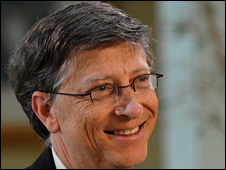 Now that Bill Gates has left the building at One Microsoft Way, Redmond, Seattle, what does the future hold for the firm?
Here are the five things that I feel Microsoft urgently needs to do if it hopes to remain as relevant over the next 20 years as it has in the last two decades.
1. Accept there is not One Microsoft Way
Microsoft's attitude to the open source community has veered from the cool to the hostile in the last two decades. For starters, it has claimed the community has violated many of its patents, without actually naming names or dealing in specifics.
The company's goal, according to some in the open source community, has been to crush Linux. And why not, you might argue. Surely every company wants to remove competitors from the landscape?
But Microsoft has abused its monopoly position too often and suffered the legal consequences too many times.
Microsoft's definition of open and interoperable has too often been less than clear, and in its pursuit of building platforms (Windows, Office, Xbox, IPTV, mobile etc) too often it has failed to offer the openness that consumers are crying out for.
But in the last few months the firm has pledged again its commitment to open standards in certain areas. The pledge must be open this time.
2. Get Live Mesh right
Famously late to the net, Microsoft is bending over backwards to embrace the future of the web. With Live Mesh Microsoft is promising a seamless integration between connected devices, and inviting developers to work on the project.
Microsoft has said Live Mesh will be an "open platform". Some developers have questioned just how open it will be. If Microsoft has any hope of competing with Google then it needs to make Live Mesh as open as possible.
3. Ditch Windows Mobile
According to one analyst Windows Mobile has already been overtaken by Apple's iPhone in terms of smartphone market share.
To be clear: In a single year Apple has, with just a single phone, achieved a greater market share than all of the OEMs offering phones with Windows Mobile installed. That has to be a slap in the face for Microsoft.
I just don't see the need for Microsoft to be in this market. Running Windows Mobile does not even give users of other Microsoft products, such as Office, any clear advantage over users of other operating systems.
The mobile market right now is a carve up between Linux, RIM (Blackberry) and Symbian. Apple has made modest inroads in the smartphone sector, and Google is lurking on the horizon with Android.
Down the road I can only see Linux, Android and Symbian dominating the global mobile market so if I were Steve Ballmer, I would walk away from Windows Mobile - today.
4. Make Xbox a true platform
The Xbox project has cost Microsoft billions of dollars in investment and start-up costs. More than half a decade in and Xbox is not exactly filling the coffers with profit at Microsoft.
Xbox was always a long-term bet: one plank in a strategy to get Microsoft into the living room and to extend its reach beyond the desktop.
It's been a qualified success - millions of Xboxes have been shifted but it is neither the market leader nor the solution to our digital living needs that Microsoft hoped for.
One solution might be to take Xbox and more crucially Xbox Live beyond the console.
Xbox is not just a brand, it is also a potential platform. Why not license the Xbox technology and have it embedded into other CE devices, such as set-top boxes or Blu-ray players, or allow other manufacturers to make their own Xbox consoles?
It's been a rumour that Microsoft will take this route for some time. I hope they do.
Games consoles are unlikely, in my view, to exist as stand-alone entities, or to be primarily games-playing machines, in the coming years. We all know they are becoming multimedia hubs, so why not let other devices absorb the Xbox, rather than having Microsoft trying on its own to turn the Xbox into a device for all seasons?
5. Ditch Vista and get Windows 7 out the door
Forget the sales numbers or install base: Vista has been a failure because for many people it is synonymous with mediocrity.
To many people it was late, expensive, overly complex and bloated; Vista neither delivered on its promise of "Wow" nor marked a genuine improvement on the existing operating system, XP.
No wonder then that Microsoft is already talking up Windows 7, the Vista successor. And if 7 is to succeed where Vista failed, it needs to be on time, cheap and slimline.
In an effort to work on a great range of PCs, Vista ended up being a painful compromise, and in some cases PC firms were guilty of encouraging users to install it on machines that just did not have the power to run it successfully.
Microsoft needs to draw a clear line in the sand for Windows 7 - those that will run the OS fully and without compromise and those that won't.
There needs to be one price and one version only of Windows 7. By all means offer a Server version for Enterprise. But no more Home, Business, Ultimate nonsense.
The BBC is not responsible for the content of external internet sites
This is dot.life - a blog about technology from BBC News.
Rory Cellan-Jones is the BBC's technology correspondent.
Maggie Shiels is the BBC's tech reporter based in Silicon Valley.
Archive
« January 2010
| Sun | Mon | Tue | Wed | Thu | Fri | Sat |
|---|---|---|---|---|---|---|
| 1 | 2 | |||||
| 3 | 4 | 5 | 6 | 7 | 8 | 9 |
| 10 | 11 | 12 | 13 | 14 | 15 | 16 |
| 17 | 18 | 19 | 20 | 21 | 22 | 23 |
| 24 | 25 | 26 | 27 | 28 |
Being Discussed Now
- Logging out... and straight back in(3)
- Gadgets of the Noughties(20)
- Plastic Logic's long journey to Vegas(21)
- Sexting teens(17)
- Wikipedia on the wane?(49)
- 'Cooling-off' for mobile phones? Not on the High Street(37)
- 2009 - the social year(36)
- Twitter, Iran and #uksnow(25)
- Broadband Britain - how far down the league?(55)
- Microsoft and Murdoch: Teaming up to bash Google?(34)
BBC Technology Headlines
- %28none%29
%28none%29 - %28none%29
%28none%29 - %28none%29
%28none%29
Visit the Technology index
Visit the BBC News website
Rory's TV/Radio reports
- Residents block Google car
Broadcast: 3 April 2009 - New adverts to tackle film piracy
Broadcast: 2 April 2009 - Call to scrap 'illegal databases'
Broadcast: 23 March 2009 - Female robot takes to the catwalk
Broadcast: 16 March 2009 - Super-charged battery breakthrough
Broadcast: 12 March 2009

- News Editors
- Sport Editors
- Journalism Labs
- BBC Internet Blog
- Radio 4 Blog
- Peston's Picks
- Nick Robinson's Newslog
- Stephanomics
- Mark Easton's UK
- Mark Mardell's America
- Nick Bryant's Australia
- Andrew Harding on Africa
- Gavin Hewitt's Europe
- Soutik Biswas' India
- dot.Rory
- Science: Jonathan Amos
- Richard Black on environment
- Today: Tom Feilden
- Fergus Walsh's medical files
- Newsnight: Paul Mason
- Newsnight: Mark Urban
- Torin Douglas
- Will Gompertz's arts
- Phil Coomes on photojournalism
- Magazine Monitor
- Mark D'Arcy in Westminster
- NI: Mark Devenport
- Scotland: Brian Taylor
- Scotland: Douglas Fraser
- Wales: Betsan Powys
- Martin Rosenbaum on FOI
- 5 Live Breakfast
- Newsnight
- PM programme (iPM)
- World Tonight: Robin Lustig
