Dialogue between religious and non-religious beliefs and attitudes
In this article, learn about how Jewish people view attitudes and teachings towards abortion and euthanasia.
Key points
- Judaism teaches human life is sacred because people are made in , the image of God, giving every person value, dignity and moral responsibility.
- The five books of Moses, known as the Hebrew Bible. teaches that God created the human life with purpose, and this means life is sacred. This affects attitudes to abortion and euthanasia.
- The Talmud teaches that a fetus is not yet a full person.
Dialogue between beliefs scripture
Jewish views on abortion
Video
Watch the video below to compare Buddhist, Jewish, and Christian attitudes towards abortion.
Buddhist presenter: How
Christian presenter: do different religions
Jewish presenter: view abortion?
Buddhist presenter: Hello, I'm Buddhist.
Christian presenter: I'm Christian,
Jewish presenter: and I'm Jewish.
Buddhist presenter: And we all believe that life, especially human life, is precious.
Christian presenter: Christians call this the sanctity of life,
Jewish presenter: which means it's holy and should always be protected. In Judaism, we call this pikuach nefesh, which means saving a soul.
Buddhist presenter: Abortion is legal in the UK.
Christian presenter: In specific circumstances which are set out in law.
Jewish presenter: But what do our religions say about it?
Buddhist presenter: Buddhism teaches that we live many lives in many bodies, but this life begins at conception, which is when a sperm fertilises an egg. The first of the Buddha's ‘five precepts’ says we should avoid taking life. So we try to live by the principle of ahimsa, which means ‘non-violence’ or ‘non-harming.’ And many Buddhists say this means abortion can't be allowed. However, some Buddhists believe that if a pregnancy is putting the life of a mother in danger, then an abortion is acceptable. This shows a Buddhist teaching called karuna, meaning compassion, which encourages us to reduce people’s suffering, if we can.
Christian presenter: In the Bible, the writer of Psalms 139 talks about God “seeing my unformed body in the womb.” So many Christians also believe that life begins at conception or soon after and should be protected. The Roman Catholic Church teaches that abortion is never allowed, no matter what the circumstances. Pope Paul VI wrote, all direct abortion are to be absolutely excluded, but in some cases, the Roman Catholic Church does support the principle of double effect. This is when, in order to do something good, something bad will also happen. For example, in the case of an ectopic pregnancy, when a fertilised egg grows outside the womb and puts the mother's life at risk, the church allows treatment to save the mother's life, even though it will result in the loss of the pregnancy. Protestant churches, like the Church of England, are also against abortion, but accept that there are reasons why it might be the best thing to do in some situations. It might be left to individual churches to give advice based on their own moral judgements.
Jewish presenter: An ancient collection of Jewish writings called the Talmud describes a foetus as ‘water’ for the first 40 days, and we take that to mean that it isn't a potential life until then. It isn't a life in its own right until birth. But we believe that a foetus is precious at all times because it's God's creation. So abortion should always be a last resort. Another book called the Mishnah says, “if a woman is having trouble giving birth, her life comes before the life of the child.” So if a mother's life is in danger, an abortion might be necessary to save her. But there are many other things to think about when deciding if abortion is an acceptable choice.
Buddhist presenter: Medical screening tests during pregnancy might show problems in the development of the foetus.
Christian presenter: The child might be born into extreme poverty or dangerous circumstances.
Jewish presenter: So religious believers might need to think about things that would affect quality of life.
Buddhist presenter: The Dalai Lama, the leader of Tibetan Buddhism, said “I think abortion should be approved or disapproved, according to each circumstance.” This shows another Buddhist teaching called Metta, which means loving kindness, and we believe that an aborted embryos, Vijñāna, their consciousness, will pass on to another life.
Christian presenter: Many Protestant Christians, including the Baptist, Methodist and United Reformed Church would agree that abortion is always a difficult choice to make, but it might be the best course of action in certain circumstances. There aren't always simple answers.
Jewish presenter: Some Jews would also say that an abortion should be allowed if the mother's physical or mental health might seriously suffer, or if the baby is likely to be born with a serious health problem. But each situation needs to be judged very carefully.
So all of our religions believe in the sanctity of human life.
Christian presenter: The Roman Catholic Church opposes abortion, but many Protestant Christians, including the Church of England, would say there are situations when it might be understandable.
Jewish presenter: Which is also the teaching in Judaism. Every case is different.
Buddhist presenter: And all of our religions teach us that every decision must be made with compassion.
An abortion is a way of ending a pregnancy, and in the UK it is legal under specific circumstances which are set out in law.
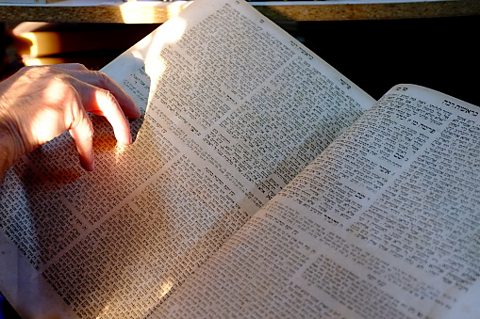
A central Jewish text that is the source of civil and ceremonial Jewish Law. teaches that a fetus is not yet considered a full person before birth. It has potential for life, but its status is different from that of the mother, so Judaism does not forbid abortion.
The principle of means that protecting the mother's life takes priority. If the mother's life is in danger, abortion is therefore permitted.
“As long as it has not come out into the world, it is not called a living being, and it is permissible to take its life to save its mother.”
Rashi on Mishnah Ohalot 7:6
Judaism also recognises the concept of quality of life alongside the value and sanctity of life. Whilst life is sacred, some Jewish people believe that when making difficult ethical decisions about abortion, the quality of a person's life - including their suffering, health, and wellbeing should be considered.
Exam-style question
Explain two Jewish beliefs about sanctity of life.
Refer to sacred writings or another source of Jewish belief and teaching in your answer.
One Jewish belief about sanctity of life is that human life is holy because it is created by God. In Genesis 1:27, humans are described as being made “in the image of God”, which means every person has special value and dignity.
Another Jewish belief is that life should be protected because taking innocent life is against God’s law. The commandment “You shall not murder” (Exodus 20:13) shows that life is sacred and should not be ended deliberately.
Jewish views on euthanasia

Euthanasia is the act of deliberately ending a person's life to relieve suffering. Euthanasia or assisted dying is currently illegal in the UK (March 2026).
Judaism teaches that human life is sacred because it is created by God. As a result, most Jewish people believe that deliberately ending a human life is wrong.
“You shall not murder.”
Exodus 20:13
Because of this, active euthanasia, directly causing death, such as giving a lethal injection, is generally forbidden in Judaism. Life is seen as belonging to God, so only God should decide when it ends.
However, may be seen as permissible in Judaism. Judaism distinguishes between prolonging life and prolonging dying. Some Jewish scholars teach that whilst it is forbidden to speed up death, there is no obligation to prolong the dying process through artificial means if the person is suffering greatly.
This view is supported by a Talmudic story in Ketubot 104a, where obstacles to a dying rabbi’s death were removed so he could die peacefully. This is often understood to mean that removing barriers to death is different from actively causing death.
Judaism also teaches the duty of , which includes comforting the dying and supporting their family. For this reason, palliative care is widely accepted in Judaism, as it respects the sanctity of life while showing compassion at the end of life.
More on Judaism
Find out more by working through a topic