What is a relative clause?
Relative clauses are parts of sentences that can be added after nouns to give the reader more information.
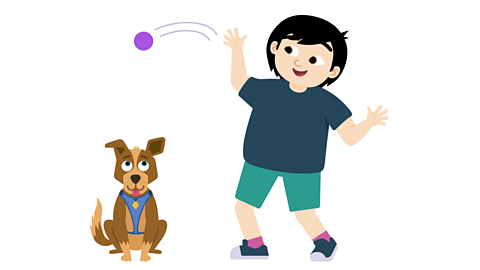
I have a dog that loves chasing balls.
In this sentence, the noun is ‘dog’ and the relative clause is ‘that loves chasing balls’.
They’re called ‘relative’ because they relate back to the noun in the sentence.
Relative clauses usually begin with a relative pronoun - words like 'who', 'which', or 'that'.
I took my dog for a walk, which he enjoyed very much.
Relative clauses allow you to include additional information within the same sentence.
They can make writing more concise and help vary sentence structure to keep your writing interesting.
How to use a relative clause
Discover relative clauses in this vlog about a city designed just for animals!
When to use relative clauses
Relative clauses are parts of sentences that can be added after nouns to give more information.

They usually begin with relative pronouns such as 'who', 'that', 'which', 'where' and 'when'.
They heat the city’s water up later in the year, when it is colder.
Relative clauses can go in the middle of sentences or at the end, as long as they sit next to the noun they describe.
The city, which is a magical place, is filled with talking animals.
They are usually separated from the rest of the sentence by commas, brackets or dashes.
The owls (who are the wisest animals in all the land) work as doctors and teachers.
Remember, a relative clause is not a complete sentence on its own. It must be attached to a noun and a main clause.
Example 1
Add your own relative clause to the sentence below to give more information about the noun.
Vlogger Kelly, who , enjoys spending her time exploring new places.
✓ Here is one correct example but your sentence might look very different.
Vlogger Kelly, who is an experienced traveller, enjoys spending her time exploring new places.
In this example, 'who' is the relative pronoun at the start of the relative clause.

Example 2
Sometimes, you can leave out the relative pronoun at the beginning of a relative clause, as long as the sentence still makes sense.
What is the relative clause in the sentence below?
The village Vlogger Kelly – an expert in animal habitats – also visited was purely for insects.
✓ Here is the relative clause.
The village Vlogger Kelly – an expert in animal habitats – also visited was purely for insects.
The relative pronoun has been left out, but all the information needed is still in the relative clause.
If included, the relative pronoun would have been ‘who’, but sometimes your writing can read better without it.
The village that Vlogger Kelly – an expert in animal habitats – also visited was purely for insects.
Task

Relative clause relay
With your friends or siblings (or even a parent or carer, if you think they’re up to it!), try adding lots of relative clauses to the same simple sentence, taking turns to add your own.
The catch is you can only use each relative pronoun once, and every new clause must make grammatical sense.
For example, the simple sentence might be ‘I have a dog’ and the relay may look like this:
Player 1: ‘I have a dog which is very playful.’
Player 2: ‘I have a dog, which is very playful, who is called Larry.’
You wouldn’t normally write like this, but just for fun, how long do you think you could make a sentence before you run out of relative pronouns?
500 Words
The UK's biggest children's story-writing competition for 5-11 year-olds is open for entries!
More on Grammar
Find out more by working through a topic
- count13 of 17
- count14 of 17
- count15 of 17
- count16 of 17