How have women’s rights advanced?
There have been many protests for women's rights during the 20th century. These include protests:
- for the right to vote
- for rights in the world of work
- opposing violence against women
- for the right to receive an education
- for the right to own a home
The First World War
The home front
The First World War was a turning point in the campaign for women’s rights and contributed to significant changes in women’s employment and political rights in Britain.
Many men were away fighting during the First World War, and women played an important role in filling vacancies on the home front. Some women were already working in traditional jobs in 1914, but the war created new opportunities in a wide range of industries. Many women took jobs in munitions factories where things such as bullets, shells and other military equipment were produced. These factories could be noisy and dangerous places to work. Accidents and explosions happened in some factories, and exposure to An explosive used in bombs. that was put in bombs could cause workers' skin to turn yellow. By the end of the war in 1918, almost a million women worked in munition factories.
As more women went to work, childcare became an important issue, and nurseries were established in some areas to support working mothers. Women did all kinds of work during the war, including in the police, on buses and on trains.
On the front
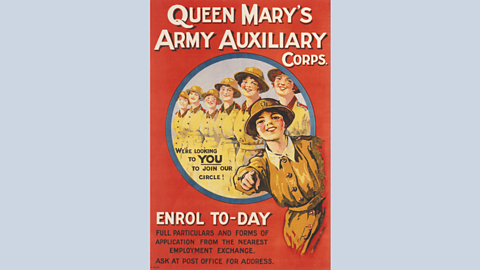
A number of women wanted to take part in the war effort. Therefore, the Women’s Army Auxiliary Corps (WAAC), was established in December 1917. It became Queen Mary's Army Auxiliary Corps in 1918. Its purpose was to recruit women for non-combat roles in the army, such as office workers. Following this, the Women’s Royal Naval Service was created in November 1917 and the Women’s Royal Air Force in April 1918. Although women were not serving in combat roles, they carried out a range of support duties that were vital to the war effort.
Social changes following the war
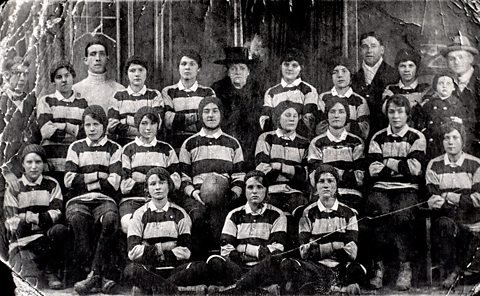
For many women, their time working in factories and on the front ended, as they returned to their roles as housewives and mothers. The war had a social effect as women’s football and rugby teams were established because they had enjoyed the social side of work during the war.
On 15 December 1917, Cardiff women’s rugby team faced Newport at the Arms Park. However, many of the teams were wound up during the 1920s, and women’s football teams were banned from using football league grounds in 1921.
Women in politics
The suffragettes
The Women’s Social and Political Union (WSPU) was founded by Emmeline Pankhurst in Manchester in 1903. Her daughter, Christabel Pankhurst, was one of its leading figures and played an important role in shaping the organisation's campaign. The WSPU played an important role in the campaign for women's suffrage, the right for women to vote in public elections in Britain. The term ‘suffragette’ comes from the word ‘suffrage’, meaning the right to vote.
Their protest methods included:
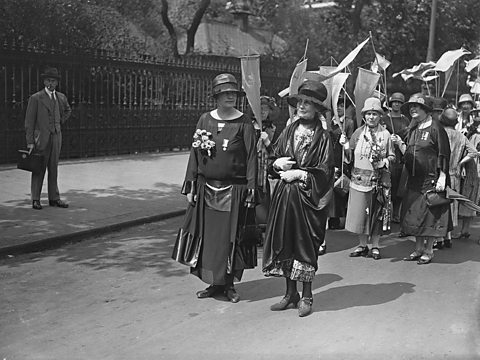
- marches and demonstrations
- protests outside the Westminster Parliament in London
- damage to property including some works of art
- chaining or attatching themselves to railings and government buildings
One demonstration in Hyde Park in London, attracted around 300,000 people in 1908. At the start of the First World War, around 1,000 suffragettes were in prison. Many went on hunger strike in protest against their treatment. Some were force-fed, while others were temporarily released from prison to recover before being re-arrested.
Emmeline and Christabel Pankhurst decided to support Britain's war effort and suspended WSPU campaigning from 1914 to 1918. However, one family member, Sylvia Pankhurst, was opposed to this and continued her political campaigning independently of WSPU.
One Welsh member of the suffragettes’ campaign was Margaret Haig Thomas, who later became Lady Rhondda. In 1913, she was imprisoned for setting fire to a post box in Newport as part of a suffragette protest campaign.
On 6 February 1918, the Representation of the People Act 1918 gave some women the right to vote. Women aged 30 and over could vote if they owned a house or were married to a man who did. Around 8.4 million women were eligible to vote in the 1918 general election. Equal voting rights with men were not achieved until 1928, when all women over the age of 21 were given the right to vote.
Political changes
Women were elected as Members of Parliament for the first time. Constance Markievicz was elected to Parliament in the 1918 general election, becoming the first woman elected to the House of Commons, although she did not take her seat. Nancy Astor became the first woman to take her seat in the House of Commons when she was elected in 1919. In Wales, the first female Member of Parliament was Megan Lloyd George who was elected for Anglesey in 1929.
Margaret Thatcher became Britain's first female Prime Minister in 1979. More women have entered Parliament over time, and following the 2019 general election, 220 Members of Parliament were women, a record high at the time.
Women’s role in protests
Greenham Common
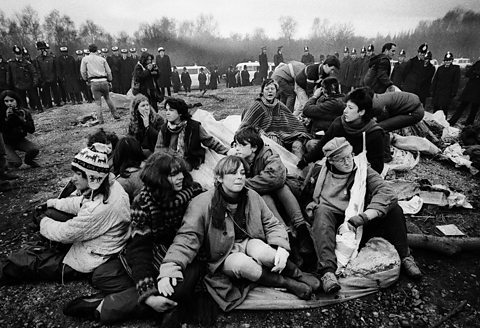
A Welsh group, Women For Life on Earth, held a protest outside the British air force established during the First World War. Greenham Common base in September 1981 against the decision to station American nuclear An object which is thrown at a target, with the intent of causing damage or an injury. at the base. A group of women set up a peace camp and stayed at the gates of the base as part of the protest. In April 1983, around 70,000 women joined hands to form a human chain, showing their opposition to nuclear weapons. The protesters faced strong opposition from the police and some local people.
Helen Thomas, a 22-year-old woman from Newcastle Emlyn, was struck by a police vehicle while trying to cross the road near the camp and later died from her injuries. A memorial to Helen stands at Greenham Common, and Dafydd Iwan composed Cân i Helen in her memory. The protest inspired similar women's peace camps and anti-nuclear demonstrations elsewhere in Europe. The military base closed in 1992 and the last permanent protesters left the site in 2000.
The Miners’ Strike
Between 1984 and 1985, many British coal miners went on strike in opposition to plans to close coal mines. Women played an important role in supporting families and communities during the strike. Because many striking men received no pay during the dispute, women helped provide practical support for their families and local communities. Women set up food kitchens, fundraisers and parcel collections to support families. Many women also took an active role in the strike itself, joining The line where strikers stand to prevent other workers from getting to work., and taking part in marches and demonstrations in support of the miners.
Quiz - Women's rights
More on Change and movement
Find out more by working through a topic
- count2 of 3
- count3 of 3