Form
About a Boy is written in the form of a novel, which is a fictional Narrative is another word for story.Ordinary language both spoken or written; different from poetry (which does not reflect everyday speech patterns). account:
- fictional – something imagined or untrue
- prose – writing that is not in verse
- narrative – a written account of something
Generally, a novel will be built around characters and action, and will be recognisable in its A literary movement and style that aims to present life as it really is, focusing on ordinary people, everyday settings and plausible events. – that is, showing things as they really are.
Novels can be separated into many different categories, or A category or type of something, for example 'fiction' and 'non-fiction' are two examples of different genres of books. Fictional books can be divided into many genres - for example mystery, comedy, fantasy or horror., such as romance, war, revenge, crime, thriller, fantasy and so on. About A Boy is a A 'coming of age' story, describing a character’s emotional growth as they move from childhood to adulthood., or a coming-of-age story, which focuses on the psychological and moral growth of the main characters from youth to adulthood.
A Check your connection, refresh the page and try again. tells of the growing up of a character who learns from his life experiences. The desired outcome of a bildungsroman is that the character reaches maturity and is accepted by society.
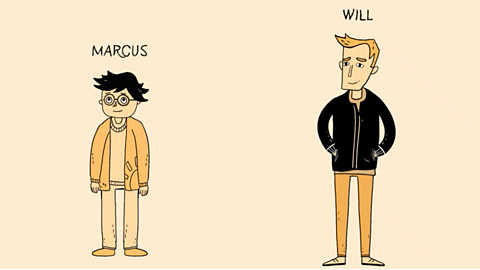
About A Boy is a coming-of-age novel because the two main characters, Will and Marcus, both achieve an appropriate level of maturity and are accepted by society. Hornby subverts the genre by not only looking at the coming-of-age of Will, a 36-year-old who behaves more like a child at the start of the book, and who has to learn how to be an adult, but also of Marcus, who is 12 years old in the novel but behaves more like an adult at the start of the book, and who has to learn how to be a child. Marcus’ mother, Fiona, also has to learn to deal with her depression and understand that it is something that will not go away. She needs to manage it in order to be a proper mother to Marcus.
How to analyse form in About a Boy
- Remember that it is a coming-of-age novel and therefore tracks the psychological and moral growth of the main characters until they are accepted by society.
- Understand that Will is an adult who is afraid of commitment and who has never really grown up. He needs to allow himself to become emotionally involved with other people, and take responsibility for himself and others until he finds maturity.
- Understand that Marcus is a child who has too much responsibility at the start of the novel. With the help and support of other people he gradually learns to feel that he does not need to be in control of everything. He eventually becomes a normal boy of his age.
Structure
The The way the poet has organised the poem on the page eg number of stanzas, lines per stanza, breaks in between lines and stanzas. of a text means the way that the writer has chosen to put it together. Some texts follow a Chronological means following the time order in which events happened. Stories told chronologically start with the earliest event and end with the last. structure, relating events in the same order that they took place. These texts will start at the beginning, then move through the events towards the ending. About a Boy is narrated chronologically, so events are seen from the beginning to the ending.
About a Boy consists of 36 chapters, alternately seen from either Marcus’ point of view (chapters one, three, five, seven etc.) or Will’s point of view (chapters two, four, six, eight etc.). The two characters have nothing to do with each other at first, but they meet in chapter eight and from that point onwards their paths gradually converge, reflecting the way that they are helping each other to live normal lives among a varied group of people.
How to analyse structure in About a Boy
- Remember that events are narrated chronologically
- Remember that events in all the odd-numbered chapters are seen from Marcus’ point of view
- Remember that events in all the even-numbered chapters are seen from Will’s point of view
Literary devices and narrative techniques
Nick Hornby uses a range of literary devices (or language techniques) in About a Boy. The narration itself is from a limited A third person narrator is not a character in the story. They see the events from the outside and tell the story using third person pronouns, like 'him', 'her' and 'they'. perspective, so the narrator tells us what Will and Marcus see, think and feel.
The narrator does not know what other characters are thinking, and Hornby uses the A technique used in literature to help make a point or show an idea of Fiona’s suicide note to allow the reader an insight into her thought processes. The dual narration is also useful in that the reader is able to form a more balanced opinion of events as they happen because they are seen from the two different perspectives. For example, in Chapter 13 when Will takes Marcus and Fiona out for the day, Marcus is proud of the way his mother looks, in her “best leggings and a baggy, hairy jumper”, while in Chapter 14 Will thinks that she should have “made more of an effort… why didn’t she wear clothes which looked like they mattered to her?” It is left to the reader to formulate an opinion on Fiona.
The different techniques used in About a Boy can be categorised as follows:
- A quick reference - often to an image, character or place - from a work of literature or music or mythology. to contemporary references
- allusions to literary references
- A metaphor is a word or a phrase used for dramatic effect, to describe something as if it were something else.
- A simile is a word or phrase used to make a comparison for dramatic effect, using 'like' or 'as'.
- humour
- Presenting an idea in a way that is interesting or strange because of being very different from what you would expect.
When analysing the use of language in About a Boy, you should concentrate on what is written, how it is written and the effect this has on the reader.
Allusion
Allusions to contemporary references
| What is written | How it is written | Effect on the reader |
|---|---|---|
| “She was beautiful in a very winning, wholesome, Julie Christie-type way.” | This quote is showing that Will is a man who grew up in the 1960s. Julie Christie played the part of Lara in the film Doctor Zhivago (1965). It was a worldwide hit. | If Will really was as cool as he thinks, he would not have compared Angie with Julie Christie, but with somebody famous in the 1990s. The reader is able to see that although Will tries desperately hard to be trendy, he is really an ordinary 36 year-old who wants to be thought of as younger. |
| “She had pointy features and red cheeks; she looked like Worzel Gummidge’s friend Aunt Sally.” | Worzel Gummidge was shown on British television from 1979 to 1981, which means that Will would have watched it when he was in his early 20s. | The fact that Will was watching children’s TV when he was already an adult emphasises the fact that he is very immature at the start of the novel. |
| “It was so obvious that Will would rather talk about the fat bloke on Countdown than about what had happened before that for a moment Marcus felt a little stab of temper because he didn’t have the same kind of choice.” | Will watches Countdown every day, showing that he has no other commitments such as work or a family. | The reader can see that Marcus is very worried about his mother and Will only asks Marcus how she is as an afterthought. This is another sign of his reluctance to involve himself in other people’s problems. |
| “There’s always a new Nirvana album to look forward to, or something happening in NYPD Blue to make you want to watch the next episode.” | Rachel says this to Will in a bid to make him realise how solitary his life is. | The reader is able to see exactly what Rachel is doing here. She does not criticise Will directly, but her words manage to force him to look at this life critically and understand that he has no interaction with others. |
Allusions to literary references
| What is written | How it is written | Effect on the reader |
|---|---|---|
| “Once, years ago, when he was a kid, he told a school friend (having first ascertained that this friend was not a C. S. Lewis fan) that it was possible to walk through the back of his wardrobe into a different world.” | This is a reference to the Narnia books by C. S. Lewis, written in the 1950s, in which a family of children enter a magical world of witches and kings and queens and talking animals by walking through the back of a wardrobe. Will would have read these as a child in the 1960s. | The reader can immediately see the connection between the children in the stories and Will. Once the children become too old in the real world, they are unable to enter Narnia. Will is the opposite of the Pevensie children in that he refuses to grow up, whilst they were sad, but accepted the fact that they had become adults. |
Metaphor
| What is written | How it is written | Effect on the reader |
|---|---|---|
| “Until he’d played the Marcus card he’d kept slipping off before he’d even started. Now he felt as though he were climbing a mountain, rather than a glacier. He imagined himself right at the bottom of the cliff-face, looking up and around for footholds.” | Will realises that he is in love with Rachel at a New Year’s Eve party. He wants to impress her and lets her think that he is a single father with a son called Marcus. | The reader can see that Will desperately wants to impress Rachel so he congratulates himself for not actually lying to her. He thinks that before he mentioned Marcus, Rachel was not interested in him. However, the comparison with climbing up a mountain emphasises how tricky Will’s situation is, even though it has improved because Rachel thinks he is a brave single parent. Before she heard about Marcus, he felt that he was trying to climb a glacier, made of pure ice. The reader knows that Will still has a hard climb ahead of him to make Rachel see him as a responsible adult. |
| “…and other days, like Christmas day or today, they seemed to be a long way away, in the middle lane of a motorway and cruising. On the Dead Duck Day it had been way too close, two wheels over the edge and lots of terrible skidding noises.” | Marcus compares his feelings about living with his mother after her suicide attempt with driving on a motorway. | Most readers will have experienced driving on a busy motorway. Although all the cars are moving smoothly in the same direction, it only takes one mistake to turn the whole thing into a dreadful disaster. The comparison emphasises how precarious Marcus feels his and his mother’s security is. |
Simile
| What is written | How it is written | Effect on the reader |
|---|---|---|
| “Ever since the Dead Duck Day he had imagined his mother’s suicide to be something like the edge of a cliff: sometimes, on days when she seemed sad or distracted, he felt as though they were a little too close for comfort…” | Marcus compares the way he feels with being on the edge of a cliff. | Standing on the edge of a steep cliff can obviously be very dangerous. It only needs one strong gust of wind or a stumble to propel the person over the top, and to fall to his death. The reader understands the way that Marcus feels so insecure after Fiona’s attempt at killing herself. |
Humour
| What is written | How it is written | Effect on the reader |
|---|---|---|
| “‘Why don’t you just go home, Marcus?’ ‘All right. But I’m going to tell my mum.’ ‘Ooooh. I’m scared.’” | Marcus has found out that Will does not have an ex-wife or a son. He threatens to tell his mother so that Will will not be able to go to any more SPAT meetings. | The interchange between Marcus and Will is exactly what you would expect to hear between two small children. The reader enjoys the use of humour here, as it makes Will seem very immature. |
| “…or, more crucially, the name of his own child – for some reason he couldn’t stop thinking of him as Ted, and he had only christened him Ned this morning…” | Will is worrying that he will make a mistake about his invented child when he is at the SPAT meeting. | This is very funny, because Will is proving the point that people who tell lies just create more problems for themselves. Nobody else knows about the invented child, but Will is already having problems with him! |
| “‘This looks more like pet and owner rather than boyfriend and girlfriend.’ ‘That’s OK’, said Marcus cheerfully. ‘You don’t mind being treated like a …like a gerbil?’ ‘No. Course not.’” | Marcus has just told Will how much he adores Ellie, but Will can see that it is a rather uneven relationship. | Comparing Marcus with a pet gerbil is very entertaining, because they are small, furry, cute little animals. Marcus is small with fuzzy hair and glasses, and Ellie finds him cute. The reader can see how funny it is when Marcus just accepts the comparison – all he wants is to be near Ellie. |
Irony
| What is written | How it is written | Effect on the reader |
|---|---|---|
| “You might as well stay for Neighbours now,” Will said. | Marcus has just called round to Will’s flat and so Will invited him to stay for a while. | The reader can see how ironic it is that Will obsessively watches Neighbours, a programme all about people who interact with others all the time and are involved with one another’s problems. In real life, Will would be horrified if he had to be as involved as the people he watches on screen. |
Test yourself
Further study
Bookclub. podcast
James Naughtie and a studio audience meet novelist Nick Hornby to discuss About a Boy – his insight into laddishness, masculine wish-fulfilment, fear and love.

Listed Londoner. audio
Nick Hornby was born in 1957, in Surrey. His dad, Sir Derek Hornby, was the chairman of London and Continental Railways. Before becoming a novelist, he worked as a secondary school English teacher.
World Book Club. podcast
Nick Hornby talks to an audience about his book Fever Pitch – about being an Arsenal football fan. Presented by Harriett Gilbert.

More on About A Boy
Find out more by working through a topic
- count5 of 5
- count1 of 5
- count2 of 5
- count3 of 5