Climate change and the greenhouse effect
Evidence suggests that climate change has been happening for over 3 million years and that the Earth has undergone dramatic changes to its climate - varying from the ice ages to periods of considerable warming.
Since the 1850s and the A period of time during the 18th and 19th century where the UK shifted to becoming a much more industrial country relying more on machinery and the use of coal and oil. the global average temperature has been rising. Many believe that this is down to human activity and the ever increasing use of technology and the burning of fossil fuels to produce energy.
Climate change is driven by a process known as the greenhouse effect. This is where heat is trapped within our atmosphere by naturally occurring gases known as Gases that absorb radiation and contribute to the greenhouse effect, these consist of water vapor, carbon dioxide, methane and nitrous oxide.. Without the greenhouse effect this heat would not be trapped and the Earth’s temperature would drop to -50°C.
However, human activity has now led to what is known as the enhanced greenhouse effect. By burning more fossil fuels and by clearing more land for uses such as agriculture, we are continuing to add more and more of these greenhouse gases to the atmosphere.
As a result more heat is being trapped and the Earth is warming. According to the An intergovernmental body of the United Nations that assesses the science related to climate change. (Intergovernmental Panel on Climate Change), since 1970 the global average temperature has been rising at a rate of 1.7°C per century. This change alone can have drastic impacts on vulnerable communities around the world.
Natural causes of climate change

Image caption, Orbital changes - the Earth's natural warming and cooling periods caused by Milankovitch cycles or variations in the tilt and/or orbit of the Earth around the Sun (Wobble, roll and stretch theory).


1 of 3
Human causes of climate change

Image caption, Burning fossil fuels, eg coal, gas and oil - these release carbon dioxide into the atmosphere.


1 of 4
Impacts of climate change
We are already beginning to see the impact climate change is having globally, with an increase in droughts, storms, rising sea levels and warming oceans. These events threaten communities and habitats endangering those that live there.
Maldives
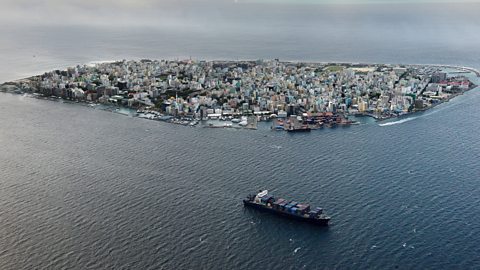
One example where climate change is having an impact is the Maldives. This country is made up of chains of islands or A ring-shaped island formed by coral. (250 of which are inhabited) located in the Indian Ocean.
The islands and atolls are all small, flat and densely populated with the highest point being 2.4m above sea level. With the increase in ocean temperatures the Maldives are increasingly threatened by violent storms.
Climate change also threatens the existence of the Maldives with sea levels projected to rise between 10 to 100 centimetres by the year 2100. Malé, the capital, is especially threatened because it is located on a small, flat, extremely densely populated atoll that is surrounded by sea walls, and other barriers to protect against storms. This means that Malé cannot change shape in response to the rising sea levels and is therefore reliant on expensive engineering solutions.
Wales
The impact of a changing climate is also being felt in Wales. Due to rising temperatures, habitats are impacted by more frequent heatwaves and higher rainfall due to storms. In turn, these are affecting the local plants and wildlife.
Rising sea levels, combined with more intense and frequent storms are increasing the risk of flooding and damage in coastal towns such as Aberystwyth.
Farmers also face challenges too. More rain, warmer temperatures and fiercer storms would make it more difficult to manage crops effectively and make a living.
More on Change and movement
Find out more by working through a topic
- count1 of 3

- count2 of 3