What are hyphens and dashes?
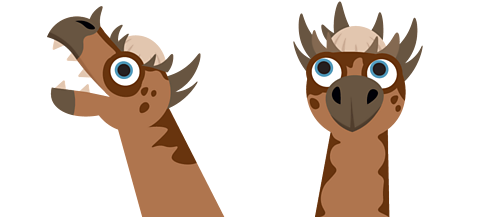
A hyphen (-) joins words together to make their meaning clear.
It’s often used to create compound words or show that two or more words belong together before a noun:
A sharp-toothed predator.
A dash (–) is longer than a hyphen and is used to connect ideas in a sentence.
Dashes can replace commas, brackets, or colons to add extra information or create a dramatic effect:
The dinosaur turned slowly – something wasn’t right.
A pair of dashes can also be used to show parenthesis – extra information that could be lifted out and the sentence would still make sense.
Some dinosaurs were herbivores – despite their fearsome appearance – and only ate plants.
How to use hyphens and dashes
Learn how to use hyphens and dashes as you discover more about the Stygimoloch dinosaur, then put your knowledge to the test in the quiz!
What's the difference between hyphens and dashes?
Hyphens (-) join words to make compound words that help with clear descriptions, especially before nouns.
Dashes (–) are slightly longer than hyphens and are used to separate ideas, add extra information, create pauses for effect, or show parentheses.

Using both hyphens and dashes correctly helps writing stay clear, precise and engaging.
A dome-headed dinosaur – or two – would make an interesting pet!
Example 1
Why is 'plant-eating' hyphenated in the sentence below?
Stygimoloch was a plant-eating dinosaur that lived in North America.
a) To show that the dinosaur is eating a plant right now.
b) To join the words 'plant' and 'eating' into one description.
✓ b) To join the words 'plant' and 'eating' into one description.
The hyphen connects the words 'plant' and 'eating'.
This forms a single adjective describing the dinosaur.
Without the hyphen, the sentence could be confusing – it might even sound like a plant that eats dinosaurs!
Example 2
Which of these sentences uses a dash correctly?
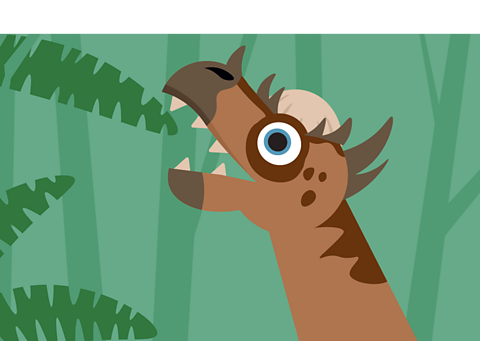
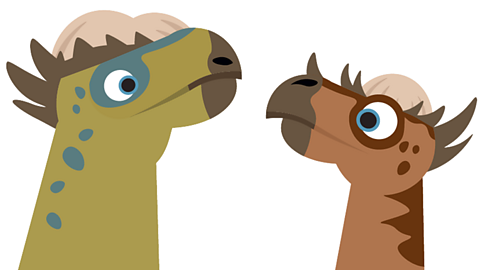
a) Many scientists believe that Stygimoloch – a dinosaur with a thick, spiky skull – may have been a juvenile Pachycephalosaurus.
b) Many scientists believe – that the dinosaur Stygimoloch was a juvenile Pachycephalosaurus.
✓ a) Many scientists believe that Stygimoloch – a dinosaur with a thick, spiky skull – may have been a juvenile Pachycephalosaurus.
a) is correct because the dash is used to insert extra information about Stygimoloch, without breaking the main sentence.
The sentence still makes sense if you remove the part between the dashes:
Many scientists believe that Stygimoloch may have been a juvenile Pachycephalosaurus.
Task
Dinosaur detective!
Create a mini-fact file about a dinosaur.
It can be real – like Stygimoloch – or made-up.
- Use at least two hyphenated adjectives to describe your dinosaur.
- Include at least one dash to add extra information or explain something in more detail.
500 Words
The UK's biggest children's story-writing competition for 5-11 year-olds is open for entries!
More on Writing
Find out more by working through a topic
- count29 of 94

- count30 of 94
- count31 of 94

- count32 of 94