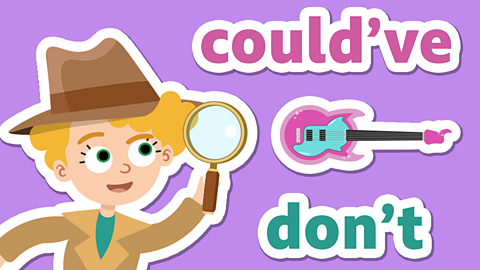
What are inverted commas?

Inverted commas are used to show direct speech. They are also known as speech marks.
They are placed before and after the exact words a character says.
“Shall we go to Grandpa’s house?” asked Sally.
Punctuation, such as commas, full stops, question marks or exclamation marks, always go inside the inverted commas.
“Yes, let’s!” replied Omi.
If the speaker is named before the direct speech, a comma is added after the speaker’s name and immediately before the first inverted comma.
Sally said, “I can’t wait to hear all his stories.”
How to use inverted commas
Discover how to punctuate speech in this story about two friends trying to find out if the Loch Ness Monster really exists.
What are the rules for punctuating speech?
When writing speech, it is important to punctuate it correctly so the reader knows who is saying what.
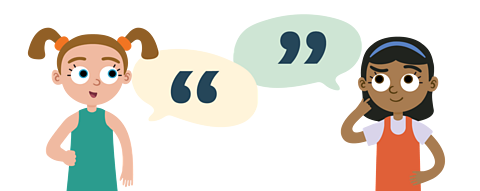
Direct speech is when the speaker's exact words are written inside inverted commas. They are sometimes called speech marks.
The speech always starts with a capital letter and ends with a piece of punctuation inside the inverted commas.
“We should ask Grandpa what he saw,” said Sally.
When a new person speaks, their speech goes on a new line. This helps the reader follow the conversation clearly.
If the speaker is named before the direct speech, use a comma before the first inverted comma.
Grandpa replied quietly, “Something moving in the distance.”
If the speaker is named after the direct speech, use a comma before the final inverted comma, because the sentence is not yet complete.
“I need to know more,” said Sally.
Question marks and exclamation marks also stay inside the inverted commas if they are part of what the character says.
“What did you see?” asked Sally.
Example 1
Add the correct punctuation to these lines of direct speech below.
a) The creature looked gentle, like it wanted to be my friend said Grandpa
b) Did you feel afraid asked Sally
✓ Here are the correctly punctuated sentences:
a) "The creature looked gentle, like it wanted to be my friend," said Grandpa.
b) "Did you feel afraid?" asked Sally.
Remember to:
Put inverted commas at the beginning and end of the words being spoken
Keep the punctuation inside the inverted commas.

Example 2
Sometimes the speaker is named before the speech.
Add the correct punctuation to these sentences:
a) Sally said “Let’s go to see Grandpa.”
b) Omi asked “Could you see clearly?”
✓ Here are the correctly punctuated sentences:
a) Sally said, “Let’s go to see Grandpa.”
b) Omi asked, “Could you see clearly?”
A comma is needed between the speaker and the first inverted comma.

Task

Local legend
The story of the famous Loch Ness Monster has been passed down through generations in conversations.
Think about where you live and whether there are any local stories or legends.
For example, the story of Robin Hood in Nottingham.
Imagine having a conversation with an expert about the local legend. Think about the questions you would ask and how they might respond, then write it down.
Remember to write your conversation using inverted commas.
500 Words
The UK's biggest children's story-writing competition for 5-11 year-olds is open for entries!
More on Punctuation
Find out more by working through a topic
- count1 of 3
- count2 of 3