Overview
- Death in a Nut is a story which has existed for centuries in the oral storytelling tradition of Travelling people in Scotland.
- This version is by Duncan Williamson, himself a Scottish Traveller, and is written down to preserve this tale from his ancestral heritage.
- An An ordinary and relatable character, usually the protagonist, whose experiences allow the audience to identify with them. character, Jack, tries to prevent Death from coming to his home and taking away his mother, who is unwell.
- Jack beats Death until he is tiny and traps him inside a nutshell which he has found. Jack throws the nut, containing Death, into the sea.
- Jack’s mother recovers, but, without Death, life becomes impossible: they cannot provide food for themselves.
- Jack searches for some time and eventually finds the nut and releases Death.
- Death is forgiving and spares Jack's mother, only coming to claim her when she is more than 100 years old.
- Despite this, Jack is happy as he has learned the lesson that Death wanted him to learn.
The story has themes of:
- time and mortality
- balance and the natural order of things
- loss and grief
- love, protection and sacrifice
Looking for some quick revision? Try an interactive quiz for National 5 English.
Context
Why does ‘Jack’ appear as a hero in folklore and other stories?
Since around the 15th Century, the name Jack has appeared regularly in folklore and stories.
Jack was originally a common nickname for John, and came to represent a relatable An ordinary and relatable character, usually the protagonist, whose experiences allow the audience to identify with them. character in stories such as Jack and the Beanstalk, and Jack the Giant Killer.
Jack tales celebrate the resourcefulness and heroism of ordinary people. Despite his humble background, Jack shows bravery, cleverness and resilience and is able to outsmart powerful figures like kings or giants, or even Death.
What is the plot of Death In A Nut?
Jack and his mother live a simple but happy life on a croft by the sea.
One winter, Jack’s mother falls ill. She tells Jack that Death will be coming for her soon, that she has left some savings for him, that he should marry and he will get on fine without her. Jack disagrees and is upset at the prospect of being left alone.
One morning, Jack sees an old man carrying a scythe walking along the shore. Realising this is Death, Jack tells confronts him, saying he cannot take his mother.
Death tries to persuade Jack that it is only natural and that his mother’s pain would be over if she died. Jack reacts violently, smashing Death’s scythe and beating him so that he shrinks.
When Death shrinks so small that Jack can hold him in his hand, he pushes him inside a hazelnut shell that he had found on the beach, and plugs the hole in the shell with a small stick. He throws the nut, and Death, out to sea.
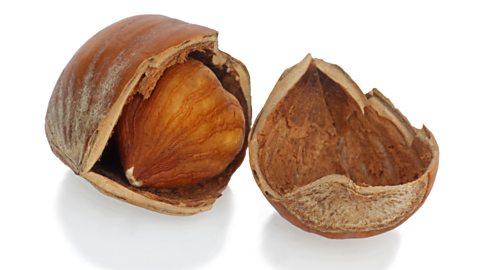 Image source, Getty Images
When Jack arrives home, his mother is up and clearly feeling better now that Death has been averted. But when they try to make breakfast, butter won’t melt in the pan, and eggs won’t crack open. They are also unable to cut or cook vegetables or kill a chicken to eat. People face similar problems in the local village.
Jack admits to his mother what he had done, but tells her that he doesn’t regret it. With her superior wisdom, mother tells Jack that death is the only thing that keeps the world alive. She tells him he will have to let Death free or the whole world will grind to a halt.
After some thought, Jack agrees.
After walking for days and searching for miles on end, Jack sits down, exhausted, realising what damage he has done. All of a sudden, the nut appears before him. Delighted, Jack unblocks the hole and Death springs free, full-sized once again.
Death is grateful that Jack released him. Even though Jack leads Death right to his home, Death does not take his mother; instead, Death leaves to get other people in the village. He says he will return for Jack’s mother, but not for a while, since Jack had been good to him.
Jack’s mother lives until she is about 100 years old. Jack has learned his lesson and knows that Death is an essential part of life, so he is happy that she was able to move on.
Image source, Getty ImagesWho are the characters in Death in a Nut?
Jack
Death in a Nut is a coming of age story for the character of Jack. He develops from a loving but dependent son, who, through the brave but naïve action of fighting and trapping death, reaches a more mature understanding of the world, and the relationship of life and death.
Jack begins the story as a teenager, (“jist a young man, his early teens”) who lives a simple life with his mother. With no father around, (“his father had died long before he wis born”) Jack has to work with his mother to provide for the household. He does this by beach-combing, collecting things he finds washed up by the sea, particularly driftwood he uses to heat their cottage (“the mos thing that Jack ever collected fir his mother was firewood”). And he collects eggs to sell in the village. These show that Jack is practical and is mature enough to take responsibility for his family.
Jack clearly loves his mother (“he dearly loved his mother”) and this is shown by what he says, and the small acts of kindness he displays to look after her, especially when she falls ill.
he always gev his mother a cup o tea in bed every mornin”
However, the mother’s illness also demonstrates Jack’s immaturity. When his mother says she thinks she will die, his response focusing on the impact this will have on him, rather than on her suffering.
you cannae dee an leave me masel! What am I gaunnae dae? I’ve nae freends, nae naebody in this worl but you, Mother! Ye cannae dee an lea me!
Jack’s determination to save his mother from Death demonstrate a mix of bravery and immaturity. When he sees Death on the beach, Jack shows no fear about confronting him. He either doesn’t worry about his own safety, or does not realise the danger he could be in. His only thought is to save his mother, which also confirms his love for her.
‘You’re no takin my aul mither!’ says Jack. And he ran forward, he snappit the scythe affthe Aul Man’s back and he walkit tae a big stane, he smashed the scythe against a stane.
But the way Jack behaves can be seen as immature. His use of violence suggests he has entered into a fight without thinking, like an upset child. However this proves effective, ("He fought wi Death and Death wis as strong as what Jack was, but finally Jack conquered him!"), as does his trapping of Death in the nut shell. This is reminder of Jack’s practicality and resourcefulness.
Jack pickit up the hazelnut, he luikit, says, ‘The very thing!’ An Jack crushed Death in through the wee hole — inta the nut! …An he walkit aboot, he got a wee plug o stick and he plugged the hole fae the outside. ‘Now,’ he says, ‘Death, you’ll never get ma mither.’
The real demonstration of Jack’s immaturity is the situation that develops from his action. Without Death, ordinary everyday life becomes impossible for Jack, his mother and other people.
We continue to see Jack’s immaturity and naivety in the comic scenes where he and his mother try to crack eggs, chop vegetables and kill a cockerel to feed themselves. Both characters are understandably confused by the unusual events but it takes some time for Jack to realise that this has been caused by his actions.
It is clear that Jack has acted without thinking about the consequences. But it is through seeing these consequences that Jack reaches a more mature level of understanding and responsibility.
Once Jack realises the problems he has caused, he shows bravery in confessing what he has done, ("**Mother, it’s all my fault!((") and accepting his responsibility.
He shows more thought and maturity in asking for advice on what to do, ("what am I gaunnae dae?"), rather than rushing into action:("Jack thought in his mind fir a wee while.")
Despite the difficulty he faces in putting things right, and the result this will have for him and his mother, he accept what he has to do. Again, he is practical, putting in the time necessary to find the nut shell and free Death.
So he walkit an he walkit, an he walkit day an he walkit night mair miles than he ever walked before, but no way cuid Jack fin’ this nut!
Jack again shows bravery and kindness when he releases Death. He has repaired Death’s scythe and takes Death back to the cottage, even though this brings death closer to his mother.
Jack had tuik it an he’d mend’t it, he sortit it an made it as guid as ever
Through his conversation with Death, it is clear that Jack is now more mature and understanding. He recognises that death is a key part of life and existence, and he shows maturity in accepting that this is the natural order of things.
Jack was happy fir he knew there is no life bithout Death.
Mother
Jack’s mother is another Stock types of character that often appear in fiction, such as heroes, villains, outlaws or jokers. character.
In traditional Scottish storytelling, Jack’s mother usually represents nurture and wisdom. She is part of the reason for Jack’s adventure, and his changing relationship with her shows his development from a dependent child to a responsible, wiser adult.She is a loving and nurturing mother who is devoted to her son, raising him alone. They share a simple but happy life. She is presented as resourceful. (“his mother wad take in a little sewin fir the local people in the village”) and capable, (“his mother wis famed fir er duck eggs”).
Despite their limited resources, she has planned ahead and saved money for her son’s future:Jack’s mother understands the natural order of life. She accepts that one day she will die, and she has planned ahead, to best set up Jack for a future without her:
Yir mother hes 40 saved a few shillins fir ye an I’m sure some day ye’ll meet a nice wee wife when I’m gone, ye’ll prob’ly get on in the world.’
When she falls ill, she suffers quietly, only revealing later that “I wis lyin there fir a minute in pain an torture”, and resigns herself to what will happen:
‘I’m an ill woman, Jack, an ye’re a young man an I cannae go on for ever.’
She is not afraid of death. Her main concern seems to be comforting Jack, and this shows her nurturing side.
Once Jack has trapped Death, and she has recovered from her illness, she immediately returns to her nurturing role:
'I feel like a lassie again, Jack! I made some scones fir yir breakfast.'
When Jack confesses to her what he has done, she shows wisdom, quickly understanding what has happened:
'dae ye no ken what ye’ve done? Ye’ve destroyed the only thing that keeps the world alive.'
She accepts that she must sacrifice herself for Jack to put things right:
‘I wad be dead, Jack,’ she says, ‘probably, but the other people would be gettin food, an the worl’d be gaun on — the way it shuid be — only fir you, laddie!’
Her understanding of the natural order is reflected in the fearless way she accepts her own mortality:
‘Well, Jack, if he comes fir me,’ she said, ‘I’ll be happy, and go inta another world an be peaceful! But you’ll be alive an so will the rest o the world.’
And again, she shows her nurturing and caring side, prioritising Jack above herself:
‘Jack, if ye dinnae set him free, both o hus’ll suffer, an I cannae stand tae see you suffer fir the want o something to eat'
Unlike Jack, whose character changes through the story, his mother’s character remains unchanging. Throughout, she is a stable support, there to help Jack on his journey. She does this without ever judging, shaming or blaming Jack, showing she is wise, loving and realistic.
Death
In this story, Death represents inevitability, balance, and the cycle of nature. Despite the threat he brings to the mother's life and Jack's happiness, Duncan Williamson presents Death as a complex and very human character. He is pleasant, honest and courteous. He is also kind and forgiving.
When Death is introduced, his appearance fits with the traditional image of the Grim Reaper:
auld man with a long grey beard, skinny legs and a ragged coat o’er his back an a scythe on his back. His two eyes were sunk inta his heid, sunk back intae his skull, an he wis the most uglies’-luikin creature that Jack ever seen in his life.
The description suggests age, weariness, and timelessness. His worn appearance implies he has existed for a long time, tirelessly carrying out his role. In contrast, his scythe is described as "shinin'", symbolising that Death's function remains constant, efficient, and undiminished.
When Death meets Jack, he is neither cruel nor malicious. His polite greeting, “good morning, young man,” and his claim that he is doing Jack’s mother "a guid turn" suggest compassion and understanding. He frames death as a release from suffering, showing that he sees himself as fulfilling a necessary duty. This idea is reinforced later when he states, “Without me, there’s no life,” emphasising that death is essential for maintaining balance in the world.
Death only gets angry when Jack destroys his "shinin scythe" and attacks him. And despite his aged and skinny appearance, Death is strong and puts up a good fight. It takes effort for Jack to overcome him.
When Jack traps Death, his significance becomes clear. Without Death the natural order collapses: life continues unnaturally, creating chaos and imbalance. This demonstrates that Death is not an enemy to be defeated but a vital part of existence. His eventual return reinforces this lesson.
When Jack finally releases him, Death is yet again portrayed as non-threatening, with the comical description of his "wee head [that] poppit oot’ of the nut."
When he speaks to Jack, Death is understanding and forgiving, suggesting wisdom built up through carrying out his role for such a long time. He does not punish Jack or even speak harshly to him, but tries to teach Jack a lesson:
You thought if you beat me an conquered me an killed me — because I’m jist Death — that that wad be the end, everything be all right. Well, Jack, ma laddie, ye’ve got a lot to learn
Death is grateful to Jack for releasing him, and for repairing his scythe. Despite what Jack has done, Death says he will come back for Jack’s mother one day “but seein you been guid to me I’ll make it a wee while!’ An Death walkit away.” This shows Death is generous and compassionate, rewarding Jack’s growing maturity and repentance by giving him some more time with his mother.
Ultimately, Death represents inevitability, balance, and the natural cycle of life, reminding both Jack and the audience that existence depends on his presence.
Narrative
Narrator
Death in a Nut is told using a performative persona. It uses the style of traditional oral storytelling, and sounds like a story being spoken aloud rather than written. Although it reflects Duncan Williamson’s humour, background, and use of Scots, it is not just his own voice—it also preserves the voices and traditions of earlier Travellers who passed the story down.
The narrator regularly uses phrases that remind the audience that the story is being told directly to them:
- "the same story I’m tellin you"
- "as I’m goin tae tell ye"
- "So off he went…"
- "When he got hame…"
- "Next thing ye ken…"
These expressions act as familiar signposts that guide the audience through the story.
The language is also very conversational and the narrator uses informal phrases such as "lo and behold" and "well, ye see…". This keeps the tone relaxed and natural, like someone speaking rather than writing.
Repetition is another key feature. Repeated phrases make important moments more memorable, creating emphasis and drama:
- "an Jack beat him an Jack beat him"
- "he pulled an he pulled"
Humour is also important. Funny and exaggerated moments, such as "The head jumped back on again" or the description of Jack shaking the cockerel, ("He pullt it, he shakit it, he swung it roond his heid three–five times").create comedy and entertain the audience.
The performative persona and style makes the story lively, engaging, and easy to follow, while expressing the overall message of the place of death in the cycle of life and existence.
Structure
Death in a Nut follows a classic narrative structure, developed long before stories were written on paper. Oral tales have very clear, memorable episodes, each of which builds on the last. The structure is simple, rhythmic, and easy to retell, which was important when stories were passed through the oral tradition.
1. Exposition
The opening of the story sets the scene. It introduces the ordinary world that Jack and his mother live in and their relationship. These will be disrupted by the arrival of Death.
2. Rising Action
An inciting incident creates drama. In this case, Death arrives to take Jack’s mother, but Jack refuses to accept this and instead fights Death. It seems that Jack has resolved the issue by trapping Death inside a nut, but the consequences of his actions are bigger than he imagines. Without death, chaos spreads. This section builds tension and shows the wider consequences of Jack’s actions.
3. Climax
The turning point — the moment of highest tension – happens when Jack has to tell his mother what has happened, and she then tells him he has to find and release Death. This is the only way to resolve the imbalance Jack has created.
4. Falling Action
Once freed, Death forgives Jack and resumes his duties. The chaos in the home and village ends, and Jack accepts the lesson he has learned. Order is restored.
5. Denouement (Resolution)
Life returns to normal. Jack and his mother continue to live on after Death passes them by and the narrator reinforces the moral of the story, “there is no life bithout Death.” Jack’s mother dies at around 100 when he is not there, but he faces her death with calm and acceptance. This provides closure and emphasises the tale’s key message.
Setting
Setting in time
The story is set “around about the wintertime, about the month o January” (line 12) and this is a time of dark and cold in Scotland. In Scottish Traveller storytelling, winter is often a time of hardship, with little food available, harsh cold and little daylight. Because of this, it was a time of year when death felt closer and communities had to band together to survive. This is mirrored in the events of the story:
- Jack’s mother is ill.
- The mornings are “grey dark” and slow to brighten (line 45).
- The cold, bleak landscape mirrors Jack’s fear of losing his mother.
The shore and the sea
The story opens with Jack and his mother living “in a little cottage by the shoreside” (line 1). The shore is a boundary between land and sea, symbolising the border between life and death, where the mother is at the start of the story. The sea is a powerful symbol. The land is solid and predictable, whereas the sea is full of danger and changes with every tide. It is also so dangerous that it is able to carry the nut away, taking Death out of the world. It represents the uncontrollable forces of nature.
This border also represents where Jack is in his life: somewhere between childhood and adult life; between innocence and wisdom. This is also known as a ‘liminal’ space. Jack spends much of his time on this beach, as a “beach comber” (line 5). This is where he collects things left by the sea, so he is closely connected to the unpredictable forces of nature. He is much closer to the unpredictable ocean than his mother is during this story. The shore is also where Jack meets Death, which further suggests that this liminal space is where two worlds intersect. It becomes the place Jack must search endlessly to restore balance.
The cottage
The home that Jack and his mother live in is described as “only a two room little cottage” (line 17). This emphasises the family’s poverty as they are likely to only have one room for sleeping and one for cooking and living in. They will not have any indoor facilities or running water. This emphasises how closely they must live together and how simple their lives must be.
The cottage, though, is a homely place, full of care. Jack cares for his mother by bringing her tea every morning (lines 14–15) and she looks after him by baking scones and keeping the house (lines 95–105).
Their warm family routines are disrupted when Death is trapped. The items which are discussed are important symbols:
- Eggs are a symbol of life, fertility and renewal. For the family, they were also a reliable source of food, but cannot be broken.
- Fat is symbolic of nourishment, prosperity and energy, and it won’t melt.
- Vegetables are symbols of growth and harvest, and these can’t be cut.
- The cockerel that can’t be killed is also symbolic of daily rhythm and the cycle of time. it shows the natural rhythm of time by crowing, and the natural order of things has been changed by Jack.
These everyday features of the domestic setting represent the natural order of life, altered by Jack’s decisions.
The village
We don’t get much information about the village, just that it is small, rural, and, like Jack and his mother, clearly dependent on farming and livestock. When Jack is sent to find food, the entire village community is gathered discussing the problems affecting this village and the next one. This setting shows that Jack’s actions have wider consequences. The impact of stopping Death impacts the wider world.
What are the themes in Death in a Nut?
Loss
Loss is the main catalyst of the story. Jack’s fear of losing his mother is what causes him to make some very unwise decisions. He finds that she is ill, and cries out:
Mither, mither, what’s wrong wi ye?
This shows that loss (or the fear of it here) can push people into irrational behaviour or dangerous choices.
Death
In this story, death is both a theme and a character. The key message of the story is that death is necessary for life. Death appears as
an auld man… wi a scythe on his back.
The story shows death not as an evil, but as a rational and forgiving character who is needed to maintain the world’s balance.
Age and youth
Jack’s youth is a source of both strength and naiveté, contrasted with the wisdom and frailty of his mother. Jack is full of energy and is impulsive in his behaviour. He runs about and is physically strong enough to defeat Death. However, his mother is “very, very bad” and her health is failing. In this story, Jack’s youth tries to defy nature – unable to face the thought of death - but with age, comes wisdom. Jack’s mother knows that you can’t defy nature or death without consequences.
Loneliness
Jack is not currently lonely, but he fears loneliness that he anticipates will come with the death of his mother - the only family he has. He tells his mother:
I canna live withoot ye.
He has to learn to be alone because he has to set off on his quest to fix what he has done all by himself. His loneliness is a terror of being left behind that he has to learn to overcome.
Time and the past
Death in a Nut explores time and the past through its focus on the natural cycle of life and death. In trying to save his mother, Jack is effectively trying to stop time. But this disrupts the natural order of the world. His mother’s acceptance that “Death’s gaunna come fir me” shows an understanding of time as something that must move forward.
The passage of time is suggested by Jack's development. Just as his mother is progressing to the final stage of her life, Jack is passing from childhood and youth to adulthood, and the lesson he learns is part of the process of growing up.
The aged appearance of Death suggests he is a force that has existed throughout time, whereas the newness of his “shinin’” scythe shows that Death's role and power remain constant, enduring throughout time.
The nature of the story reflects the influence of the past. It reflects the oral storytelling tradition and the use of Scots language help preserve the voices and culture of earlier generations.
Love
At the beginning, Jack “dearly loved his mother,” and his care is shown through small acts of kindness, such as bringing her tea every morning.
When she becomes ill, his reaction reveals that his love is intense but also fearful and possessive:
Ye cannae dee an lea me!
This love motivates his decision to defeat Death in order to save his mother. However, the story shows that love can lead to harmful consequences if it ignores wider responsibilities. By trying to protect his mother, Jack unintentionally brings suffering to the world.
In contrast, his mother represents a more selfless love. She looks after Jack, carefully providing for the family while setting money aside to support him in the future. And she is willing to accept her own death for the greater good, showing that true love involves sacrifice.
Comparisons to other short stories
Death
Death features in all four stories in different ways and to different degrees.
- In Death in a Nut, the main theme is about coming to terms with death as part of the natural order of existence. Death is portrayed as an old man, suggesting that death has existed throughout time. His shining scythe suggests that his work is ongoing, efficient and constant. The absence of death causes chaos and suggests that life is without death is more difficult that accepting the death of a loved one.
- In Things My Wife and I Found Hidden in Our House, despite the death of Alice's grandmother, and her grandfather's first wife, the results of their actions live on, threatening the lives and relationship of Alice and Rain. Doubt is introduced over how the grandmother died. Rain's near drowning strengthens our suspicion.
- In A Voice Spoke to Me at Night, the man in the mirror has become isolated because everyone in his village has died from plague.The loneliness this causes him seems to bring about the connection with the equally isolated narrator.
- In Andrina, the death of Andrina and her subsequent ghostly visits allow Torvald to revisit his past and find a sense of peace and closure.
Loss
- In Death in a Nut, Jack fears losing his mother, and traps Death rather than face this. But the loss of Death in the world brings him perspective and he learns to accept that death and loss are part of existing.
- In Andrina, Torvald has experienced the loss of the life he might have had, albeit through his own choices. He also loses Andrina who represents both his unresolved guilt and the happiness that he could have had from family.
- In A Voice Spoke to Me at Night, loss in is shown through the medieval man’s survival story. He lost everyone he knew to plague.
- In Things My Wife and I Found Hidden in Our House, loss is shown through the couple’s gradual loss of safety, and control in their home. They also seem to lose the possibility of a peaceful future, as the ending suggests the kelpie has not been banished by their actions.
Age and youth
- In Death in a Nut, Jack is young and acts on his emotions without thinking of the consequences. In contrast, his mother is older, wiser, and more accepting of the natural order of life and death. When Jack too learns to accept death, it is a mark of his maturing and developing a more adult attitude.
- In Andrina, Torvald is old and ill whereas Andrina seems to be strong, warm and open. The irony of this story is that it is the youthful Andrina who has died, whereas Torvald is lingering, ill, tired and guilt-ridden. But there is also a sense that the older Torvald has achieved a level of understanding and empathy that his younger self was lacking.
- In A Voice Spoke to Me at Night, the narrator is young and is living a modern life which feels very disconnected from society. The man in the mirror suggests age and years of experience of loss and loneliness.
- In Things My Wife and I Found Hidden in Our House, youth is represented through Rain and Alice, a young couple building a future together. Their task of cleaning out the old house shows a desire to refresh things; to make things new and clean. They work together, showing teamwork and connection. But their domestic setting is threatened by older traditions and beliefs, relating to older relatives from the past.
Love
All the stories deal with love, or the lack of it, in some way, and associated ideas such as isolation and loneliness.
- In Death in a Nut, Jack's love for his mother is so strong that he battles Death rather than lose her. The mother shows love by being willing to sacrifice herself so that the world can return to normal.
- In Things My Wife and I Found Hidden in Our House, the central relationship remains strong and supportive, but is still threatened by the supernatural.
- In A Voice Spoke to Me at Night the narrator has no relationships and is isolated, but then forms a bond with the man in the mirror. The narrator comes to see loneliness as a powerful force - "a kind of love for everyone that is never returned".
- Andrina deals with the Torvald’s youthful loving relationship with Sigrid, and how he abandoned her when she became pregnant. But we are shown the enduring power of love as expressed in Sigrid's letter, and in the way the ghost of Andrina comforts the grandfather she never knew.
Loneliness and isolation
- In Death in a Nut it is Jack's fear of losing his mother and becoming isolated that leads him to battle Death, and trap him in the nut shell.
- In Andrina, Torvald’s loneliness is deep seated, caused by his own choices. It has caused him to be disconnected from his community and to have no close friends or relatives
- In A Voice Spoke to Me at Night, the narrator is extremely lonely, living a quiet life made up of evenings alone in their flat. Their lack of social connections creates a sense of bonding and a longing for a relationship with the man in the mirror.
- In Things My Wife and I Found Hidden in Our House the setting feels isolating, and the couple lack wider social connections that could offer an outlet, respite or protection from the threat they face. Grandmother’s house is a place where the couple become increasingly convinced there is a supernatural danger and it becomes a trap of their own fears.
Supernatural
We see the supernatural in all of the stories in this selection, but each uses the idea differently:
- Death in a Nut features Death as a supernatural force in human form. Although he appears sinister he is later shown to be understanding and compassionate.
- A Voice Spoke to Me at Night features a ghost from the past who appears in the narrator’s mirror. Initially the narrator shows fear and a lack of understanding of what is happening, but forms a connection with the man in the mirror that they find comforting and positive.
- Andrina features a an old man visited and comforted by the ghost of the granddaughter he never knew. Initially, Andrina appears as a living and comforting, if mysterious presence. It is only later that Torvald finds out her true nature. But again, the ghost brings comfort and a sense of closure.
- Things My Wife And I Found In Our House treats the supernatural as a source of horror and threat. It uses the mythology of the kelpie to explore how past crimes can continue to threaten the living. Rather than offering comfort and support, here the supernatural threatens life and relationships.
Time
Time plays a part in all of the stories.
- In Death in a Nut, Death is portrayed as an old man, suggesting he has always existed. The theme of time links to how Jack matures and becomes an adult through his encounter with Death, and through the idea that trying to stop death almost stops time in the way it prevents normal life from taking place.
- In Things My Wife and I Found Hidden in Our House the lives and relationship of the main characters are threatened by actions of two generations ago. The past continues to have an impact.
- In Andrina, the title character's visits to her grandfather lead him to face his past actions and overcome his regrets.
- In A Voice Spoke to Me at Night despite a difference of centuries between the man in the mirror and the narrator, they are able to connect because of their shared loneliness. Although the narrator's isolation seems tied to technology and modern life, there is a suggestion that feelings of loneliness have always, and will always exist.
Communication
- In Death in a Nut, Jack learns his lesson about the necessity of death when he finally listens to his mother and accepts that she is willing to die.
- In Things My Wife and I Found Hidden in Our House, Rain seems naive and feels Alice's grandmother was trying to communicate positively with them. It is Alice who communicates the back story to the haunting.
- In A Voice Spoke To Me At Night, although they share an emotional connection, there are communication issues between the man in the mirror and the narrator. This is mainly due to the language barrier as the man from the past speaks a mixture of Scots and Latin, meaning the narrator has to record him and translate it later.
- In Andrina, Bill tells Andrina exaggerated stories about his life. Sigrid's letter is a key communication that informs Bill about his granddaughter, her death, and the life Sigrid had after Bill abandoned her.
Quiz
Revise Death in a Nut and other short stories with interactive quizzes
More on Scottish short story collection
Find out more by working through a topic
- count5 of 5
- count1 of 5