All about haunted houses
If the doors are creaking and the lights are flickering, don’t go down those stairs…
You know the A significant or recurrent theme in media., and perhaps there’s an abandoned house in your neighbourhood that makes you walk a little quicker when you pass it.
But where did the idea of a ‘haunted house’ come from? From humble ghost stories to Hollywood mansions, BBC Bitesize investigates the origins of the haunted house.
The global polter-guide
Ghost stories are universal and ancient. A Babylonian tablet dated 3500 BC describing an exorcism is thought to be the earliest known depiction of a ghost.
In the first century, Roman writer Pliny the Younger recorded that a bearded apparition rattling chains was haunting a house in Athens, Greece.
But outside of ghost stories and legendary spirits, documented hauntings as we know them today are pretty sparse until much later. This is probably because of different folk beliefs.
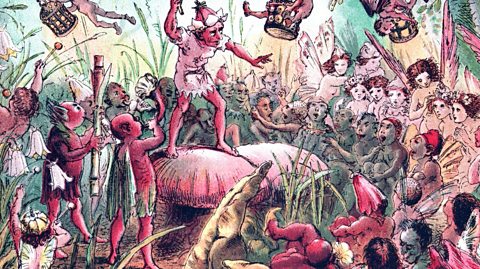
For a long time in the British Isles, paranormal activity was said to be the work of fairies rather than ghosts. Fairies were thought to be invisible, as they operated in a different world that exists alongside our own, but they could be invited into a human's home or even take people back to theirs. Fairies could be responsible for helpful, mischievous or even malevolent happenings around the house.
Similar ideas existed in pre-Islamic Arabian and later Islamic cultures. Jinn - often romanised as 'Djinn' or anglicised as 'genies' - are invisible beings that live on Earth alongside humans and occupy vacant homes or other empty places. Some jinn torment humans and make them behave badly, like demons and possessive spirits in other cultures.
It seems no matter where in the world you are, people have always been sure they’re not home alone…
Spend a penny, see a ghost
So, when did ghosts officially start moving in?
By the time Shakespeare was writing about them, English society was more sceptical of faeries, and witches were the supernatural threat to be wary of.
Roman Catholic attitudes reflected that ghosts were souls visiting from Purgatory, either to warn or deceive the living. Ghosts as characters in plays such as Shakespeare’s Hamlet usually symbolised death or madness. During the 18th century, the oceans were reportedly haunted by vessels lost at sea, and living sailors were warned to look out for phantom ships.
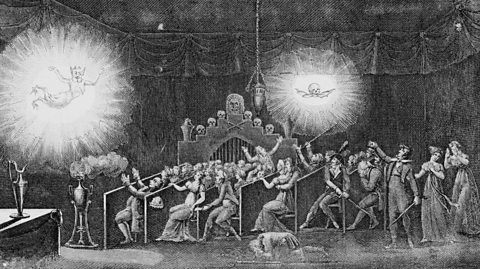
But it wouldn’t be until after the Industrial Revolution and the following centuries that the sites of medieval historic battles, murders, executions and tragedies became haunted hotspots. Neogothic architecture brought back the look of the Middle Ages, and Gothic literature took off. Phantasmagoria, a form of horror theatre involving optical illusions, mesmerised Europe in the 18th century. By the 19th century, skeletons, demons and ghosts were projected on stages all over Britain.
Public interest turned into scientific research: paranormal investigation began when the Society for Psychical Research was founded in 1882, and ‘psychic researchers’ used early technology to monitor ghostly goings-on. By the turn of the century, castles, buildings and houses all over the world became haunted locations, with frequent ghost sightings reported in America, the UK and Europe.
And if that wasn’t enough, we also have this era to thank for the earliest haunted houses you could visit. In 1802, the ‘scare attraction’ was revolutionised when Marie Tussaud showcased her wax sculptures in the Lyceum theatre in London. Tussaud’s 'Chamber of Horrors' featured eerie wax figures, whose likeness was taken directly from the death masks of executed people, including King Louis XVI and Marie Antoinette - eek!
It's a haunting in the USA
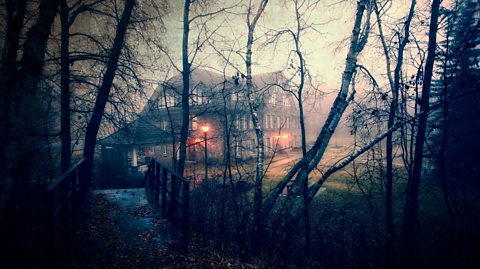
As soon as it became possible to make feature-length films, feature-length horrors were born - and the haunted house became a staple backdrop.
The 1927 film The Cat and the Canary, based on the 1922 play of the same name, is often credited with launching the haunted house in pop culture. In it, a dying millionaire is driven mad by his greedy relatives, who are then tested by his haunted mansion.
Offscreen, Halloween was a night for trick-or-treating for children in America, and pranks were a common tradition. However, the Great Depression of 1929-33 caused Halloween hijinks to turn disruptive and even grisly, as teenagers and young adults engaged in neighbourhood vandalism.
To counter this, many communities organised 'trails of terror' and 'ghost houses' to keep them entertained and off the streets.
The modern phantasmagoria
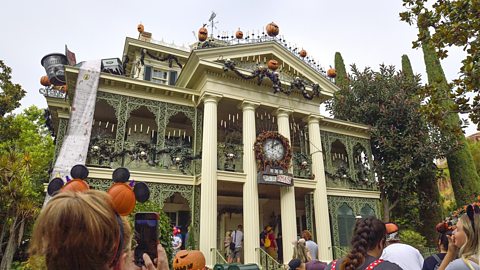
But these ghost houses were only a neighbourhood haunt. In 1969, almost 20 years after the project was approved, Disney opened its large-scale ghost ride, the Haunted Mansion - an immersive ghost walk and train through a house of practical effects. Its launch solidified the haunted house as a cultural icon and inspired carnival and ‘dark ride’ attractions all across the country.
And even haunted history repeats itself: American studios embraced another period of horror cinema in the 1980s, with films like The Shining, Poltergeist and A Nightmare on Elm Street. Hollywood’s ghosts kept the haunted house alive in pop culture. As these spooky traditions have persisted over time, portrayals in literature and film now range from the vengeful to the misunderstood and sympathetic.
This article was published in October 2023 and updated in September 2026
