All about eclipses
It’s a pretty extraordinary thing. Briefly, for a few minutes, day turns to night as the Moon blocks out the Sun's light.
Throughout history, solar eclipses have been viewed as bad omens. The Incas believed they were a sign their sun god was angry, while the Ancient Greeks and Romans believed they foretold negative political events. In Norse tradition, wolves chased the Sun and Moon, and an eclipse meant the Sun had finally been caught.
We now have scientific explanations for why they happen, and we no longer worry that they spell our doom – but we’re still fascinated by them. Here, BBC Bitesize takes a look at what solar eclipses are, why they happen and how you can see the next one in August 2026.
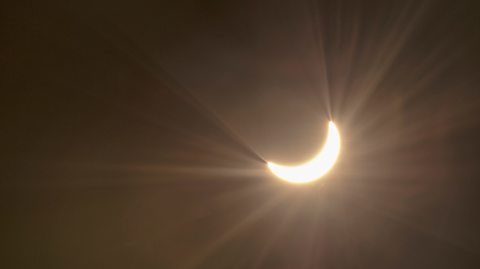
What is a solar eclipse and why do they happen?
Put simply, a solar eclipse happens when the Moon passes between the Sun and Earth.
It’s not quite that straightforward, though, because there are different types. When all three line up exactly, it’s a total eclipse. This happens because the diameter of the Sun is 400 times greater than that of the Moon, but it’s also 400 times further away.
We experience complete darkness for several minutes during a total eclipse, but only if we’re in the path of totality. When the Moon blocks the Sun, it casts a shadow on part of Earth that creates a trail as our planet rotates.
This shadow is known as an umbra. But other parts of Earth will be cast in a penumbra, where the Moon only blocks out part of the Sun’s light rather than all of it. This is a partial solar eclipse.
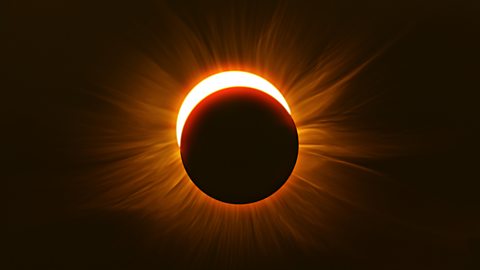
An annular eclipse – or ‘ring of fire’ eclipse, as it’s sometimes known – happens when the Moon’s diameter looks like it’s less than the Sun’s. This means we can still see the rim of the Sun.
Why does this happen? The Moon’s orbit around Earth isn’t perfectly circular, so it’s further away from Earth at some points than at others and looks smaller. It’s not actually fire we’re seeing when this happens, though – it’s light.
When is the next solar eclipse in the UK?
There are usually between two and five solar eclipses every year, but most of these are partial. There’s a total eclipse about every 18 months, but as we’ve already seen, whether you can see it depends on where you are in the world.
In general, a total eclipse is visible every 400 years from the exact same spot. The last time there was one visible in Britain was 1999 - more on that below. The UK's next total solar eclipse is due around 2090.
You don’t need to wait that long to see an eclipse, though. There will be a partial eclipse in the UK on 12 August 2026, with a total eclipse visible from the Arctic, Greenland, Iceland and Spain.
Depending on where you are in the UK, around 89% to 96% of the Sun will be covered, with other parts of Europe, Canada, the USA and northwest Africa also experiencing a partial eclipse.
Where can I see the solar eclipse and how can I do it safely?
Eclipses don’t hang around for long, so speed is key. The longest total eclipse in recent history, on 11 July 1991, lasted for six minutes and 53 seconds.
That’s because the Moon and Earth are always moving, so while it takes hours for the Moon to pass in front of the Sun, totality only lasts for a maximum of seven minutes and 32 seconds.
The most important thing to remember is that you should never look directly at the Sun. Even filters like sunglasses don’t protect your eyes against infrared radiation, so you can still cause permanent damage. You should only use binoculars or a telescope fitted with a certified solar filter.
There are special eclipse glasses you can wear, or you can create a pinhole camera. Just make sure any equipment you buy to view an eclipse is purchased from a reputable supplier.
Five famous solar eclipses
May 28 585 BC
We’re starting off in the ancient world, where it’s believed an eclipse once ended a war.
It interrupted a battle between two peoples, the Lydians and the Medes, which was raging in Anatolia in what is now Turkey. Suddenly, in the midst of the fight, the sun disappeared and everything came to a halt. Both armies viewed this as a bad omen from the gods and made peace.
The event is known as the Eclipse of Thales, because it is said to have been predicted by Greek philosopher Thales of Miletus down to the exact year. However, modern experts question whether this was simply a lucky guess, as there was no scientific method for predicting eclipses at the time.
3 May 1715
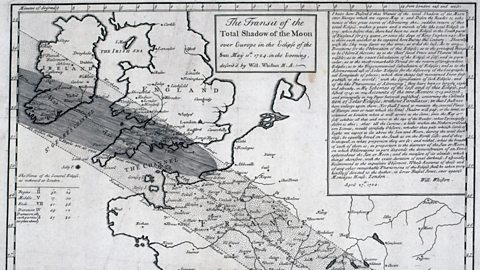
In the early 18th century, a total solar eclipse was visible over parts of Britain, including directly over London. It lasted over three-and-a-half minutes.
Astronomer Edmond Halley wanted to see if he could use Sir Isaac Newton’s laws of gravity to predict the timing of the eclipse to within four minutes of accuracy – and he did.
Halley published a map for the public, showing the exact path the Moon’s shadow would take over England. It was the first time this had ever been done.
The map was about improving scientific knowledge, but it was also about calming public fear. Many people were still anxious about eclipses, believing they were a sign from God or that they heralded an apocalypse. Halley’s map showed the shadow was a natural phenomenon that could be tracked and predicted.
May 29 1919
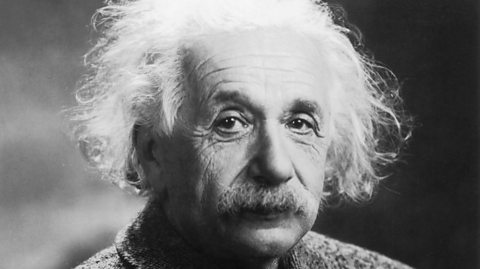
As we've just seen, solar eclipses can help us prove scientific theories as well as understand the Sun better. The Eddington Eclipse of 1919 – or more accurately, the photos taken of it – supported Albert Einstein’s theory of general relativity.
In 1915, Einstein theorised that gravity caused light to bend, and a total eclipse occurring from northern Brazil and West Africa four years later provided an opportunity to test this.
Photos taken by British scientist Sir Arthur Eddington and his team showed the positions of stars shifted outwards when their light passed close to the Sun, by the exact calculations Einstein had predicted. When the results were announced later that year, Einstein became a scientific celebrity.
August 11 1999
An estimated 350 million people around the world watched the 20th century’s final total solar eclipse in August 1999, which fell over parts of Europe and Asia.
It was witnessed as a partial eclipse across the whole of Europe, but some parts – including Cornwall in the UK – fell into the path of totality. Despite it only being midday, the temperature dropped and darkness fell as though it were midnight.
Many were disappointed, as thick cloud cover meant they couldn’t get a clear view and had to rely on live pictures captured by an RAF plane flying at almost 30,000 feet. The previous total solar eclipse visible from mainland Britain had occurred in 1927.
August 21 2017
This more recent eclipse is significant for two reasons. It was the first time since 1918 that the path of totality crossed both the Pacific and Atlantic coasts of the USA – meaning it stretched from one side of the country to the other.
Secondly, it was the first time since the Declaration of Independence in 1776 that the path had fallen exclusively within the US, meaning no other country experienced the eclipse as total.
About 88% of America’s adult population is believed to have watched the event, either directly or electronically, and millions travelled to other cities just for a better view.
1999: The last total solar eclipse of the millennium
Originally broadcast on BBC News on 11 August 1999, this BBC Archive video captures what it was like for those who witnessed the total solar eclipse that year.
Reporter Nicholas Witchell was in Plymouth, Devon, but the report also features footage from Cornwall and the Channel Islands.
BBC Archive offers a unique collection of thousands of archive films, capturing life and events across the UK since the 1940s.
Video begins with dark shots of people gathered outside to see the eclipse. They are counting down and cheering
A few did see it, and marvelled at one of nature's most extraordinary experiences.
Gazing up through the clouds, sometimes only for seconds, the total eclipse was visible.
Video cuts away to people setting up telescope equipment and shots of a grey sky with thick clouds
Hours earlier, the telescopes had been set up in hope. But, for most people, the cloud was impenetrable.
For them, the only way of seeing the eclipse was to watch the live pictures from an RAF Hercules, which had to fly at nearly 30,000 feet, much higher than it would normally operate, to get above the clouds and give its cameras a clear view.
A man in the background counts down: five, four, three, two, one, now. The video cuts to a view of the moon from the airborne cameras
Just before 10 o'clock, from the airborne cameras, first contact - when the edge of the moon, just visible in the top right-hand corner here, starts its progress across the face of the sun.
On the ground, under leaden skies, the watchers are ready.
Video cuts to a view of the moon almost completely covering the sun, so that we can only see a slither of light
11:06: the sun is now just a crescent band of light. The spectacle is about to begin.
11:07: the Isles of Scilly. The moon's shadow is racing in from the Atlantic at high speed. The light is fading fast. Automatic street lights come on, seabirds start to make roosting calls.
11:09: St Michael's Mount off the south Cornish coast is in silhouette.
Video cuts to a shot of the moon completely covering the sun, with white light visible around it
And then, at 11 minutes past 11, on the 11th day of the month, over Falmouth, the airborne cameras show the moment the last rays of light disappear as the moon covers the face of the sun. The eclipse is total.
11:12: St Michael's Mount is now in darkness. It appears to be midnight at almost midday. Camera lights flash as the blackness envelopes boats out at sea and moves along the Cornish coast.
Reporter Nicholas Witchell speaks directly to the camera
It's 13 minutes past 11 now. The moment of totality has just reached us here in Plymouth. Now, of course we can't see it, but you can certainly feel it and sense it. The light went very quickly and the temperature has dropped.
Video cuts to shots of people gathered to watch the eclipse in the Channel Islands. Witchell speaks in VoiceOver again
11:15 now, and totality has reached the tiny Channel Island of Alderney. Here, there are gaps in the clouds, and the total eclipse can be seen.
Video cuts to another shot of the total eclipse, but a shaft of light begins to appear over the top of the moon
It has been 72 years since Britain last witnessed such a phenomenon, and it lasted only minutes. The diamond ring of light appeared as the moon moved away. The total eclipse was over.
For some it had been spiritual, for others, scientific. For many, it was eerie, and for those who did catch a glimpse, it was unforgettable.
A man speaks to the camera about his experience
I was surprised at how emotional the whole thing was. As it suddenly got dark, it was a feeling of humanity clustered together on a hilltop. It was very primeval, almost prehistoric.
A woman speaks to the camera about her experience
My heart was thumping and racing. It was a very sort of uncanny experience.
Video cuts to another shot of the total eclipse. Witchell is speaking in VoiceOver again
It had been a day when the heavens had promised much, but delivered rather less thanks to the weather. A day when people in Britain had a once-in-a-lifetime encounter with the star which gives this planet life, and its people a shared sense of our place in the Universe.
Nicholas Witchell, BBC News, Plymouth.
What is a lunar eclipse?
You might also have heard of a lunar eclipse.
Solar eclipses only happen during a New Moon, when the Moon is positioned between the Sun and Earth and is invisible to us. During a solar eclipse, the Sun lights up the side of the Moon we can’t see, leaving the side facing Earth in darkness.
There isn’t an eclipse every time there’s a New Moon, because the Sun, Earth and Moon don’t always line up so that the Moon’s shadow lands on Earth. As we’ve already heard, the Moon’s orbit around Earth is on a slight incline compared to Earth’s orbit around the Sun.
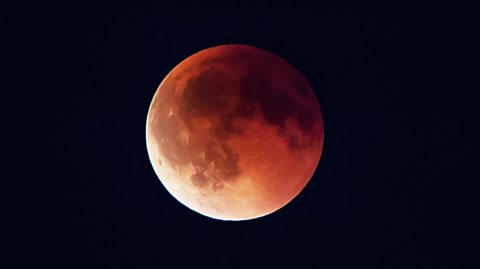
So, what is a lunar eclipse? It's caused when the Moon, Sun and Earth align during a full moon – when we can see a complete, bright circle from Earth. When this happens, Earth has passed between the Sun and Moon and casts a shadow onto the Moon.
During a total lunar eclipse, the Moon appears red, because some sunlight bends through Earth’s atmosphere. This is often known as a blood moon.
Like solar eclipses, lunar eclipses happen about two to five times each year, with total eclipses occurring roughly every 18 months.
This article was published in August 2026
