Why is Stonehenge important?

Stonehenge is a world famous and significant historical monument (a special statue or structure built to remember someone, an event or idea) that was built on Salisbury Plan in Wiltshire.
Work began on this mysterious structure around 3000BC, and it took hundreds of years to complete.
Many archaeologists (someone who studies objects and places from the past) and historians don’t fully understand what Stonehenge was truly used for, but believe it was used for religious activities, similar to other stone circles found across Britain.
Important words
Important words on Stonehenge.
| Keyword | Definition |
|---|---|
| Archaeologist | A person who studies objects and places from the past. |
| Bronze Age | A time when people discovered how to make and use bronze for tools and weapons. |
| Ceremony | A number of actions people do for an important and special event, such as a wedding. |
| Monument | A special statue or structure built to remember someone, an event or idea. |
| Neolithic | A time when people started farming. Also known as the New Stone Age. |
| Sarsen stone | A very large and strong stone made from sandstone. |
| Solstice | One of the two days in the year when we have the longest day (Summer Solstice) or the shortest day (Winter Solstice). |
Where is Stonehenge?

Stonehenge is one of the world’s most famous monuments.
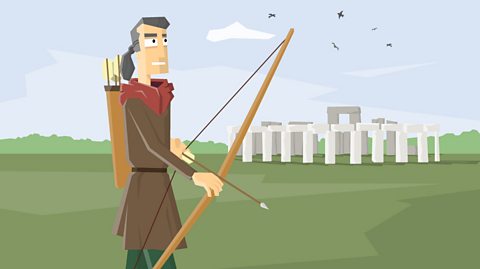
It stands on Salisbury Plain, in Wiltshire, and its giant stones can be seen from miles around.
Stonehenge took many hundreds of years to build.
Work began in the late Neolithic Age, around 3000BC.
Over the next thousand years, people made many changes to the monument.
The last changes were made in the early Bronze Age, around 1500BC.
We may never know exactly why Stonehenge was built, but people probably gathered there for religious ceremonies (a number of actions people do for an important and special event, such as a wedding).
How was Stonehenge built?
The first task was to cut the boulders into shape.
Archaeologists believe that the ancient Britons hammered wedges of wood into cracks in the stone.
When the wood was soaked in water, it expanded and split the stone.
Next, the builders used chisels and hammers to shape them.

The stones were then transported to the building site.
They were probably carried on rafts down rivers, then dragged overland by teams of men and oxen.
It's believed that the stones were placed on giant wooden sledges and pulled along the ground using log rollers.
The builders dug deep ditches for the stones.
Then they pulled on ropes to raise them and packed the ditches with rocks to hold the stones in place.
Watch: How Stonehenge has changed over the years
Watch the video to learn more about how Stonehenge has changed since it was built.
Find out how Stonehenge has changed over the years.
More than 4,000 years ago a small ring of stones stood for around 200 years.
Then came a single ring of huge standing stones into which a smaller ring of smaller stones was inserted.
Then another outer circle of small stones was added before the circle of massive stones enclosed the whole thing.
This was the final phase of construction.
Stone Henge’s heyday would last around 200 years until 1900BC.
The stones’ alignment means that on the Summer Solstice the Sun rises directly behind the main entrance to the monument. That is why thousands of people gather here every year at this time to watch the Sun rise.
What was Stonehenge for?
Why did the ancient Britons build such a massive monument at Stonehenge?
What exactly went on at this sacred site?
Some people think that Stonehenge was used to study the movements of the Sun and Moon.
Other people think it was a place of healing.
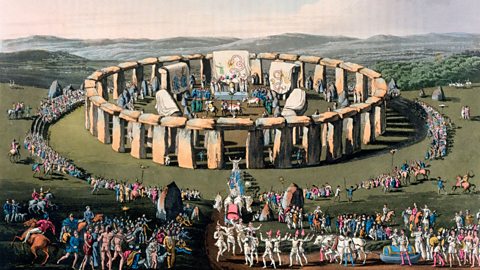
The ancient Britons believed that the Sun and Moon had a special power over their lives.
It is very likely that they held special ceremonies at Stonehenge on Midsummer’s Day (the longest day of the year) and on Midwinter’s Day (the shortest day of the year).
Many experts believe that Stonehenge was used for funerals.
They suggest that people carried the dead along the River Avon, and then walked up to Stonehenge in a grand procession.
The most important funeral ceremony of the year was probably held on Midwinter’s Night at Stonehenge.
This may have been because it is the longest night in the year.
Other stone circles in the UK
Stonehenge is just one of hundreds of stone circles that have been found in Britain. During the early Bronze Age, circles built from stone or wood played a very important part in the religious life of the British people.
Click through the slideshow to learn more about other stone circles in the UK.

Image caption, Avebury stone circle is actually three circles in one! Two rings of stones stand inside a much bigger ring, known as the Great Circle. When it was finished in the early Bronze Age, there were around 100 stones in the Great Circle.


1 of 4
How do we know what happened at Stonehenge?

Over many years, many archaeologists and historians have studied Stonehenge and discovered new clues.
When Stonehenge was first investigated, it was thought to have been built by the Romans.
As time went on and more evidence and artefacts were found, ideas about Stonehenge slowly changed.
This is when archaeologists discovered that it was built by ancient Britons.
Artefacts, like tools made of antlers, have also been found near Stonehenge.
This has helped archaeologists to understand more about the people who lived there.
All of these discoveries and the efforts of archaeologists and historians throughout time have helped people to understand more about Stonehenge, what it may have been used for and how it may have been built.
Think like a historian

Have a look at the thinking points below and think about your answer to each question. You could even write them down on a piece of paper or discuss them with somebody else if you want to.
Why do you think archaeologists and historians have different ideas about who built Stonehenge and what it was used for?
Why do you think Stonehenge is considered a significant monument, even though we don’t know exactly what it was used for?
The stones at Stonehenge were placed so that the sun rises behind the main entrance on the Summer Solstice. How do you think people’s use of the monument has changed over time?
Did you think that many archaeologists and historians may disagree because a lot of the evidence has to be interpreted, and people can interpret it in different ways? This means experts may come to different conclusions. As new evidence continues to be found, people's ideas about Stonehenge can change.
Did you think it is a significant monument because it is a key example of a stone circle made in the late Neolithic period? People can use it to learn about the people who built it and what may have been important to them. Maybe you thought it is significant because it shows us how skilled and hard working the ancient Britons were to have built such an impressive monument using simple tools.
Did you think that this shows that Stonehenge may have been used for religious ceremonies when it was first built? You may have thought that it still holds special meaning for people today as thousands of people still gather there every year to watch the sun rise on the longest day.
Activities
Activity 1: Explore what Stonehenge looked like 4,000 years ago.
Activity 2: Stonehenge quiz
Let's find out what you know about Stonehenge in this quiz.
Grown-ups corner
Are you a parent, carer or teacher?
Take a look at some of the links below on KS2 History which are packed full of knowledge, videos, quizzes and activities.
KS2 History: New Stone Age
BBC Bitesize for Teachers
KS2 History: Bronze Age Britain
BBC Bitesize for Teachers

KS2 History / PSHE and Social Studies : What does Stonehenge Gold tell us about the Bronze Age?
BBC Bitesize for Teachers

Horrible Histories: Raid and Trade game! game
Play Horrible Histories: Raid and Trade KS2 History

More on Prehistoric Britain
Find out more by working through a topic
- count5 of 6
- count6 of 6
- count1 of 6