
|
 |  |
 | |
| Home | Impartiality | Accuracy | Fairness | Respect | Independence | |
| | | | |
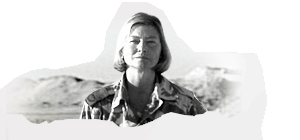 Wherever possible, gather information first-hand. If you are unable to do this, talk to eyewitnesses or those with direct knowledge of issues or events. Being an eyewitness - by Kate Adie, the BBC's former chief news correspondent. A reporter is an eyewitness. It's a privileged position, and one which is not easily granted, especially in conflicts or times of crisis. Press conferences, official statements, public relations and spokespersons, photo-opportunities, and guided tour 'facilities' may be useful, but they are no substitute for raw facts. A reporter should hold to a central principle of being a first-hand witness, for there is much that is veiled, interpreted and hidden. Getting to the heart of the story In conflict there is a greater need to get to the heart of a story. Surprise and secrecy are favourite weapons of commanders, and the harsh realities of war are often kept secret by both the victors and the vanquished. And so 'prohibited areas' and 'military zones' are created, with the media discouraged, sometimes threatened, if they ignore them. Road-blocks, special permits and 'escorts', are all obstacles to seeing and hearing for yourself at critical times. Considering risks Danger has to be considered, risks have to be calculated, precautions taken. A dead reporter brings back no story; therefore the danger has to be weighed with the need to find the facts. It may be necessary to ignore some prohibitions, as long as there is journalistic justification. A reporter needs to be know why the story has to be pursued. No journalist has immunity or neutrality - anywhere. And in some places, journalists may well be targeted - considered as spies, or not sympathetic to a particular cause. Determination and fair-dealing are essential. In war, issues such as patriotism and nationality impinge on reporting. Independence and objectivity can be questioned - especially when what is dear to you is at stake - your family, your country, your way of life. Every reporter needs be aware of such influences and instincts, and be honest about how they are reporting - acknowledging censorship or restrictions, or allegiance or sympathy. |
| |||
| | | |
| |||
 | ^^Back to top | << Back to Home | |

