
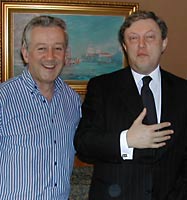
Grigory Yavlinsky was once a presidential candidate
The BBC's Allan Little is covering the run-up to the Russian Presidential elections, due to be held on 2 March.
Tuesday:
Ten years ago his voice counted for something in Russia's political discourse.
Grigory Yavlinsky was the leader of the Yabloko block in the Russian parliament, and a presidential candidate who could be expected to poll respectably across the country.
But the decline of his political fortunes mirrors what has happened to the liberal opposition - the so-called young reformers - generally in the eight years since Vladimir Putin became president.
I asked Mr Yavlinsky whether he agreed that most Russians now associate the democratic reforms of the 1990s not with progress but with criminality and chaos; they were, after all, years in which a handful of powerful individuals became fabulously wealthy while most Russians lost their life savings because of galloping inflation, the currency collapsed, unemployment soared, and the Russian government defaulted on its debt.
He agreed. The liberal opposition were now paying the price of a popular backlash against the experience of the Yeltsin years.
The Putin brand
It may be true that there has been overt intimidation; true that opponents of the Kremlin have been driven out of the nation's political dialogue, deliberately discredited in the mainstream media as agents of an anti-Russian and hostile West, denied access to television stations that are now state controlled; true that Russia's anti-extremism laws have been used cynically to silence dissenting voices.
All of this may well be profoundly undemocratic - and Amnesty International today joined the chorus of criticism, saying that human rights had been systematically abused by the Putin government.
But none of this detracts from the prevailing reality of this election - that Mr Medvedev will win because Mr Putin has chosen him, and that that is a reflection of the enduring - and growing - popularity of the Putin brand.
And this, Mr Yavlinsky, once a presidential hopeful here, agreed was the current great Russian paradox: that there might well have been a clear retreat from the democratic reforms of the 1990s, but that that retreat is popular.
Paradox
It was endorsed at the ballot box in last December's Duma elections and it will almost certainly be endorsed in the election on Sunday.
The paradox is this: that in Russia, a retreat from democracy, a retreat to greater authoritarianism, carries a certain (very Russian) democratic legitimacy.
That is what Mr Yavlinsky and those young reformers who held such power in the 1990s have to contend with as the Putin project continues, unbroken, into the Medvedev presidency.
End of Section
Monday:
See pictures from Allan's first days in Moscow
Ask anyone who lived in Moscow in the 1990s - as I did - and has come back for the first time and they will say the same thing: the transformation is dramatic. It is a different city.
The grandeur of its monumental city centre is as pleasing as ever: the Kremlin walls, the onion domes, the winter sun glinting off their double-headed eagles. How many urban spaces are there in the world that command such breath-taking beauty?
But it's the Russian capital's new wealth that is truly breath-taking. There is a Muscovite middle-class now with money to spend.
There are bars and restaurants, chicly turned out and serving excellent cuisine, there are advertising billboards offering affordable package holidays in Spain and Turkey: none of this was here when I was the BBC's Moscow correspondent 10 years ago. Where has it all come from?
Most Russians will answer the question in three words: President Vladimir Putin. When he took power in 2000, Russia was on the brink of collapse after a decade of westernising reforms - aimed at turning Russia into a Western-style free-market democracy - had gone disastrously wrong.
Extraordinary luck
It was a decade in which many Russians lost almost everything - their life savings, their jobs, their pensions - while a tiny handful of so-called oligarchs grew enormously wealthy.
Putin's supporters - eight years on - say the president can take the credit for calling a halt to all that.
But ask his detractors where the new wealth comes from and they will use three quite different words to answer the question: oil and gas.
There's no doubt that President Putin has been blessed by extraordinary good luck: his presidency has coincided with a sustained period of unprecedentedly high energy prices.
Those Spanish holidays are paid for by oil and gas money which has trickled down and into the pockets of ordinary folk.
And that's one reason why ordinary folk will vote on 2 March to replace Vladimir Putin with... Vladimir Putin Mark II.
Foregone conclusion
Dmitri Medvedev has been hand picked by the outgoing leader. So great is Mr Putin's popularity that the election result is a foregone conclusion. "If Putin had picked you to be his successor, Allan" one leading commentator here told me, "then you would be the next president of Russia".
So what sort of democracy is it that turns a presidential election into nothing more than one big nationwide gesture of patriotic solidarity by a grateful electorate?
The answer is Russian democracy. Under Putin the country has retreated from its disastrous westernising experiment of the 1990s and that has meant a retreat from western-style democracy.
Wealthy opponents of the Kremlin have been jailed on charges many here regard as trumped up; journalists have been murdered; the television stations which, 10 years ago, carried a wide diversity of opinion, have been brought under state control and are slavishly loyal to the Putin project.
National narrative
The real opposition has been, in effect, systematically closed down - discredited in the media, intimidated into silence, shut out of the national dialogue.
The paradox is this: it's all hugely popular. President Putin's trump card has not been oil and gas at all.
It has been his instinctive feel for what most Russians in this post-Yeltsin decade value - a proud national dignity, a belief in Russia's inherent greatness, and a sense that it is regaining its rightful place in the world.
Putin has given the Russians back a national narrative - a story to tell themselves - from which they can take pride. That's why Dmitri Medvedev will win.
And Vladimir Putin? He will leave office but stay in power. The Putin transformation of Russia goes on, probably with Putin as prime minister and retaining real control over the man who, nominally, will be his boss.
Ten years ago we used to say that we knew what Russia was in transition from, but not what it was in transition to. Well we know much more about that now.
And that - to look at this new Russia, to pick our way through its unfamiliar contours, its emerging topography - is why the BBC World Service has asked me to come back, 10 years on.
End of Section
What do you think of Russia under Putin? Send us your comments on Allan's diary
The Putin Project, the BBC World Service's in-depth coverage of Putin's Russia can be found here.

