

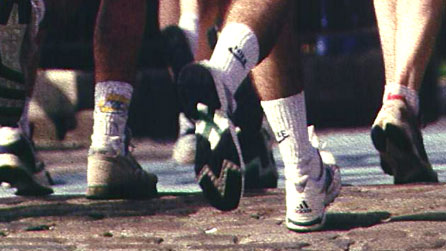
The Executive Director of New York Road Runners Foundation tells of dedicated students and the dedicated teachers who work with them.
Raise Your Game: How do the kids start off on the Foundation programme?
Cliff Sperber: The first message to them is we want to run, we want to have fun, but we're also going to work. We're going to be pushed, we're going to be challenged, and we want them to be involved in that. We want them to set reasonable and realistic goals, and then work hard to achieve those goals, re-setting the goals higher each time.
We explain to them that they're in a structured programme and that there are some really nice incentives they can earn by achieving in the programme. We reward kids just for coming out to a certain number of sessions. They can get a running shirt or a hat by coming out and being good sports and supporting their team-mates.
It's important they're part of a team, whether it's a class team or an after-school programme team. One of the main disciplines the kids have to learn is pacing themselves, because initially they all just want to sprint, and it's not a sprinting programme. We talk about stretching, the warm-up and cool-down after the practice and develop the concept of pacing. Pacing in running, and in life, is a very valuable concept to understand!
RYG: How do they learn the importance of team support?
CS: It's not about competition, though we do have races and meets and special events. We're very fortunate as we have a relationship with the Children's Hospital of New York Presbyterian, and we have health and wellness expos with them track-side at what we call track and field jamborees.
We invite kids to run in the New York Roadrunner Races in Central Park. On a special Sunday, once a month, they go out and they can run with 3-5,000 adults in Central Park as part of the New York Roadrunner races, and it's a really high experience.
It's clearly a team-building experience for the kids to go out en masse and run with all these people who are competing against other teams. But, what we try and teach the kids is that winning the competition isn't as important as how much you can improve individually. That comes from setting and improving your goals and supporting your team-mates in reaching their goals. We actually rate the kids on sportsmanship and support, and those that indicate that they're working with their team mates get some of these incentives more quickly.
RYG: Do you have a formal educational aspect to your programme?
CS: Kids who run will pursue any discipline with a good degree of earnestness, but certainly running seems to get them healthier, calmer, more disciplined, more focused, and builds up their self-esteem and self-confidence. They're going to be able to pay more attention in the classroom, and feel better about doing work and completing assignments.
All of which, can lead to higher grades. Furthermore, we do have an optional component that we offer to our teacher/coaches. For instance, if you're running a 12 minute mile, the teacher/coach can give you some assignments which are based exactly on your experience. What percentage improvement do you have to attain to lower your personal best from 12 minutes to reach your goal of 11 minutes?
We have anatomy lessons as they're part of running. Even the history of running is covered as we offer some sample books you can read and do a book report on. So it's really easy to tie-in sports for recreation and health into education. A lot of the kids do really buy into that because they're enjoying the sports so much that they don't see the education as work but just a continuation of the fun they're having with the programme.
RYG: How do you select your teacher/coaches?
CS: We've got 2 model programmes - The School Day Programme, where we work with the physical education teachers in the school and we train them to operate a running programme in support of their PE class. As there are limited resources in many of the schools, and a lack of space and a lack of equipment, the simplicity of our school day programme is such that it can be done in almost any school and a lot of the PE teachers have taken this on.
We also have an after-school programme which is more comprehensive. The teams practise a minimum of twice a week for 1 - 2 hours. These are the kids who get to run in the New York Roadrunner races on the weekends, and the 75 or so teachers who are currently in our programme have virtually all volunteered because they've seen other teams involved, heard from other teacher/coaches and read about us from our media coverage.
They are all teachers who care enough about their kids to be involved in a programme like this, and when we see that kind of motivation on their part then we're motivated to work with them and make sure they get a good programme.
See also
Elsewhere on the BBC
Elsewhere on the web
Latest
I started training by myself because I didn't have a coach.
Skeleton bobsleigh slider
Training ground
Work hard
Colin Jackson reveals more top tips on making exercise part of your lifestyle.