


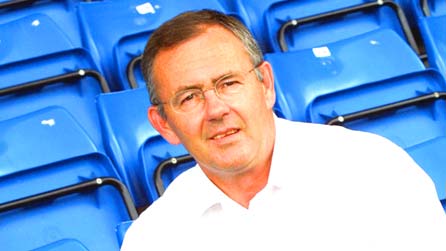
"Live television is just like being an athlete - you've got to train for it," says Paul Dickenson on athletics and rugby.
Raise Your Game: Is it a dream job?
Paul Dickenson: I never dreamt when I was a kid I would end up in this position, I used to look upon guys like Ron Pickering and David Coleman, and of course, Stuart Storey as gods. I thought how on earth did they manage to do it, so this is a dream come true.
I've got the best seat in the house! I'm sitting in a seat where you would have to pay a couple of hundred of dollars to watch things that I love watching, and actually getting paid to commentate on them!
RYG: How did you get involved in sport? Were you a sportsman yourself?
PD: Can't you tell by looking at me! I threw the hammer and I competed until I was about 34 years old and then I thought 'I've got to start earning a living now'. I was a schoolteacher by profession. Then I had my own gym and health club, but I had spare time on my hands whereas before you'd be training and working. So I had all this excess energy and I got picked up by a local radio station who asked 'Would you like to come in and help us type out results, make cups of tea and all that?'
I learnt how to make programmes and eventually was asked if I wanted to go out on the road with a microphone and try to do some commentary. I ended up commentating on football matches, rugby matches, hockey matches, local budgerigar shows, cat shows and everything else! After a few years of doing that unpaid, as a volunteer, I was at Crystal Palace watching a meet, just as a spectator, and I saw the BBC commentary team. They remembered me from my athletic days and I said to David Coleman 'I'm actually after your job'.
Profile
Name:
Paul Dickenson
Job:
BBC Sports Commentator on athletics and rugby.
Career History:
- Former discuss and hammer thrower - represented Great Britain in the 1976 and 1980 Olympic Games.
- 1990 First appearance for BBC TV - commentating and reporting for the Commonwealth Games.
RYG: Just tongue-in-cheek?
PD: Oh yes! He remembered this and about two months later I got a telephone call from the BBC saying 'We need somebody to do track-side interviews at the World Championships in Rome'. My first ever interview was diabolical. It was with the great Carl Lewis. All of a sudden, I was thrust into a position which was amazing for me, interviewing Olympic champions, World champions and so on, and that was the start of it.
RYG: Is there a huge difference between reporting as you were doing in 1987 to commentary?
PD: I remember my very first commentary. I was a fish out of water. I just didn't really know what I was doing, but you're on a very steep learning curve very quickly. At the Commonwealth Games 1990 I sat in the commentary box as opposed to being down on the track and it was fascinating.
I was a late starter in this as a lot of people start in their 20s. I was in my 30s by then. It was something which I never thought I would do, but having started to do it, you've then got to start taking it very, very seriously so it becomes a brand-new job for you. Just like being an athlete, you've got to train for it.
RYG: Is your personal preparation quite meticulous? I know some of the names you've got to pronounce are tricky.
PD: It's like a hobby, if you're keen on something, if you're interested in it, the homework comes very easy. It becomes a joy to do it, a pleasure - so you've got to treat it as homework. It's very much a case of doing the preparation because you want to and you cannot sit down in a commentary box without having done some homework otherwise you're going to look like an idiot.
People who are watching at home want to know that you know what you're talking about, so you've got to sound knowledgeable and you've got to make it sound easy. I'm not commentating to somebody at home who knows a huge amount about athletics, I might be commentating to an auntie or an uncle sitting at home who might not know anything about rugby, anything about track athletics, so you've got to make it sound very simple. That requires a huge amount of background reading and preparation so that you can put it in little sound bites.
RYG: Is the way you present and prepare for the commentary box similar to preparing lessons?
PD: I suppose so. Any teacher will tell you that if you make a lesson sound interesting, it's not because you're smart, it's because you've done your homework! You know kids always complain about having to do homework, but that is the way in which you get to learn things. If I have a sheet in front of me which is for the 100 metre race, I know how far 100m is, I know what the World Record is, the Commonwealth Record, the British Record and so on.
I will know a little bit about each person, so that I can come out with those facts and figures prior to and during the course of a race, in the same way as if you're teaching a lesson of biology, you might not know anything about the particular aspects of genetics or something like that prior to the lesson, but you swot up. I have to stand there and talk authoritatively about a subject just like when I was teaching. It's got to be believable, people have to believe in you as a schoolteacher, and believe in what you're saying and the fact it's correct and so on. So homework is important.
RYG: Is this job in television glamorous?
PD: There's a lot of hanging around to be done! People say you've got a glamorous job, there's a lot of travelling, and there's a lot of hanging around doing absolutely nothing, but once you're actually there with a microphone in your hand and you're broadcasting it's like being on a permanent high. I wouldn't do any other job in the world now I've experienced the world of live television!
Latest
If you have a passion, you've got to apply yourself and don't let anyone tell you that you can't do it.
Olympic gold heptathlete
Training ground
Work hard
Colin Jackson reveals more top tips on making exercise part of your lifestyle.


Paul Dickenson
"It's like a hobby, if you're keen on something, if you're interested in it, the homework comes very easy. It becomes a joy to do it, a pleasure."