
Anne Cakebread encourages us to "have a go at everything and don't be afraid to fail."
RYG: Job in brief?
AC: I do a range of work, such as information graphics, caricatures, cartoons, illustrations etc for different publications and organisations, including Rugby World magazine. Once a month they send me the text for the Frank Keating column and I read it then brainstorm ideas for illustration with the deputy editor.
I do a rough pencil drawing, scan it in and send it to the deputy editor and he'll say yes or no. It will go back and forth like that until he's happy. Then I'll add colour using Photoshop to demonstrate movement and expressions.
I'll limit my colour palette so the illustration is not too busy - so it's easier for the eye to read - and get the colours to work together. I'll then send that file off as a jpeg to be given a final yes or no - it's usually a yes as I've only got 2 days to turn it around before it goes to press.
For the Six Nations I draw the kits and logos using a package called Illustrator. It's a low resolution package which magazines like because it doesn't use too much memory. I've got a basic graphic template of the shorts and shirt and I'll have to research the colours and badges for each team.
RYG: Qualifications
AC: International Baccalaureate at Atlantic College: I did 6 subjects - Art, English, Economics, Chemistry, Maths and Spanish.
Degree: Fine Art
RYG: Work experience
AC: During the second year of my degree I worked in a school painting murals. I also worked for the local Argus for a week to see what it was like for people receiving illustrations. It was useful to see what happens at the other end of the process.
RYG: Skills required
- Determination and persistence: Being a freelance illustrator involves a lot of hard work in terms of sending work off and getting rejections. You might send out 200 fliers but only get 2 responses from that. It's a very competitive market.
- Breadth of learning: Art is obviously a useful qualification and skill, but it's worth doing a range of subjects. Sometimes their potential application might not be obvious until later, but all subjects come in to art in some shape or form. Physics is useful because you learn how light diffracts. In maths you learn about x,y co-ordinates which I use in Illustrator, and also making shapes from shapes. English helps because I have to take words, summarise them and put them into pictures, so metaphors and similes are important. If you want to get work from abroad then languages are helpful.
- Knowledge of software: You can teach yourself or get jobs where you know you'll learn the software.
- Knowledge of sport: If you're going to illustrate football, for example, it helps if you've got some knowledge of it. I'm a Cardiff City fan, and have been brought up with football. I play 5-aside now. It gives you a greater spatial awareness, which crosses over into art.
- Confidence: Have a go at everything and don't be afraid to fail.
RYG: Your path?
AC: My first job after graduation was for a media graphics company which did information graphics for publications such as F1 Racing and Angling Times. It was badly paid, but I used it to learn the computer programs. I left after one year and set up by myself, and I've now been doing it for 12 years.
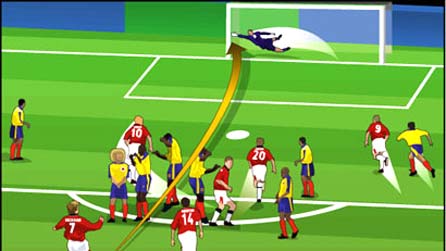
One of my first breaks was for a magazine called Total Football. I showed them what I could do and they offered me a page per month. They'd send over videos and pencil drawings and I'd draw the moves before a goal. You can show the tactics and movement in one drawing to illustrate where the shot come from by showing the figures at certain angles, and using arrows and 'whoosh' marks.
I saw a story in the Guardian, illustrated it, sent it off to them and they published it. Once you've got that kind of work in your portfolio, it snowballs from there.
RYG: Advice
- Keep drawing: Draw everything and don't be afraid to copy work for practice. During art O-level I'd draw everyday in my lunch break.
- Pester people: Most of my work comes in by word of mouth now and through my agents, but to start with I'd go and visit publications and pester them. Take along a small portfolio full of illustrations relevant to them - things they could possibly use. If you've got time, draw something especially for them. You'll only get 5 minutes with them, so you need to be concise.
- Do lots of sport: I'm 36 and learning to snowboard. It's never too late. If you're healthy you'll notice a difference in terms of your concentration levels, reactions and brain function. You'll work much better after exercise and it's also good for your social well-being. It's a good way to make friends and contacts with people who might help you out.
- Set up a website: It's vital to have a website - an online portfolio. It's made a massive difference for me. Potential clients can look through my work and show me which particular style they're looking for.
See also
Elsewhere on the BBC
Elsewhere on the web
Latest
Stick to what you believe in.
World Cup winning rugby coach
Training ground
Work hard
Colin Jackson reveals more top tips on making exercise part of your lifestyle.