'Good Queen Bess'
Elizabeth I is one of England's greatest monarchs – perhaps the greatest. Her forces defeated the Spanish Armada and saved England from invasion, she reinstated Protestantism and forged an England that was a strong and independent nation.
But she had a very difficult childhood and was fortunate to make it to the throne at all. When she was young, her father Henry VIII executed her mother Anne Boleyn. She was stripped of her inheritance and was imprisoned in the Tower of London.
1533 - Born into the Tudor dynasty

Elizabeth is born on 7 September in Greenwich Palace.
News of her birth causes rejoicing across the country, but is a bitter disappointment to her father Henry. He is desperate for a male heir to continue the Tudor dynasty. Although Elizabeth is made next in line to the throne, the King prays his next child will be male – superseding her claim to the throne.
1536 - Mother beheaded

Elizabeth is two years and eight months old when her mother Anne Boleyn is accused of adultery and beheaded on the orders of Henry VIII.
Her father marries Anne’s lady-in-waiting Jane Seymour a week later. Elizabeth is declared illegitimate and removed from the royal succession. Her title is downgraded from 'Princess’ to 'Lady’. Elizabeth is neglected for a number of years until Henry's final wife Catherine Parr takes charge and makes sure she is educated to the highest standards and, crucially, taught the art of public speaking by renowned Cambridge scholar Roger Ascham.
1547 - Father dies
Elizabeth is 13-years-old when Henry VIII dies. Her nine-year-old half-brother Edward becomes King.
Elizabeth joins the household of her stepmother Catherine Parr. When Elizabeth is caught in an embrace with Parr’s husband Thomas Seymour, she is banished from the house. In 1548 Catherine dies in childbirth and Seymour is subsequently executed for plotting to marry Elizabeth and kidnap Edward VI. When Elizabeth is questioned by the authorities she protests her innocence and escapes prosecution.
Simon Schama explains how Thomas Seymour and Elizabeth's relationship developed. A History of Britain by Simon Schama (BBC Two, 2000).
Simon Schama:
When Catherine Parr died a rumour started circulating that Seymour had his sights set on marrying Elizabeth. To even think of such a thing was treason. Even worse, some wagging tongs said Elizabeth was pregenant with Seymour's child.
It took all of Elizabeth's composure and self confidence to persuad Lord Protector Somerset that she was innocent.
Elizabeth:
My Lord, there goweth rumours abroad which be greatly against my honour and honesty which be these, that I'm in the tower and with child by my Lord Admiral. These are shameful slanders. I most heartedly desire your Lordship that I may come to the court and show myself there as I am. Your assured friend to my little power, Elizabeth.
1554 - Imprisoned in the Tower of London

After Edward’s early death in 1553 Elizabeth’s older sister Mary I becomes queen.
Mary returns the country to Catholicism and begins a series of bloody purges of Protestants. 287 are executed during her short reign. Mary’s plan to marry Prince Phillip of Spain sparks an unsuccessful rebellion and Elizabeth is interrogated about her involvement with the plotters. She is imprisoned in the Tower of London before being put under house arrest in Woodstock, Oxfordshire.
1558 - Elizabeth becomes Queen
Following the death of her half-sister Mary, Elizabeth succeeds to the throne. She is 25.
Elizabeth has inherited a country wracked by religious strife and knows she needs public support to remain queen. The celebrations for the coronation the following year are spectacular. As her procession makes its way through London on its way to Westminster she pauses to listen to congratulations and receive flowers from ordinary people on the street.
Simon Schama describes Elizabeth I's coronation. Clip from A History of Britain by Simon Schama (BBC Two, 2000).
Simon Schama:
The 25 year old Elizabeth came into an inheritance of high hopes and deep anxieties. The celebrations at her coronation were carefully designed to show off the young Queen as the paragon of virtue. This charade of piety though was hardly enough to compensate for the misfortune of having another woman on the throne.
All the same, the sceptics must have been reassured by Elizabeth's precocious self-possession. For what the councillors saw, was not some girlish ingénue, but someone who seemed full, it was said, of manly authority.
1559 - Returns England to Protestantism

Elizabeth reinstates the Church of England, and declares she does not want to make "windows into men's souls".
She removes the Pope as head of the English church and instead becomes its Supreme Governor. She introduces a new Book of Common Prayer and republishes an English translation of the Bible. Elizabeth takes a pragmatic view of her subjects’ personal faith and religious orthodoxies are not strictly enforced.
1560 - Falls in love?
Elizabeth has many suitors but the one who comes closest to winning her heart is Robert Dudley, Earl of Leicester.
The two are very close and she appoints him as one of her most trusted advisors. When his wife Lady Amy Dudley dies suddenly in suspicious circumstances in 1560, rumours start spreading about the nature of Robert's relationship with the Queen. However Elizabeth ignores the rumours. The precise nature of their relationship remains a mystery to this day.
Simon Schama asks if Elizabeth was really in love with Robert Dudley. Clip from A History of Britain by Simon Schama (BBC Two, 2000).
Simon Schama:
But how much of a couple were they? Did they, as all the gossips in Europe and all diplomats and most movie-makers since have assumed, become lovers. What was in the way was Dudley's wife, when she died Dudley would be free and sleeping with your intended was not that unusual in Tudor England.
When pressed about the rumours, Elizabeth airily retorted that such things were impossible when she was surrounded day and night by her ladies. With the terrible example of the fate of her own mother constantly before her, it would have been foolhardy to the point of insanity for her to sleep with Dudley.
1566 - Refuses to marry

Parliament refuses to grant Elizabeth any further funds until the matter of her marriage is settled.
This angers the Queen and, using her skills of rhetoric, she lambasts members of Parliament saying the welfare of her country is her priority, not marriage and Parliament should keep out of her personal matters – she will marry if and when it is convenient.
1583 - A revolution in theatre

Elizabeth’s reign sees a flourishing of the English theatre.
Legislation encourages actors to join touring companies such as Lord Sussex’s Men and Lord Leicester’s Men. They settle in London, first performing in taverns and then in purpose-built theatres. The Queen takes an interest in plays, attending performances at court, and in 1583, she commands the formation of the Queen Elizabeth’s Men. By the 1590s the dominant acting company is the Lord Chamberlain’s for whom Shakespeare writes and performs.
1580-1585 - Exploration and the beginnings of Empire

Elizabeth looks beyond Europe for opportunities to expand trade and increase the nation’s wealth. Her reign sees many voyages of discovery.
In 1580 Francis Drake becomes the first Englishman to circumnavigate the globe. In 1585 Sir Walter Raleigh sets up a colony of about 100 men on the east coast of North America, which he names Virginia after Elizabeth I, ‘the Virgin Queen’.
1587 - Executes Mary, Queen of Scots
Elizabeth's Catholic cousin Mary, Queen of Scots is under house arrest in Chartley Hall, Stafford as she poses a threat to Elizabeth.
Elizabeth builds up an extensive network of spies headed by Francis Walsingham to help protect her. He implicates Mary in a plot to depose Elizabeth and she is tried and convicted of treason. Elizabeth is reluctant to execute her cousin. She doesn’t want to set a precedent by executing an anointed monarch. After months of prevaricating, she finally has Mary beheaded at Fotheringhay Castle.
Simon Schama describes how Elizabeth's spymaster entrapped Mary, Queen of Scots. Clip from A History of Britain by Simon Schama (BBC Two, 2000).
Simon Schama:
Mary and her household were suddenly packed up and sent to close confinement at Chartley Manor in Staffordshire. Mary was furious, desperate to find a way out of her prison. So of course she was thrilled when she discovered an ingenious means to smuggle coded letters to her supporters.
What Mary didn't know, of course, was that this was a trap. Walsingham had set the whole thing up. The letters were intercepted.
When Mary's latest champion. the rich merchant Anthony Babbington supplied Mary with details of a plot to murder Elizabeth and put Mary on the English throne, Mary wrote back with encouragement.
The trap was sprung.
1588 - The defeat of the Spanish Armada
After the death of Mary, Queen of Scots the Pope urges Philip of Spain to invade England.
England and Spain have long been bitter rivals and Philip launches a great fleet of ships, known as the Spanish Armada. Elizabeth is adamant she will retain her crown and that England will remain free from the influence of Rome. She addresses the troops encamped at Tilbury saying she will fight by their side. The Armada is engaged by the Royal Fleet in the channel and then driven to the North Sea by strong winds. Only half of the 130 ships make it back to Spain.
Elizabeth I makes a rousing speech to the English soldiers gathered at Tilbury. Clip from A History of Britain by Simon Schama (BBC Two, 2000).
Elizabeth I:
My loving people, I come among you, not for my recreation and disport but being resolved in the midst of the heat of the battle to live and die amongst you all. To lay down for God and my Kingdom and for my people, my honour and blood, even in the dust.
I know I have the body of a week and feeble woman, but I have the heart and stomach of a King, and a King of England too. And think foul scorn that Spain or any Prince of Europe should dare invade the borders of my realm. To which rather dishonour I, myself, will take up arms.
1603 - Elizabeth dies a beloved queen
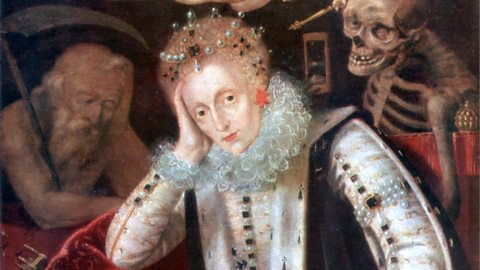
Elizabeth I dies aged 69. Known forever as 'the Virgin Queen', she remains unmarried and childless until the end.
In her final years Elizabeth's reign is beset by problems in Ireland and her failing health. However, the mourning which follows her death is unprecedented. Many ordinary Londoners take to the streets to watch Elizabeth's journey to her final resting place in Westminster Abbey. As Elizabeth leaves no direct Tudor heir, James VI of Scotland – the son of Mary, Queen of Scots – is named king. The Tudor dynasty that has ruled England for 118 years comes to an end.
