| 24 September 2014 |

| |
| BBC Homepage | | |
| |||
| Contact Us | | |
Theatre and Dance PreviewsYou are in: Beds Herts and Bucks > Entertainment > Theatre and Art > Theatre and Dance Previews > Huw's Meeting Joe Strummer 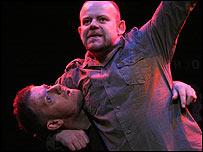 Meeting Joe Strummer Huw's Meeting Joe StrummerKaty Lewis Huw Higginson talks about his latest role and growing up with punk. Meeting Joe StrummerBroxbourne CivicFriday 5 October 2007 8.00pm Alban ArenaThursday 29 November 2007 8.00pm Following its Fringe First success at the 2006 Edinburgh Festival, the UK tour of Paul Hodson's inspirational and moving play MEETING JOE STRUMMER arrives in Hertfordshire this Autumn. 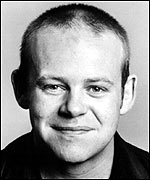 Huw Higginson The show follows the lives of two young men, one middle-class, one working-class, from adolescence in 1977 to middle-age as they are transformed by Joe Strummer and The Clash's potent mix of rock 'n' roll, iconic imagery and rebel politics. One of its stars HUGH HIGGINSON, who spent ten years in The Bill as PC Garfield, told us all about his latest role. What's the play about?Huw: Basically the play charts the lives of two guys from the age of 16/17 to 45 and the influence that Joe Strummer and The Clash had on both of their lives and what it gave to them as they grew older as well as as young men. It's one middle class boy and one working class boy, does the music have a different effect on each?Huw: It has the same effect on both but it's interpreted in different ways. At the beginning of the play the middle class kid wants to be working class because it's cool but as he grows older, although he still loves the music, he sees that the band are an act, and that it's a performance whereas the working class boy really takes the politics of the band to heart. they were quite a left wing band in a way and were at the van guard of Rock Against Racism and things like that. He tries to live his life through the philosophy of the band in a way that's almost impossible to do because it does have some contradictions in places. It kind of messes them both up in different ways but the play comes full circle at the end in that they both take something positive out of the philosophy out of punk and the left wing ideals of the 70s. What attracted you to this role? Was it something that you thought you could identify with?Huw: Yes, I grew up with punk. I was more of a psychobilly really but I was really into a lot of the punk bands at that age and it really recalled a time for me. That's really the strength of the play, it recalls a time for a generation who grew up with Thatcher's Britain of the 70s and 80s and the music which rebelled against everything that was being installed by a particular type of politics at the time. So obviously you think that music was a really important part of that time for young people?Huw: Absolutely. people talk very fondly about the 60s but a decade later in the 70s everything changed again. It was really quite anti-establishment and saying this is our voice, we need to be heard and we should be allowed to be heard. The 60s was probably more famous for that revolution but in lots of ways punk was a lot more extreme I think, in the way that it radicalised people's attitudes and ideas, specifically within a time that many people thought was an oppressive political situation. Joe Strummer died a couple of years ago - does the play talk about him a lot?Huw: Yes it does. Joe was obviously the frontman of the band and was its talisman, its voice, its politics. The play actually covers his death as well which is actually quite a moving moment especially for the really big Clash fans who come and see the show. Earlier in the tour his widow came to see the play and, as much as she enjoyed it, it was obviously quite moving for her too. But even if you're not a Clash fan, it's almost like a play about a rite of passage for two guys. It's about growing up and maturing. Is there a lot of Clash music in it?Huw: Yes - there are a lot of tracks interspersed from White Riot to Minstrel Boy. There's good coverage of the music but while Paul Hodson, who wrote it, is a massive Clash fan, he said he didn't want to do a bio-pic play. He wanted to play full justice to what Joe Strummer and The Clash meant by actually putting it in the eyes of the fans, so while there's a lot of Clash music, it's more about the band's influence. There's a huge generation who absolutely adored The Clash who are now in their early to mid-40s and that creed that was instilled in them by the band when thet were young still remains. People who grew up with punk will obviously enjoy this a lot, but is it something that a wide variety of people will like?Huw: Yes - it's certainly not designed just for a niche market. It's a play about a rite of passage and growing up and remembering your childhood and youth. It's as much about those things and finding out who you are, as it is about the influence of The Clash, so it really has a broad, broad appeal. I guess that looking back nostalgically and seeing what made you what you are is a universal theme?Huw: Absolutely, and that's why the play works, on that level as well as others. It's not just for The Clash fans, it's for everybody. This tour must be very different from doing TV drama like The Bill?Huw: Yes it is. But to be honest, this is the work that you become an actor for. It's different from doing TV and film but this show has got a lot of soul, a lot of character and a lot of heart which is why it's a real joy to do. So your heart is on the stage is it?Huw: Absolutely. I had ten years in The Bill and I will never knock that time, I had a fantastic time, but since moving on I've done lots and lots of really, really nice theatre jobs so on stage is the place to be, it really is! last updated: 04/10/07 Have Your SayYou are in: Beds Herts and Bucks > Entertainment > Theatre and Art > Theatre and Dance Previews > Huw's Meeting Joe Strummer  Rhythms of the World! |
| | About the BBC | Help | Terms of Use | Privacy & Cookies Policy |