| 24 September 2014 |

| |
| BBC Homepage | | |
| |||
| Contact Us | | |
Theatre and Dance PreviewsYou are in: Beds Herts and Bucks > Entertainment > Theatre and Art > Theatre and Dance Previews > An Indian 'Dream' 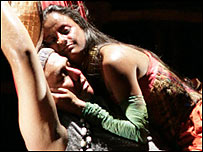 A Midsummer Night's Dream An Indian 'Dream'Katy Lewis Tim Supple's acclaimed Indian production of Shakespeare's 'A Midsummer Night's Dream' is coming to Watford ahead of a world tour. He told us why he thinks it works so well! A Midsummer Night's DreamWatford Palace Theatre 10-15 September 2007 Mon, Tues & Fri: 7.30pm Wed & Sat: 2.00pm and 8.00pm A theatrical event like no other, Tim Supple's acclaimed Indian production of Shakespeare's 'A Midsummer Night's Dream' combines the astonishing skills of actors, dancers, martial arts experts, musicians and street acrobats from across India and Sri Lanka and uses SEVEN different languages including Tamil, Malaysian, Bengali and Sanskrit. The show was two years in the making and caused a sensation in India where it played Delhi, Bombay, Madras and Calcutta. A sell-out run at the RSC in Stratford-upon-Avon followed last year, and now finally in 2007, audiences across the UK can experience this breathtaking production prior to a World Tour. I think you can guess that I enjoyed it! 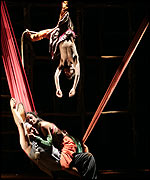 A Midsummer Night's Dream I saw it at the Swan in Stratford last year and can say quite unashamedly that it is one of the best things that I have ever seen in a theatre. But initially, when you read the programme beforehand and see that the entire play is done in seven languages, you begin to think that you may have made a mistake, how can this possibly work? Shakespeare can be difficult enough in English! But the truth is, it just does work, and what's more, it communicated to me in a way that I never thought possible. A Midsummer Night's Dream was the first I was therefore delighted to be able to talk to director Tim Supple who was able to give me his unique take on why he thinks it works so well, as well as talking about how he is adapting it to other theatres. I have seen many interpretations of A Midsummer Night's Dream, but when I saw this production, it was like first time I had ever seen this play. As a director, is that what you always hope to achieve for an audience member?Tim: Of course yes, but it's one of those things where, it maybe what you'd love to achieve but it doesn't necessarily help you if your aim is to achieve that. If you're thinking directly 'I want to make this a new experience for people' then you're not necessarily going to achieve it. What I really try to do is to get as far into the heart of a piece [as I can]. I try to find out for myself its true identity as it appears to me and then when I feel the truth of that, then I somehow try to put that across to people. And if that then emerges to audiences as unlike any experience they've had before then that's great. But it's not the thing you're thinking of when you're working, you're thinking what is this play, what is really happening? Obviously what makes this production feel so different is the performers of course, but I didn't go to India thinking how can I do A Midsummer Night's Dream differently, they are just the people I was working with. There are lots of different styles in it, dance, music, acting, street theatre, and seven different languages such as Tamil, Malaysian, Hindi, Bengali and Sanskrit. You see this written in the programme and you think how on earth is it going to work, but it just does. Why do you think it works so well?Tim: It's a good question. One thing is that all the translations into the different languages follow the Shakespearean text very closely so somehow the Shakespeare itself runs like a continual river through all the other images. So it's still the same words, it's still the same actions, and it's still the same scenes communicating through. And this story and the actions of the characters sustains throughout, so it feels like one whole thing. It doesn't feel bitty or patchy in terms of its language. I think also that the world of A Midsummer Night's Dream is one in which many different characters collide. Those different characters come from different walks of life and different places in society, but they also come from outside human life, the supernatural characters, the fairies, and there are the high aristocrats and the working people. 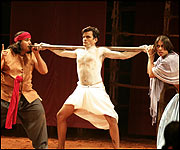 A Midsummer Night's Dream And the truth is that India is a strongly multilingual society so there is a different language spoken by the aristocracy and different languages spoken on the street and there are different languages even within communities, so it was very natural to the community of actors that I was working with and somehow that naturalness communicates itself on stage so it doesn't seem like a strange experiment. It just seems very natural both to the actors and to the play. And then I think audiences, although they are not used to seeing plays in this mixture of languages, accept it. Theatre can be very magical in that some things, if you explain them, sound strange, but if they are made natural onstage it can just appear as natural. That's the wonderful thing about theatre. And the different styles and characters do seem to reflect the spectrum of India don't they?Tim: That's absolutely right. I also read that you thought that Shakespeare was suited to India because it was closer to his world, and I'd never thought about that before. Can you explain a bit more about what you meant by that?Tim: Well, when you come to do Shakespeare's plays or see Shakespeare there are many aspects of his world that are no longer true in our world now and that's why people update the plays or place them in different contexts. For example, some are set in Edwardian England or post-war England because they are looking for a time when it felt appropriate. In A Midsummer Night's Dream you've got things like a father who wants his daughter to marry someone and is willing to enforce a law against her if she doesn't marry the person that he wants. You've got extreme difference between rich and poor to the degree where the poor people are preparing a play for the rich people and know so little about the rich people that they are afraid if they frighten the ladies they might get hung. You've got this completely estranged world between rich and poor. You've got a sort of belief in the supernatural that's alive and present. And those are just three examples of things that are more present in India than they are in the West. Some people in India lead a totally modern life but you can also find in India life led in ways that is not that different to Elizabethan England. Take somewhere like Bombay which is at the centre of India's economic miracle. It has some highrises and it has business but you can walk round a corner in a street and life is not that different to how it was in Elizabethan England. It's not true of all India but it exists in India and this is something that is very striking, whereas in the West, broadly speaking we live in a very different way. Our social existence is very, very different to Elizabethan England and we struggle in rehearsals to really think what it was like. So, we talk of Shakespeare as a universal writer of human themes because our social conditions have changed so much, but in India they haven't. It was a huge hit in India and all your performers are from there, where did you find them?Tim: I travelled across as much of India and Sri Lanka as I could and everywhere I went I had people helping me arrange sessions and auditions where I would bring performers together or I would go and see people's work. I would go and see performance wherever I could. And I came across a great variety of performance - street performers, dancers, musicians, actors, folk actors etc. often I would gather people together and do big working sessions which were quite wonderful and gradually I filtered through and whittled down a number that I was most interested in. Do they have a different style from British actors?Tim: There are actors who work in similar ways to British actors and there are many who are very different. Broadly speaking, in India there is less text and less realistic acting. There is more physical, musical performance and more styalised performance - those are generalisations. But in the cities a lot of actors are interested in realistic acting. In Bombay a lot of actors are interested in plays. But in a lot of India, the fundamental traditions of performance are still connected to the roots of theatre which really lies in telling a story through music, dance and acting. This is exhilarating - they take you into an aspect of Shakespeare that we find hard to access. The thing that we have to remember with Shakespeare is that within his psychology as a writer, there was a more ritualistic kind of theatre than we are used to, but he also took a huge step towards modern theatre with characters and emotions and self reflection and all of that, but in the West we find it very hard to access the more ritualistic, the more ancient side of Shakespeare. That's something again that I found alive and kicking in India, there's an unbroken line there going back 2000 years of living theatre history, it's quite incredible. Alive and kicking is a good way to describe this show. I saw it in the Swan in Straford, where there were fairies everywhere, and the space, which is in the style of an Elizabethan Theatre, was used to its full advantage. This production is going to be in the Watford Palace. Have you had difficulties adapting it to a different kind of space, the more traditional proscenium arch type of stage?Tim: The Watford Palace is the beginning of a long journey for us. It will be the first time we have adapted it to the proscenium stage and after Watford we will go on a long tour where we will play it in proscenium stages. All I can say is that we've adapted it many times before. In India we did it in very big outdoor venues, in Stratford it was smaller and in the Roundhouse in London it was bigger again. I am fully confident it will adapt, but it will be different, it will feel more separate and will bring out that aspect of the play which is a very kind of good night out play. This is associated with the proscenium arch where we sit back in the seats and we are entertained by something on the stage and I think that will be brought out more. I think different qualities will emerge in the production and people will experience it in different ways and I am fully confident that it will have every bit as much pleasure for people just in a different way. We have to remember that there will now be thousands and thousands of people who will now see it around the world who never saw it at the Swan so it doesn't matter! That's all they'll see! last updated: 04/09/07 Have Your SayYou are in: Beds Herts and Bucks > Entertainment > Theatre and Art > Theatre and Dance Previews > An Indian 'Dream'  Rhythms of the World! |
| | About the BBC | Help | Terms of Use | Privacy & Cookies Policy |