| New Statesman | Milton Keynes Theatre Mon 24 Jul: 7:30pm
Tue 25 Jul: 7:30pm
Wed 26 Jul: 2:30pm, 7:30pm
Thu 27 Jul: 7:30pm
Fri 28 Jul: 7:30pm
Sat 29 Jul: 2:30pm, 7:30pm Box Office:
0870 060 6652 |
Laurence Marks and Maurice Gran are two of the most experienced writers in the business. In a career spanning over 25 years, they've had numerous hit shows to their names including Shine On Harvey Moon, Birds of a Feather, Love Hurts, Goodnight Sweetheart and of course, the 1980s satirical comedy, The New Statesman. 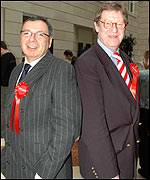 | | Maurice with Laurence Marks |
Now, some 14 years after Rik Mayall's original portrayal of the monstrous Tory MP Alan B'Stard, finished its run on TV, The New Statesman is back - and he's changed sides! Having now defected to New Labour, Mayall is reprising the role of the principle-free politician in The New Statesman - Episode 2006: The Blair B'Stard Project, where as Blair's henchman he woos Condoleezza Rice and appears to have had a role in most of the party's controversies of the past few years, including the infamous 45 minute warning, the death of David Kelly - and he even knows where Iraq's weapons of mass destruction are! The writers have said that they thought about having the MP moving parties before but the Labour Party was still popular then. Now they feel that it is unpopular enough, and ironically has moved to the right enough, to make it work. Maurice Gran told us how the idea came about and what it was like transferring a successful TV comedy to the stage. How did the idea for The New Statesman first come about all those years ago?Maurice: Rik asked us to write something for him after we met him at a comedy convention. We went out to lunch and asked him what sort of thing he wanted as we only knew him from Rik in The Young Ones. He said that he liked to play characters that reflected the negative side of his personality – predatory, vain, cowardly, sex mad and crooked. We said “You have to play a Conservative backbencher then!” The Head of Comedy at Yorkshire TV at the time was a Rik fan so we took it to him. How did the stage version come about all these years later?Maurice: We were talking to a theatre production company about which of our TV projects might work live on stage and this was the one that they thought would work best. We are novices to live theatre but their enthusiasm was infectious and of course they were very excited when we said that he [Alan] of course would now be New Labour! Given the character’s Machiavellian nature, I think it’s a stroke of genius to make him responsible for just about everything in the past few years, from persuading the government about the 45 minute warning, to buying Weapons of Mass Destruction and even playing a part in the death of David Kelly. It’s all very apt.Maurice: Yes! And gets “apter” every day – it all makes perfect sense! And the enjoyable side is that you sort of persuade the audience that this character MUST exist – he is the factor X in all this. And then you turn around and say he’s NOT real! That’s right – you really believe that this character must exist somewhere!Maurice: Yes - the Mandelson and the Campbell figures that we refer to are not the prime movers, they are just executives to someone else’s ideas. And of course it would be patronising to suggest that the Prime Minister did it all himself. I particularly enjoyed your pops at the BBC!Maurice: Well - we’ve burnt and re-burnt our boats with them but the BBC is a very forgiving organisation! Was it difficult to get back into the mind set of Alan B’stard?Maurice: It was most important that Rik could get back into it. He was anxious about it but it actually came quite quickly. We had get togethers and he said that he could feel the character returning. But for us, in a funny sort of way, we don’t think he ever went away. He is so much a part of the real world – it would have been much harder to do this with one of our more fictional shows. And of course in the 80s Rik was really too young to play him – now he is of an age! It’s a very topical show. Has it evolved as the run has gone on?Maurice: We haven’t updated it as much as we expected. Of course you can’t make major changes because of having to rehearse them, it’s not like just dropping in a close up. But in fact the script has held up better than I thought – even the Prescott has held on until the last week - which was a big surprise! After over 25 hugely successful years doing TV work, you only did your first stage play last year, didn’t you?Maurice: Yes – it was fantastic and it was something we always wanted to do. We worked quite hard on a project 10 years ago but it never came off. It was great doing this play at the Stephen Joseph Theatre in Scarborough and with Alan Ayckbourn, it was a sensational experience working with him and in the theatre where every night is a bit different. Theatre is a living medium, there is a great excitement to it, we learned a lot and we are still learning. Was writing for the stage a hard transition to make?Maurice: How you tell your story is different because theatre is a different medium. You are going from writing a 90 minute piece with maybe 60-70 scenes in TV. There are little snippets which you move the story on through and where a two minute scene is a long scene. Theatre is simpler to present therefore it must be more sophisticated in the content within a scene because there’s nowhere to hide. You can’t tell a joke and then cut to another scene. You can’t say something like “You’ll never get me jumping out of a plane” and then cut to him jumping out of a plane! So was putting The New Statesman on the stage hard because he had previously been a TV show?Maurice: It was less difficult because of what we’d learnt at Scarborough, we’d learnt a lot of our stagecraft there so we were more confident. The most difficult thing was figuring out what to put on the stage, working out where to leave the TV show behind and where to start again. For example, there was a lot more violence in the first draft and in the early performances and Rik had to become comfortable with being less physical. He was very aware that his audience would know him more from Bottom than as Alan B’stard so would be expecting him to hit everybody over the head all the time but we had to go more with mental violence than physical. You are one half of a phenomenonally successful writing partnership. How would you describe the relationship?Maurice: A tetchy, middle aged, sexless marriage! What’s the secret of such a long lasting partnership?Maurice: The ability to be incredibly rude to each other without taking it personally! You’ve worked with so many performers over the years, do you tend to have good relationships with actors?Maurice: We are very close to Rik, but for most of our career we have always been very busy. In the 90s we were writing one show and producing another so we weren’t in rehearsals as much as we would have liked. There are writers that are there everyday and I admire them, but you don’t have to be there. You’re not paid for it. Our relationships with actors are mostly working relationships. I know many charming actors but none I’d like to be stuck on a desert island with! Of all the shows you’ve written, is there one that you have particular affection for?Maurice: We feel that most of what we’ve done has been enjoyable, and even if it’s not worked out, we’ve enjoyed the writing process. We do have affection for Shine on Harvey Moon though. It went from a 1/2 hour show to a 1 hour show so it was the first time that TV took us seriously And of course The New Statesman because it’s given us so much fun. What’s next for you then?Maurice: My main criticism at the moment is that TV has turned comedy into archaeology – it’s all about clip shows now, the 50 best this or that. I’m working on a 50 best comedy clips programme at the moment, but I’d rather be nostalgic not about the past but about what is yet to come! We’re incredibly busy at the moment. We’ve got a couple of comedy pilots to write and a TV drama pilot to write which is going to be very heavy and a reaction to the glamorisation of murder. It’s a big departure for us and for TV. I’m fed up of seeing murder as an excuse for a detective with an interesting quirk and a funny hat to come and do his stuff. We’re also doing another stage play - hopefully for Scarborough again - and then there’s a radio play to do which will be fun. Radio is great, it doesn’t pay but it’s fun to do so when you want to do something in lieu of charity work you do some radio! Where do you find the time for all this work?Maurice: I don’t know the answer to that! Probably by ducking and diving and lying to producers! When I look back at the seven or eight years when we had our production company and were responsible for about a couple of hundred shows I think I must have been on some kind of drug – although I can’t remember taking anything! I guess you start to get more reliable about your working schedule but as a writer yourself, you will know that there’s nothing like a deadline to get you going! |