Liz Bonnin introduces a video clip examining the evidence that the UK climate is changing, with increased droughts, increased summer temperatures and wetter winters.
Note that this video was produced in 2019.
Video
LIZ BONNIN: Hi, I’m Liz Bonnin. Climate change is a topic that usually comes up when you’re studying physical geography the British weather can be wild, wonderful and downright weird and in the last few years we’ve had droughts big freezes and the wettest winter on record.
When things are changing so fast the country’s plants and wildlife can get in a muddle. Countryfile’s Tom Heap investigates the evidence for a changing climate in the UK.
TOM HEAP: While for some these extremes show that our climate is changing, a warmer world, they say, is delivering wilder weather others, though, say our climate’s always been unpredictable.
It’s like a blizzard of petals, it’s great. It’s like those Chinese movies.
ALISTAIR GRIFFITHS: We’ve done some preliminary work, so we’ve got data back to the 1950’s. And we’ve also got a weather station here. And we’re beginning to look at, sort of, preliminary findings that are showing that flowering is becoming slightly earlier and longer, in time frame.
TOM HEAP: If you’re only going back a few decades, which is a blink of the eye in terms of climate, how robust can it be?
ALISTAIR GRIFFITHS: Well it’s, it’s … We have to continue to collect that data so that we get a long data … longer data set to then … and make that more robust.
TOM HEAP: But you, as a gut feeling are pretty convinced that these trees are experiencing something different than they would have done you know, 50 years ago?
ALISTAIR GRIFFITHS: I think there’s, there’s some, there’s some evidence that suggests that they’re experiencing something to do with climate change. Whether it’s 50 years ago or not, I’m unsure but I think the more data we do, we can see that there is some element of change in climate.
It’s told us that gardeners and professional gardeners see that climate change is happening, believe it’s happening. There are extreme weather conditions which are more challenging for them. Different flowering times - so early, late, often, sometimes, double flowering time.
TOM HEAP: How strong are these results, it occurs to me that those that see something are the ones that report therefore it’s a bit biased to that.
ALISTAIR GRIFFITHS: It is biased but what it does is it gives us a snap shot of people are thinking, gardeners are thinking and allows us to, to sort of do further research to provide them evidence to deal with things like flooding and droughting and, and that’s what we want to do at the RHS is provide that advice so that they can garden and enjoy their gardens.
TOM HEAP: So does the inter-governmental panel on climate change it says that global average temperature is increased by just under one degree centigrade in the last 130 years. A small change, but enough to effect our sensitive ecosystems.
RICHARD BRADBURY: We might see a couple of Dartford Warblers just on top of the gorse here, there’s a couple of territories.
Dartford Warbler is a species which is really quite sensitive to the cold in winter. They need places where the, the mean temperature in the coldest month is above two degrees centigrade. So traditionally they’ve been associated with southern Britain.
As the climate has changed, the species has really increased in numbers, going up to about 3000 pairs. They’ve colonised south west England, they’ve gone up into south Wales, places as far north as Cannock Chase and East Anglia and even a pair in the Peak District.
TOM HEAP: So as we have fewer cold winters they’re doing better and they’re able to move further north.
RICHARD BRADBURY: Absolutely.
TOM HEAP: The pattern hasn’t been consistent, has it? I mean, within the last five years I can remember some very snowy, very cold winters. So how do they cope with the, the variation we get anyway?
RICHARD BRADBURY: I think it’s the fact that the frequency of these bad winters has been declining, especially through the 90’s and the noughties, that’s what’s been responsible for this really quite dramatic push forward.
TOM HEAP: And how convinced are you that this is a symptom of climate change?
RICHARD BRADBURY: Well it’s, it’s hard to be absolutely certain but it’s also hard to, to see that it could be anything else that’s responsible for a northward push of a, a cold sensitive species like this.
Species ranges do change. They move north and they move south as the climate changes. What’s different this time is the magnitude and the rate of climate change. And the real question mark is whether or not the species are able to move at the rate that the climate is changing.
TOM HEAP: So there’s growing evidence that climate change is effecting us now, But are these isolated cases, or is the impact more wide spread?
RICHARD BETTS: So this is the operations centre. It’s the nerve centre of the Met Office weather forecasting activity.
TOM HEAP: At the Met Office they don’t just do weather forecasts, they look at climate change across the world. Richard Betts, a scientist here, helped write a major international report which says a wide range of plants and animals are being effected.
RICHARD BETTS: So we’re seeing the natural world responding to a change in climate in the UK. We’re also seeing that happen in other countries around the Northern Hemisphere and also you can see it from a satellite as well, you can see trees coming into leaf earlier in the spring. So these changes in the natural world are signs that the climate is changing and, in fact, these are the clearest indicators of an impact of climate change.
TOM HEAP: A lot of your information though and understanding comes from models. Talk, talk me through what we’ve got here.
RICHARD BETTS: So we’re seeing temperature changes relative to the pre-industrial state essentially. Blues are colder. Yellows and oranges and reds later on will be warmer than the pre-industrial state. So you can see the different patterns of warming around the world, and as we get onto the end of the 21st century, we’re getting these high levels of warming, four or five degrees or more.
TOM HEAP: We’ve been looking at the response of plants and animals you know, makes me wonder how they’ll cope when the Earth might look like this.
RICHARD BETTS: What we’re seeing at the moment, or what we expect for the future, is change which is unusually fast.
TOM HEAP: And therefore difficult for nature to adapt fast enough to keep up with?
RICHARD BETTS: That’s right. And in particular if species are responding differently at different rates, you’ll get disruption of the ecosystems through these different rates of response.
If you’ve got certain natural events tied to spring … if one species is moving forward by a week and another by two days they come out of synchrony, so if they’re depending on each other that interdependency is potentially broken. So disrupting those ecosystems is what would be expected as a consequence of this.
TOM HEAP: So botanists and bird and bug specialists do seem pretty convinced. They’re seeing some signs of nature responding to a changing climate.
And whilst wildlife has adapted to shifting weather patterns before, if today’s change is too rapid, it’s feared some species could get left behind.
LIZ BONNIN: So there you go. Climate change is so often just associated with dramatic images of melting glaciers at the North and South Poles but we also mustn’t forget the impact closer to home.
Download/print a transcript of the video.
Tom Heap examines the evidence that the UK climate is changing, with increased droughts, increased summer temperatures and wetter winters.
The film considers the evidence that plants are flowering earlier in the UK and also how moorland birds are adapting to a changing climate. Finally, the team visit the Met Office to witness computer modelling and how this can contribute to our understanding of a changing climate.
Teacher notes
Download/print the Teacher Notes for this episode (pdf).
Before watching the video
Discuss with students what they already know about climate change and what evidence there is for climate change. Ask students why they think it is important to know whether our climate is changing and what changes there have been in their lifetimes.
Introduce key terms such as:
Climate change: Long-term shifts in temperature and weather patterns.
Interdependency: The dependence of two or more things on each other.
Magnitude: The size or extent of something.
During the video
You may wish to stop at relevant points during this short film to pose questions and check understanding or wait until the end.
Useful questions might include:
- How far back does the climate data go?
- What evidence do gardeners have of climate change?
- How much have temperatures increased by?
- What can birds tell us about climate change?
- What does the Met Office do?
- What do the models show?
- Why are ecosystems being disrupted?
After watching
Discuss with students what evidence was seen in the clip. Can students suggest other ways in which evidence of a changing climate can be seen for example dendrochronology, ice cores and temperature records. How reliable do they feel each method is? Students could rank the different evidence in order of reliability.
Ask students again why they think it is important to understand the changes in our climate. What evidence do they now have for this? What impacts did they see within the UK and what could happen to our ecosystems without that understanding?
Students could further research the methods or the organisations that carry out the investigations into climate change such as the Met Office or the British Antarctic Survey. For example, students could visit British Antarctic Survey to find out more about ice cores.
Where next?
Look at temperature records over time and task students with creating graphs to show average winter temperatures each year.
Ask students to describe what their graphs show. This is a great opportunity to practice presenting and analysing data.
Curriculum notes
This topic appears in Geography at KS3 (Climate change) and KS4 / GCSE (Climate change) in England, Wales and Northern Ireland and National 4/5 in Scotland.
More videos from this series
What is the water cycle? video
Iain Stewart describes the water cycle including evaporation, condensation and precipitation.
How does a river change as it travels downstream? video
An archive clip of Sir David Attenborough as he follows the course of the Amazon River as it travels downstream.
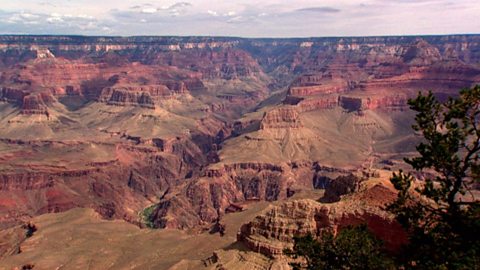
The erosion of the Grand Canyon. video
Liz Bonnin introduces the Grand Canyon - its ancient geology and what can be learned from the erosion of the rocks.
What coastal management techniques are being used on Hayling Island? video
Introduces the coastal management techniques used on Hayling Island in Hampshire to control drift and flooding.
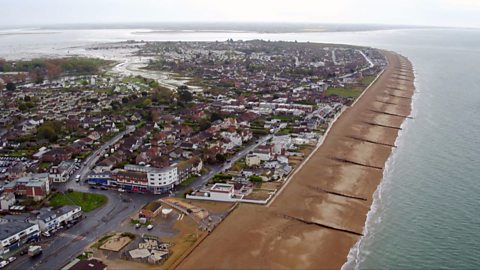
What is a ‘spit’ and how does it form through longshore drift? video
Katie Knapman explains how a spit forms through longshore drift and is a dynamic physical process, constantly changing the coastline.
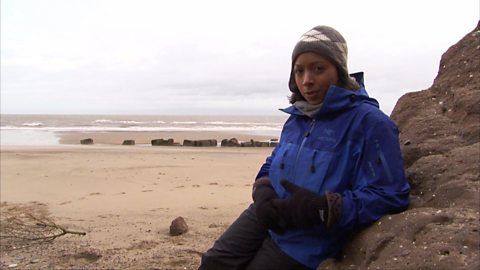
The geology of the Jurassic Coast. video
Exploring the Jurassic coastline and its geological significance with rocks spanning the Cretaceous, Jurassic and Triassic periods.
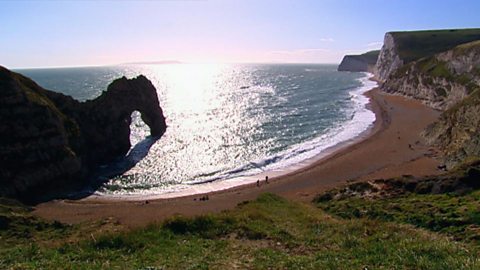
How have physical processes impacted the landscape of Yorkshire? video
Julia Bradbury explains the formation of Malham Cove including limestone pavement, highlighting the impact of glaciers on the landscape.
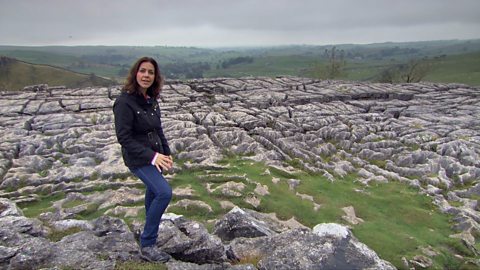
Glaciation and the UK coastline. video
Alice Roberts explains how Britain was once connected to Europe, but changed due to rising sea-levels following the Ice Age.
How has glaciation shaped the landforms of the Northern Hemisphere? video
Iain Stewart explains the glaciation of the Northern Hemisphere, focusing on the Yosemite Valley in California.
How can plate tectonics impact oceans? video
Exploring how the plate tectonics impacts the coastline, focusing on California through study of the San Andreas fault.
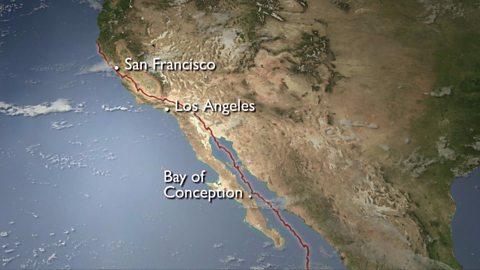
Plate tectonics in the UK - Anglesey. video
Nick Crane explores the geology and seismology of Anglesey - earthquake hot spot of the UK.
Deforestation and the growth of soya in Paraguay. video
Simon Reeves visits Paraguay to consider the deforestation that has occurred there to grow soy and the challenge of conservation vs development.