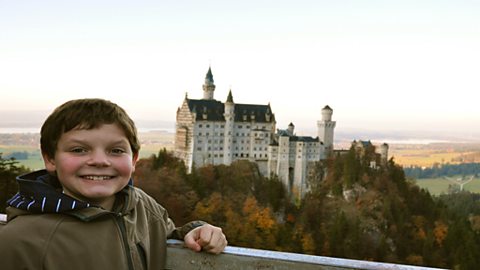
A child-led introduction to Cologne, Germany, suitable to support study of a European location at KS2.
The video
Nicholas: My name is Nicholas, and I am nine years old. I live in the city of Cologne.
Nicholas - TRANSLATED: It is the fourth largest city in Germany. You'll see that Cologne is a pretty busy place.
You can't say Cologne without mentioning the River Rhine. Because the Rhine is part of life here. The Rhine flows through the city and people live on both sides of the Rhine. My grandma lives very near the Rhine, and I visit her often. Sometimes we go off to high places and look at the views. You can even see castles. I like it when she tells me things about the river.
Did you know the Rhine is one of the longest and most important rivers in Europe? It is over 1,000 kilometres long. It’s source is in Switzerland, and it ends in Rotterdam in the Netherlands. I like strolling by the water's edge, because you can find so many things. It is a lot of fun, because you can watch the boats and wave to the captains.
SHIP HOOTS HORN
Sometimes they hoot and call us. My grandma says she has never seen the Rhine so low. When we were on a walk today, she said she had never seen those rocks before. This is because we haven't had enough rain. Usually, you can't play on these rocks because the river covers them all. My grandma can still remember when the river came right up to there. The river went up to over ten metres. But my grandma says that Cologne has a very good defence system, to protect us from floods.
It is very easy to get around Cologne with buses or a tram. But the best are the trains. You can get a normal train or you can get a high-speed train called ICE. ICE stands for Inter City Express. ICE is a fantastic express train, which can go up to 300 kilometres an hour. It's the fastest train in Germany.
There's also another fast train, it's called the double express. Here, people can sit upstairs and downstairs. When I travel from the main station, I always cross over the famous Hohenzollern Bridge. People have hungover 40,000 padlocks on it. These are love locks to show how much people love each other. Look at this one! When they've locked it, they throw the key into the Rhine.
If you walk over the bridge, you will come to the old part of town. That's where our famous cathedral is. It is one of the most visited sites in Germany. It took 750 years to build it. Cologne cathedral has the largest free-swinging bell in the world. It's called Fat Peter and weighs 24 tonnes.
But there's something else that Cologne is really famous for. The Christmas markets. We have seven really beautiful ones in Cologne. My sister and I love this one. Elves are hidden all over the place, but I can easily spot them.
The market in the old part of town is called the Elves Market. It is called this because of our very famous fairy-tale, The Elves of Cologne.
Nicholas: This is the famous story of Cologne.
Nicholas - TRANSLATED: There are so many lovely things! Over four million tourists visit the markets in just four weeks.
There's also a puppet stand. The lady selling the puppets at the stand was really nice and we chatted about the puppets for a long time. You can also learn a lot about wood cutting, because there's a wood sculptor there. If you come in December, you will be able to have loads of fun in the markets. Mmm! Yummy! Delicious!
Video summary
Download/print a transcript of the video.
Cologne lies in the German region of North Rhine Westfalia.
It is famous for the river Rhine, the Christmas markets and the cathedral. Many tourists visit each year.
The Rhine runs through Cologne and the city is very prone to flooding, so has developed some sophisticated flood defences.
Nine-year-old Niklas shows us what life is like in this city as he watches the river barges sail past, laden with cargo from the North Sea ports.
Cologne is situated on both sides of the Rhine and is dependent on bridges to keep the city connected and moving.
Teacher Notes
Download/print the Teacher Notes for this episode (pdf).
Teacher Notes prepared in partnership with the Geographical Association.
Central idea
- Places have a unique range of physical and human features.
Think, work and apply like a geographer
- Compare
- Sense of place
- Diversity
- investigate
Questions to explore
- Where is Cologne?
- How do rivers affect life in a city?
- Where are the source and mouth of the river Rhine?
- How do people travel around cities such as Cologne?
- Are all areas of a settlement the same?
- What makes a city different to a town or village?
- How do places change over time?
- What makes Cologne an attractive place to visit?
- What makes our local town/city a great place to visit?
Key learning outcomes
- To know that cities have a range of shops and services.
- To know how to locate Cologne on a map and explain where it is.
- To know that rivers usually start in uplands areas, flow to the sea and pass through towns and cities on the way.
- To know how to recognise human and physical features and decide whether they would attract visitors.
Geographical vocabulary
- City
- River
- Flood
- Flood defence
- Attraction
Suggested learning opportunities
Sights and sounds of a settlement
- Pupils record down the different sights and sounds that can be seen and heard throughout the video.Pupils predict which of these sights and sounds they will see and hear in their local area. Explore the local area and compare whether similar human and physical features can be heard and seen.
- Pupils could conduct a soundscape where they record down the sounds that they can hear in one location and then compare to another spot in the local area. This will support understanding around how sounds can be different over time and even close distances.
Come to Cologne
- Pupils explore maps and information pages about Cologne and create a leaflet for a guided tour of its main attractions. This should include a suggested route and incorporate modes of transport that will enable attractions on both sides of the river and even just beyond the city limits to be explored.
- Something similar to also be created for your local town or city.
Ideas for going further and links
- Pupils could investigate which countries the river Rhine flows through and investigate the role the river has in the development of a city such as Cologne. This can include the challenges that a large, flood prone, river presents to the city and how these are managed.
KS2 Geography: A location in Europe - Hamburg, Germany
KS2 Geography: Rivers - the course of a river from source to mouth
KS1/KS2 Primary Geography: Rivers
This clip will be relevant for teaching Geography at KS2 in England and Northern Ireland, Progression Step 3 in Wales and 2nd and 3rd level in Scotland. The National Curriculum for Geography at Key Stage 2 emphasises study of a European location and making comparisons with a location in the United Kingdom.
A location in Europe - Haarlem, Netherlands. video
10-year-old Mika describes the traditional Dutch architecture of her hometown of Haarlem, Netherlands.
A location in Europe - Rotterdam, Netherlands
11-year-old Martina introduces the busy port of Rotterdam, Netherlands, where her parents work.
A location in Europe - Veere in the province of Zeeland, Netherlands. video
Nine-year-old Robbert introduces his hometown of Veere in the province of Zeeland, Netherlands.
A location in Europe - Kinderdijk, Netherlands. video
Nine-year-old Donna introduces Kinderdijk - a region famous for its canals and windmills.
A location in Europe - the North Frisian island of Sylt, Germany. video
11-year-old Helen explains what life is like on the German island of Sylt.
A location in Europe - Inzell, Germany. video
11-year-old Josephine introduces the physical and human geography of Inzell, in Bavaria.
A location in Europe - Hamburg, Germany. video
Nine-year-old Zoe introduces the physical and human geography of Hamburg, Germany.
A location in Europe - Füssen, Germany. video
12-year-old Philipp introduces Füssen in the Allgäu region of Bavaria.