Scouting DR Congo - where England can win the game

Newcastle United's Yoane Wissa is among the more well-known DR Congo players
- Published
In the knockout stages of a major tournament, there is a genuine risk of elimination irrespective of the opposition.
Germany's elimination at the hands of Paraguay - a team that started the World Cup losing 4-1 to Mauricio Pochettino's USA - proves that point well.
England's next opponents, DR Congo, finished their group in third place, beating Uzbekistan, drawing to Portugal and losing to Colombia, but how do they play and what challenges might they pose against head coach Thomas Tuchel's men?
DR Congo face England on Wednesday (17:00 BST), live on BBC One and iPlayer.
Throughout the tournament so far, they have set up in a 5-3-2 formation, a shape that has been consistent both on and off the ball.
Their average possession so far sits at 38.8% which pales in comparison to England's 65.7% - second only to Spain (70.3%). This suggests that DR Congo are a stubborn defence-first team looking to spring counter-attacks on their opposition.
And while this is mostly true, they are surprisingly front-footed in how they defend.
This could change against England, but against both Portugal and Columbia, opponents that dominated the ball, DR Congo pressed high against them from goal-kick situations.
From their defensive block, they look to hold their line higher than you would expect from a team with 38% possession, not dropping into their own box as often.
There is also a tendency for their players to apply pressure, particularly to the player on the ball, and nearby team-mates around the ball.
All of these decisions, although more proactive than simply camping in their own box, are quirks England could look to exploit.

Although they have defended well, it is not uncommon to see DR Congo set up their 5-3-2 shape as high as this. This keeps teams away from their goal, but it does make them vulnerable to long passes over the top
From goal-kicks, we can see DR Congo's two strikers and three midfielders take advanced positions looking to press the opposition's keeper, centre-backs and holding midfielder.
Their wing-backs are tasked with pressing the full-backs and in defence, the three centre-backs are left to defend against three attackers.
They are ready to go man-to-man everywhere, which plays into England's hands.
While the pressure could force an England error but with a squad used to dealing with high presses particularly at club level in the Premier League, Tuchel will be hoping their technical quality does not fail them.
Where England may get some joy is in using wide full-backs in these deeper areas of the pitch. The idea being, by playing low, the marking DR Congo wing-backs have to press across larger distances.
The full-backs, if found in these situations, have more time and space on the ball so we could see England return to playing down the sides of the pitch, through what Tuchel describes as their "wide units" - full-back, midfielder and winger - rotating to pull the DR Congo players out of position, targeting this weakness.

Following a goal-kick, Colombia's full-back has time on the ball because of his lower starting position. DR Congo press in a man-to-man fashion but through clever rotations, Colombia's midfielders pull DR Congo's midfield out of the way, opening a direct pass into the forward dropping deep. We have seen similar ideas from England against Croatia - namely in Declan Rice moving into wide areas to free up space for Harry Kane to drop deep.
Another key point to note is that Tuchel has built his squad to entice pressure, before "accelerating through the middle third" - a phrase used by England assistant coach Anthony Barry.
The idea being, by pulling the opponent's attack and midfield away from the defensive line, there is more space and there are fewer defenders between your attackers and the goal.
This concept explains why the likes of Elliot Anderson and Harry Kane, at times, launch direct passes from deep into powerful runners in behind, and why England looked better against a pressing Croatia side than they did against a smartly passive Ghana.
Whether pressing high or defending in a block in the middle of the pitch, DR Congo have continued to apply some forward pressure against Colombia and Portugal.
Tuchel will likely be hoping the opposition stick to that plan as his side will look to release the likes of Jude Bellingham, Marcus Rashford, Anthony Gordon and Noni Madueke in behind.
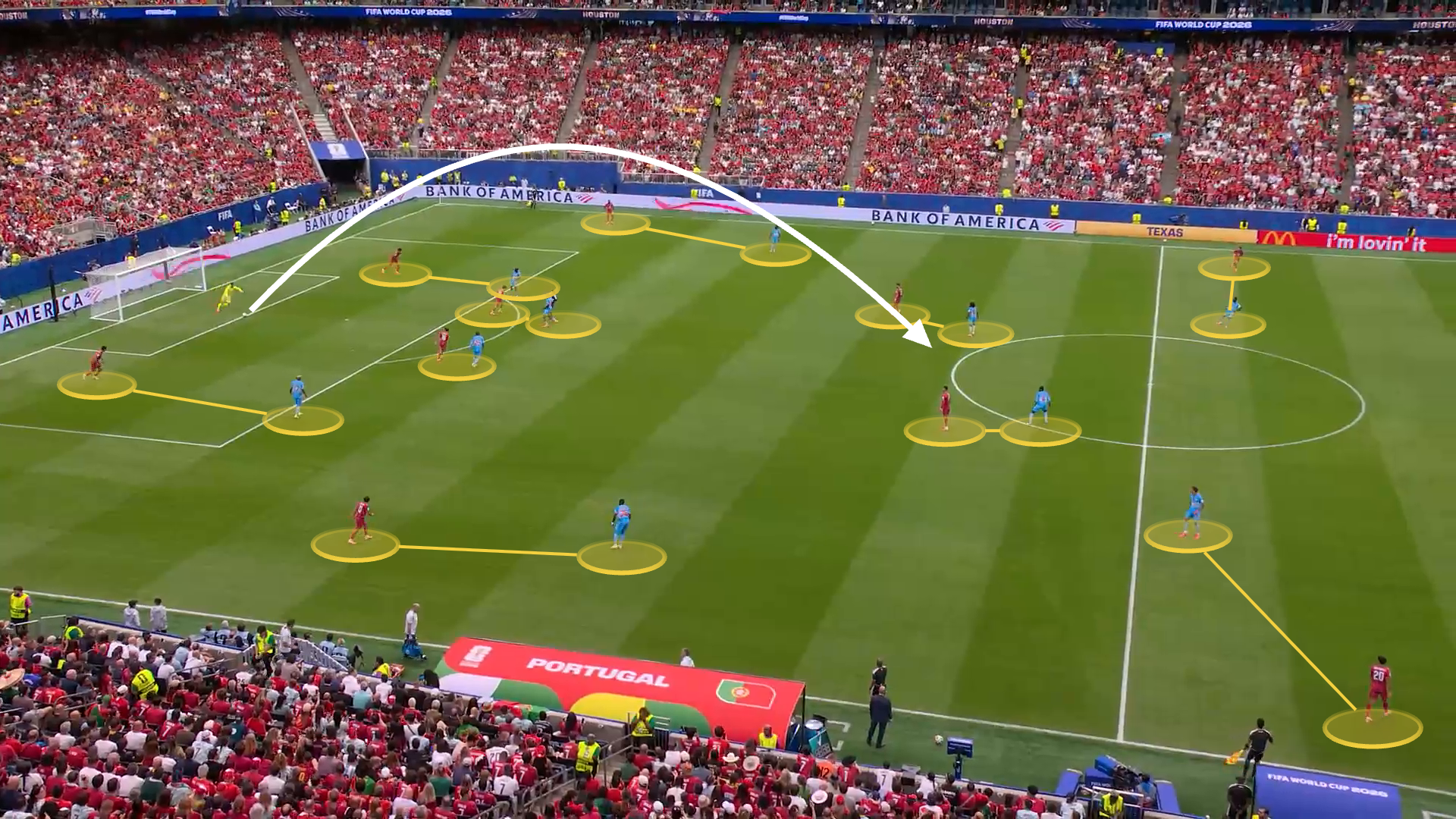
Image caption, Here we can see DR Congo's man-to-man approach from goal-kicks. With Portugal leaving attackers high and dropping everyone else towards the ball, the middle of the pitch is empty. Going long gives Portugal a four against four situation


1 of 2
In their defensive block, DR Congo's front two often apply pressure to the centre-backs on the ball while screening passes into defensive midfielder but if teams build with more than two players in the first line, their attackers are outnumbered.
It has then been the tireless job of the nearest central midfielder to push up and apply pressure - something of which England can take advantage.
Nico O'Reilly or a central midfielder like Jude Bellingham or Declan Rice, could pin that central midfield infield, opening up an unmarked pass out wide.

Colombia used a traditional back four against DR Congo to great effect. With DR Congo's two strikers blocking the middle of the pitch and the wide central midfielder and wing-back pinned by Colombia players, the full-backs could provide an overload on the flank. This is an approach I could see England copying
A third central defender playing in the role Jarell Quansah did in England's last game could trigger DR Congo's wide midfielder to press before England combine to move the ball into the space vacated by that midfielder.
There was a bigger focus from England on passing the ball through the centre of the pitch against Panama, so it will be interesting to see if this is a pattern that continues.

Here we see an example of a third central defender pulling a DR Congo player out of the midfield line. This leaves a big space behind him that England might look to target
Against Ghana's resolute 4-5-1 low block, Tuchel was heard instructing his players to play "short, short, short" then "a long switch", hoping to see his wingers receive the ball unmarked in space.
We will likely see this once more against DR Congo.
With only three central midfielders, overloading one side of the pitch and playing short passes to pull DR Congo closer to the ball leaves a gap on the far side of the pitch. Playing a long pass here would result in an England winger with time to run at, and beat the wing-backs.
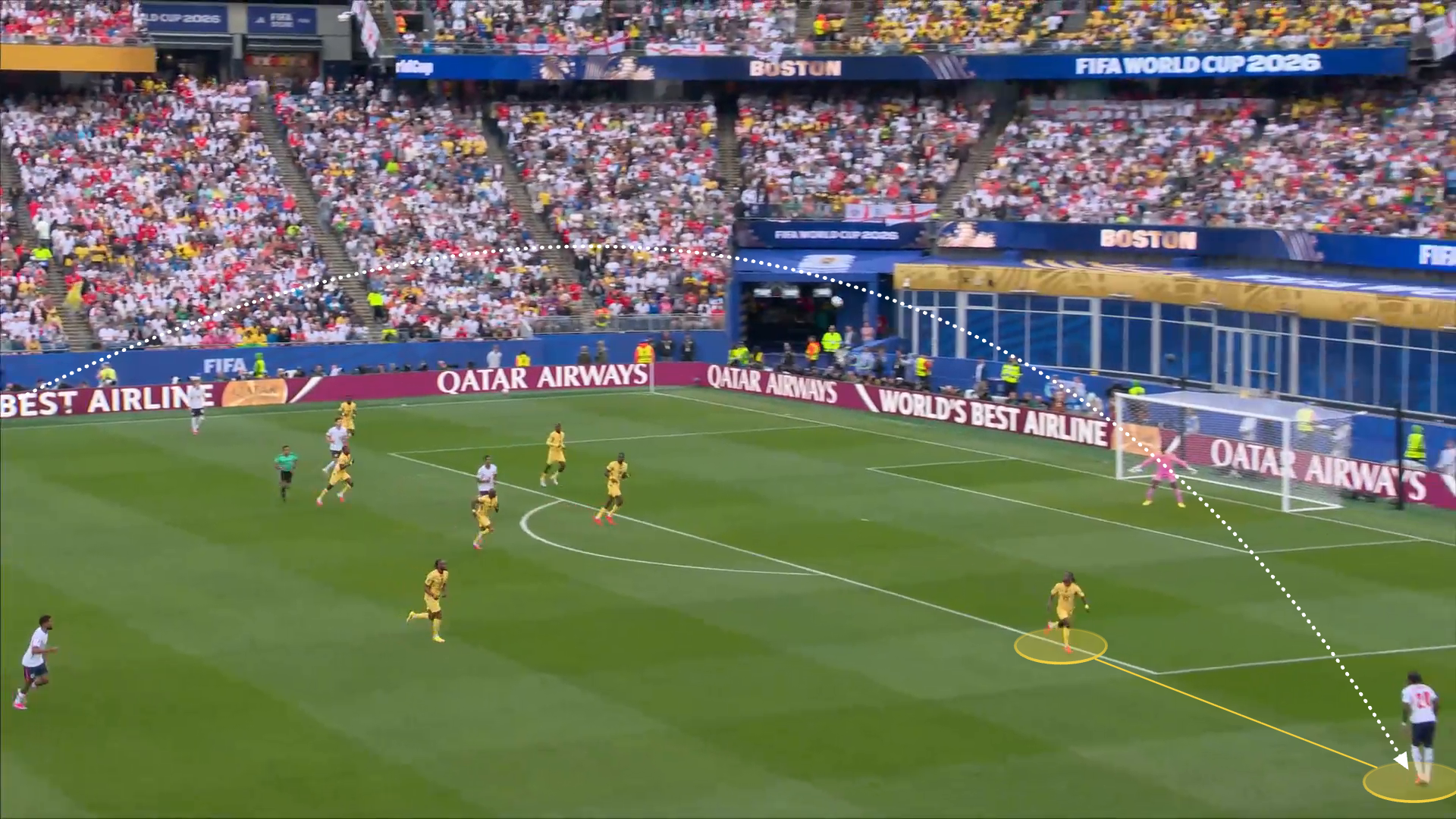
Image caption, This is an example of the long switches Tuchel encouraged England to play to find attackers in space against Ghana's impressive defence


1 of 2
And DR Congo's lack of width across the midfield can be exploited through simple horizontal passes from one side of the pitch to the other. There is naturally a risk with passing across the pitch in this manner, but we saw Spain expertly undo Saudi Arabia in the group stage, taking advantage of this same idea.

Here Spain have dragged Saudi Arabia's midfield four across the pitch and towards the ball before switching play to the right, where full-back Pedro Porro and winger Lamine Yamal are free
A safer scenario in which this weakness can be targeted is at throw-ins.
At this World Cup, DR Congo have committed many players to surrounding the area around a throw-in in the opposition's half. It has been easy for teams to find a player from the throw unmarked and given DR Congo's relative lack of width, a first-time pass back to the thrower before looking to switch play could quickly get England in a good attacking position.
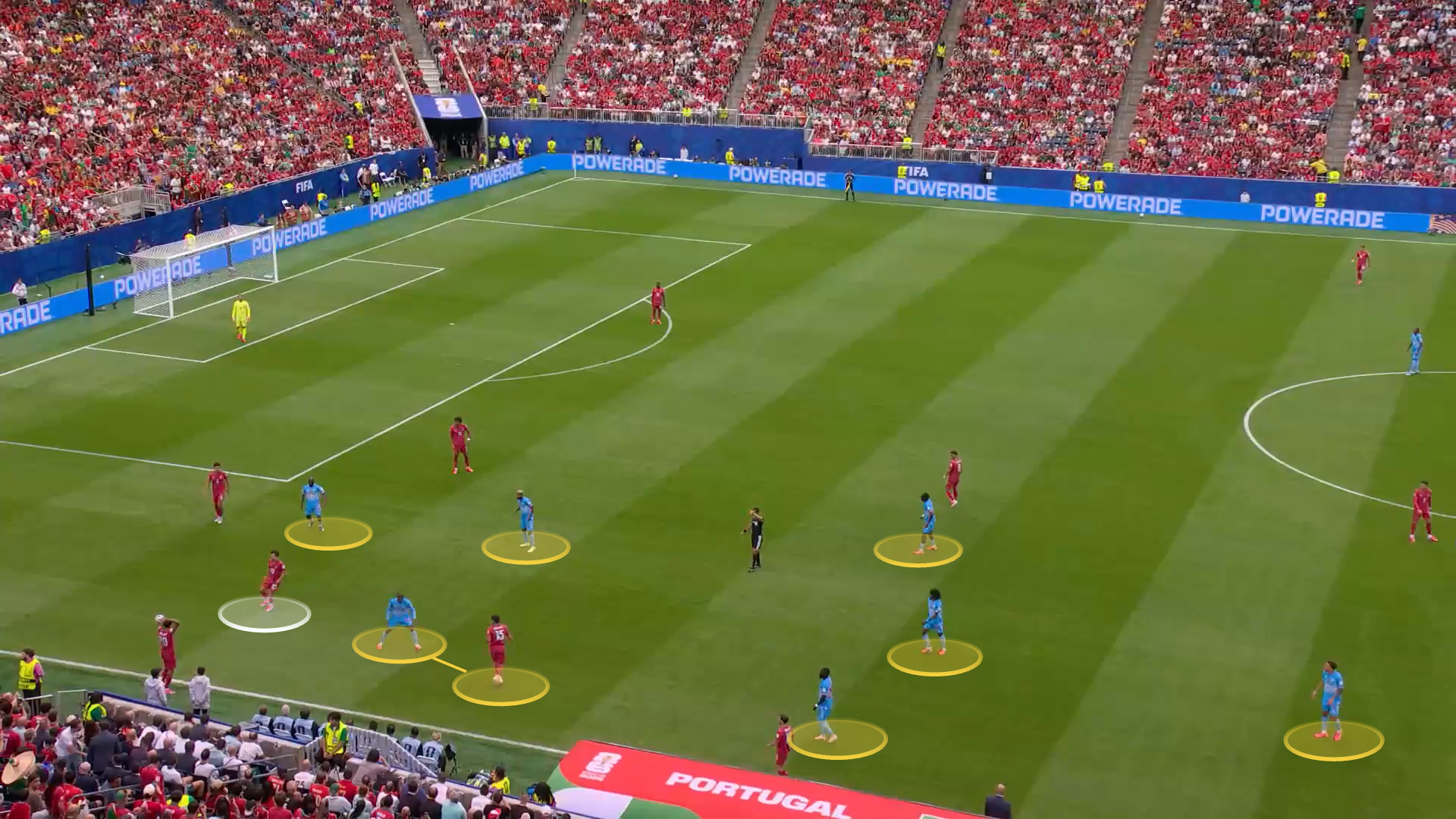
Image caption, Joao Neves drags the closest Congo player away from the thrower whilst Vitinha shows for the ball, unmarked


1 of 2
All of this is not to say that DR Congo do not carry their own threat.
From goal-kicks, they often build up short but in an unconventional manner. Their back three is spread wide, forming a back four when the keeper is involved.
The wing-backs take wide positions and a holding midfielder sits in front. The remaining two midfielders and two forwards' positions are harder to read but they crowd around where longer passes are aimed rather than staying in predetermined zones, which can help them get control of loose balls more reliably.
This widely spaced shape in build-up makes DR Congo's passing more risky and whilst Portugal did get some joy applying pressure to dispossess DR Congo's midfielders, this style of build-up makes it harder for opponents to press DR Congo cohesively because of the large distances they have to cover as a unit.
It would be naive to ignore their most dangerous player too, with Yoane Wissa's ability to read attacking situations and react quickly in the box a big threat for any side in world football.
