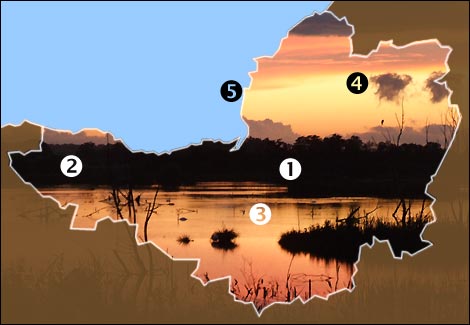
I've been watching wildlife since I can remember and aspire to be a wildlife journalist. I have travelled the county searching for wildlife hotspots, and I have whittled down my top five places where you can watch nature in Somerset. Here's the countdown from five to one: 5: Brean DownThe area is great for bird migration as the Down juts out into the Bristol Channel. When I visited the area with my colleague Adam Thomas and wildlife expert Chris Sperring, we watched ravens and meadow pipits forage there. "The place is great for migrating birds and peregrines can be seen at the Down," Chris Sperring says. In winter, black redstarts are often present at Brean Down as are flocks of winter thrushes. Redwings and fieldfares spend the winter in the UK and stock up on our berries, before returning north-east to their breeding grounds. Marbled whites and meadow browns frequent the area in summer along with other species of insect. OS map reference: ST297587 4: Chew Valley LakeChew Valley Lake is the largest man-made lake in the region and holds a wide variety of wildlife. Tim McGrath from Avon Wildlife Trust says the lake is important to birds. "From August to March there can be over 12,000 birds present at any one time! The site is notable for its winter numbers of wildfowl and is also nationally important for little- and great-crested grebes, teal and coot." 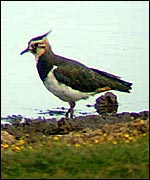 | | Lapwing |
In spring the reedbeds are alive with warblers. I've seen reed, sedge and the extremely loud Cetti's warbler, whose call blasts from the reeds and drowns out virtually every noise in the near vicinity! A wide variety of waders can be seen on the muddy shores (in times of low water in late summer) including lapwing, dunlin, ringed plover and green sandpiper. Apart from the birds the site is also important for other wildlife. "In one field by the shore of the lake, there is a large population of green-winged orchids, the extensive reedbeds hold harvest mice, and otters have also been recorded," Tim says. Visitors can access the reserve by purchasing a permit from Woodford Lodge, which is located on the north-western shore off the B3114. OS map reference: ST573614 3: West SedgemoorAs the water levels increase the wildfowl begin to appear. In winter various species of duck (wigeon, teal and pintail) and wader (snipe, lapwing and golden plover) appear. In winter waterfowl counts exceed 50,000 on a regular basis! These in turn attract birds of prey including the peregrine which swoop through the flocks trying to chase an individual. 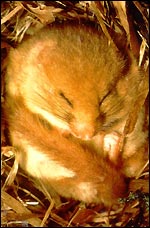 | | Dormouse |
Swell Wood is famous for one of the largest nesting grey heron colonies in the West Country, which can be viewed from the hide. Dormice live in the hazel coppice, although are hardly ever seen. In spring orchids, primroses and bluebells carpet the ancient woodland. In winter the wood is alive with a wide range of birds (woodpeckers, finches and thrushes). Roe deer also retreat to the wood in winter but throughout the rest of the year can be seen on the fields browsing. When I was very young, I can remember watching a badger strolling along the road from the woodland, totally oblivious to us. OS map reference: ST361238 2: ExmoorExmoor has arguably some of the wildest and remotest sites in the county, and is home to the famous red deer. In spite of being Britain's largest native land mammals, they can be surprisingly difficult to find. I found a trip on the bus from Taunton to Ilfracombe provided views of these animals (and no walking was even necessary!) The wide expanse of woodland on Exmoor (largely made of sessile oak) is home to a vast array of birdlife, including a number of summer visitors. Redstart, wood warbler and pied flycatchers all migrate to Britain for the summer, and can be seen in various locations on Exmoor. Two species of insectivorous (insect-eating) plants live on Exmoor, the pale butterwort and sundew. 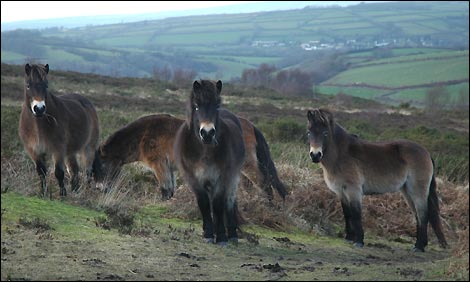 | | Exmoor ponies (John Burgess) |
Ecologist Alison Cox from Exmoor National Park says: "Both plants live in boggy, inaccessible locations where they use their sticky hairs on their leaves to trap insects." The heath fritillary butterfly is a very scarce species in the UK. "They have declined hugely in the UK, but there has been a lot of work to increase numbers on Exmoor," she says. "They live in hedges between heath and woodland, and numbers are increasing at various sites." 1: ShapwickThe reserve covers a huge expanse of reedbed and marsh, which are buzzing with wildlife. Otters are resident here, and site manager Phil Holms says: "You've a better chance of seeing them in the daytime than anywhere else in England!" 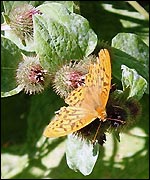 | | Silver-washed fritillary |
On seeing my first otter here many years ago, I was surprised how large they are in comparison to the Asian small-clawed ones which are found in most zoo collections. "The population density of both otter and Cetti's warbler is probably the highest in the country." The reserve has a huge diversity of species. "There are 24 species of resident mammals, including water vole and lesser horseshoe bat and twenty-seven butterfly species including the silver-washed fritillary," Phil adds. "During May up to 50 hobbies (a summer migrant falcon) can be seen feeding over the reedbed." Ospreys migrate through the reserve and bitterns are occasionally recorded in winter at Shapwick and at the nearby Ham Wall RSPB reserve. OS map reference: ST423412 / ST449397 Starling stormWesthay Moor Nature Reserve also contains similar species to Shapwick but its main claim to fame is its huge starling roost. 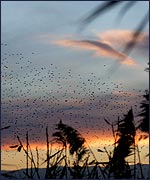 | | Starlings over Westhay (Lynne Newton) |
In winter the birds roost in the reedbed, and numbers in 2005/6 were estimated at times between six and 10 million! This in my opinion is one of Somerset's greatest natural spectacles - despite the likelihood you will be showered in bird droppings! OS map reference: ST456437 Next-door neighboursYou don't even have to clock up any miles on the old motor to see wildlife; a wide range will be living in YOUR garden. Hedgehogs, foxes and many birds use gardens as corridors to pass from different feeding sites. Many mammals pass through at night, while birds vary with the season and can be attracted by food and water. Adding a pond can encourage birds, frogs, newts, dragon- and damselflies, which is a great way of watching wildlife from your sun-lounger in summer! |