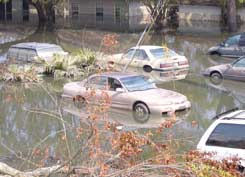
Modern day New Orleans was a city that defied the odds. Built on a mosquito-infested swamp surrounded by water, it sits in a bowl 2.5m below sea-level. Its very existence seemed proof of the triumph of engineering over nature. The storm hits
But on the 29 August 2005 the city took a direct hit from Hurricane Katrina and overnight turned into a Venice from hell. In the chaos that followed the worst natural disaster in American history, a forensic investigation has begun to find out what went wrong and why. Scientists are now confronting the real possibility that New Orleans may be the first of many cities to face extinction. The forensic analysis
Professor Ivor Van Heerden of Louisiana State University's Hurricane Centre used computer modelling to simulate hurricane paths across New Orleans. He had been appointed by the state to discover why New Orleans flooded so catastrophically and had his own unique methods of gathering data. By collecting eye-witness testimonies from residents and the stopped clocks from their flooded homes, Van Heerden pieced together a timeline of the levee breaches. He also took samples from the breach sites for analysis. His results were shocking. He believed they showed that there was a design fault in the levees. "The old system that led to the design and the building of them, the funding, the decision making process, didn't work. We've got to change that and part of that is going to be for the federal government and the engineers corps to step up to the plate and say we screwed up." The coast is disappearing into the sea
Over the years the levees and dams stopped annual floods from the Mississippi River. As a result sediments that were brought down by the river to replenish the land were prevented from reaching their natural destination. Gradually Louisiana started to lose its coast. Today it has the highest rate of coastal land loss in North America. Every 20 minutes an area the size of Wembley stadium is swallowed up by the sea. Shea Penland, a coastal geologist at the University of New Orleans, knows every inlet, every cove and every stretch of marsh that surrounds the city. He also knows that Louisiana's wetlands, thought of as wasteland for years, are in fact critical to the survival of the city. Providing protection against storm surges, these wetlands are a natural defence against the onslaught of hurricanes. As he says: "The first line of defence isn't the levee in your backyard, the first line of defence is that marsh in your back yard and we're learning what that means." After the disaster, he chartered a seaplane to investigate the overnight loss to Louisiana's precious wetlands. What he discovered sounded like the death knoll for the city. In just one night, Louisiana had lost three-quarters of the wetland that it usually loses in one year. Without this protection, New Orleans is a sitting duck against future storms. And the problems don't just stop there. The city itself is sinking. Since 1878 it has dropped by 4.5m, one of the highest rates of subsidence in the entire United States. Once again it's mainly human intervention that is to blame. According to Professor Harry Roberts, a geologist at the Louisiana State University: "It's been accelerated by man's efforts to keep the water out of the city. When you pump the water out of those kinds of soils they start to collapse and even more importantly the organic material oxidises and goes away so you've taken out one component of the soil, and all that adds up to subsidence." The future
The city will have to change to survive. There will have to be a paradigm shift in the thinking about the environment surrounding the city. What was once ignored as wasteland, will now have to be protected. Radical plans are also underway for the city itself. Local urban planner Professor Bruce Sharky believes that the survival of the city is dependent on preserving its lowest lying areas, its devastated residential areas, as parkland. Areas like the Lower 9th Ward, built 2.5m below sea-level and where hundreds of people died, will exist no more. They will be turned into green spaces, serving both as buffers against future flood waters and as a reminder that sometimes nature should be left alone. The residents of New Orleans who lived in the Lower 9th are fighting this idea but ultimately the survival of the city for future generations may depend on it. The future for New Orleans is today uncertain. The city is sinking city, sea levels are rising, and there is an increased intensity of hurricanes. The challenges ahead are enormous, but in some form New Orleans will be rebuilt. However, one lesson will reverberate around the world – humankind cannot take on mother nature and think it can win every time. "For man as a species we have to respect mother nature," says Dr Penland. "We have to realise that there are boundaries that have been given to us that we have to respect and our technology cannot be 100% successful all of the time." Back to top Back to the Horizon homepage |