

Sand mandala
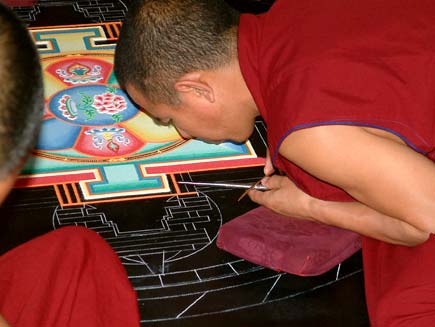
Beginning the mandala
A mandala is a symbolic picture of the universe, used in Tibetan Buddhism and other faiths.
First, the design of the mandala is marked with chalk on a wooden platform. This meticulous process takes an entire day.
Then the monks use metal funnels called chak-pur to place millions of grains of dyed sand to make the elaborate patterns.
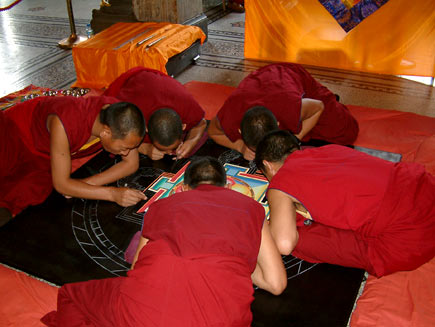
Purpose of a mandala
The mandala sand painting process begins with an opening ceremony, during which the lamas consecrate the site and call forth the forces of goodness. The monks chant and dance in resplendent dress.
The mandala's purpose is to help transform ordinary minds into enlightened ones and to assist with healing.
Tsepak Rigzen explains how and why the mandala is created (3:24 mins)
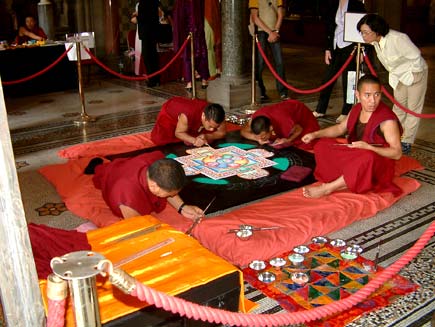
Mandalas' place in Buddhism
According to Buddhist scripture, mandalas constructed from sand transmit positive energies to the environment and to the people who view them. They are believed to effect purification and healing.
Mandala sand painting was introduced by the Buddha himself and there are many different designs of mandala, each with different lessons to teach.
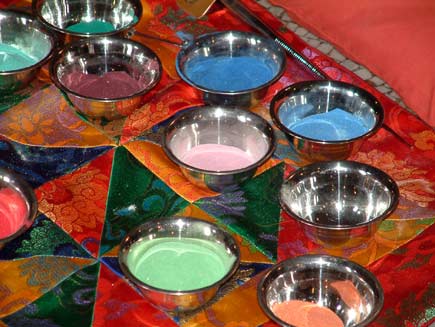
The sand
The sand used in this mandala, constructed at Manchester Town Hall in 2003, was actually ground marble from Southern India.
A mandala does not have to be made of sand: it can be a painting on a wall or scroll, or a visualisation in the mind of a very skilled adept.
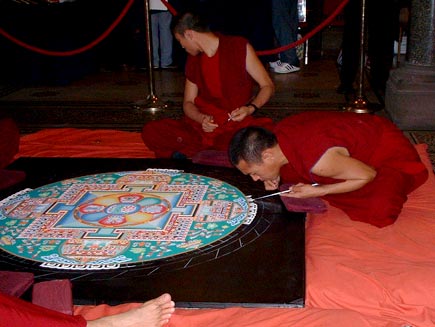
The monks
The mandala is constructed from the centre outwards.
The monks creating this mandala came to the UK from Drepung Loseling Monastery near Lhasa in Tibet. Sand mandalas are particularly used in Tibetan Buddhism.
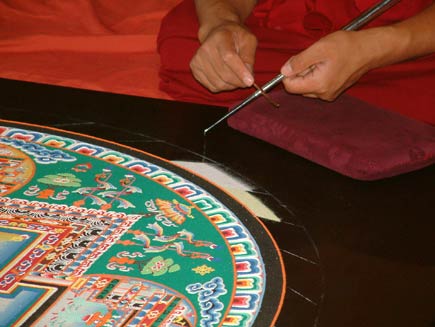
Chak-pur
The vibrations of the serrated chak-pur being grated with a metal rod cause the sand to flow like liquid.
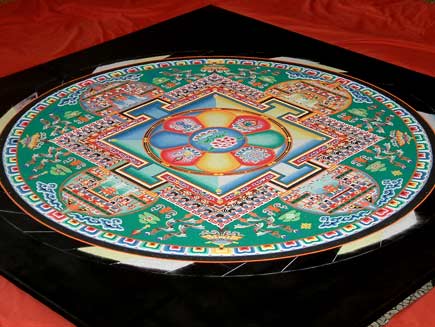
An imaginary palace
The mandala represents an imaginary palace that is contemplated during meditation. Each object in the palace has significance, representing an aspect of wisdom or reminding the meditator of a guiding principle.
The Tibetan mandala contains deities, with the principal deity in the centre of the pattern. The deities who reside in the palace embody philosophical views and serve as role models.
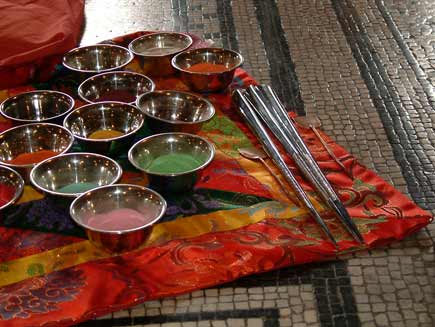
Other mandala materials
Other popular substances for the 'sand' are powdered flowers and herbs or grains. In ancient times, powdered precious and semiprecious gems were also used.
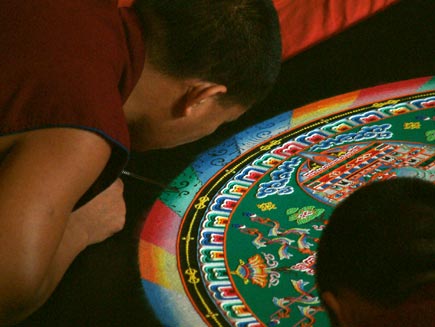
Finishing the mandala
This mandala took six days to complete. A monk adds final detail to the borders.
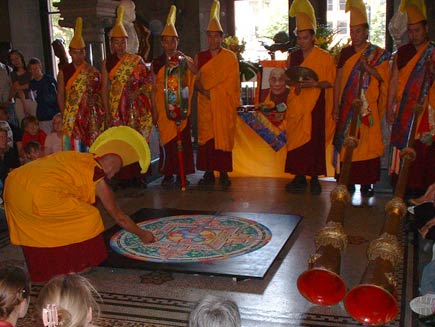
Destroying the mandala
Once the mandala is complete, it is ritually destroyed.
The monks ask for the deities' healing blessings during a ceremony. As they chant, one monk begins the destruction of the mandala by scraping a knuckle through the sand.
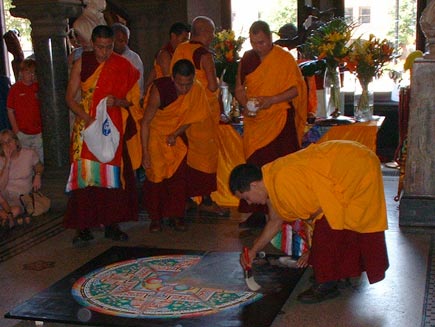
Sweeping the sand
Another monk uses a paintbrush to sweep the sand, slowly and carefully, from the perimeter to the middle of the mandala.
The destruction of the mandala is intended as a reminder of the impermanence of life.
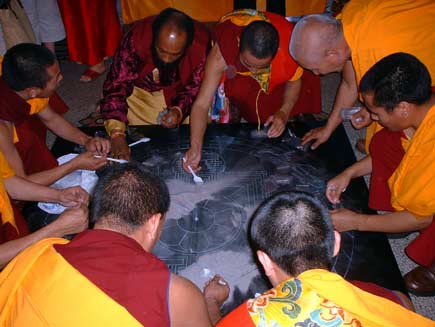
The sand is collected
The coloured sand, now reduced to heaps of nondescript grey, is carefully collected and swept into an urn.
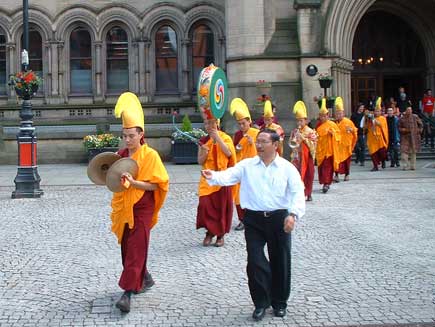
Taking the sand to the river
The monks proceed to a nearby river to scatter the sand.
This is a way of extending the healing powers to the whole world. It is seen as a gift to the mother earth to re-energise the environment and universe.
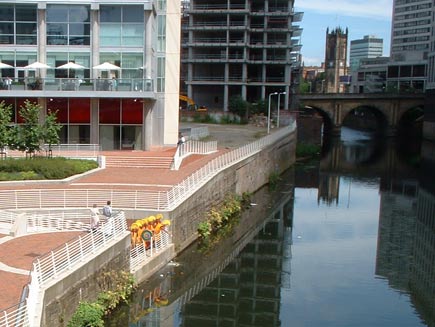
Scattering the sand
The sand is tipped into the flowing water of the River Irwell.
Blackfriars Bridge and Manchester Cathedral can be seen in the background.
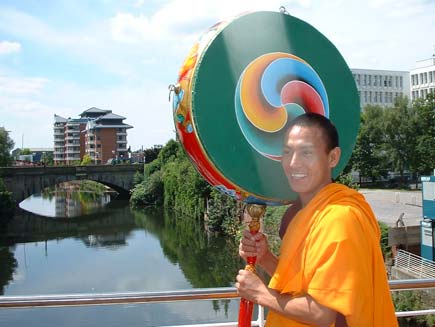
Music and dance
Music, costume and dance form an important part of the ceremonies. The instruments used also have spiritual significance.
Tsepak Rigzen explains the significance of the music and dance (3:13 mins)


