

Egypt's Coptic Christians
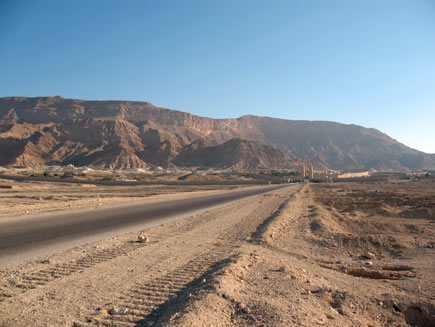
Approaching St Antony's Monastery
The Copts are the Christians of Egypt, a community of over five million people that proudly preserves its traditions, calendar and liturgy.
The Eastern Desert, to the west of the Egyptian coast of the Red Sea, was the place chosen by Saint Antony (251-356 CE) to escape the world and come close to God in solitude. The monastery was founded by Antony's disciples, immediately after his death, on the site of his grave.
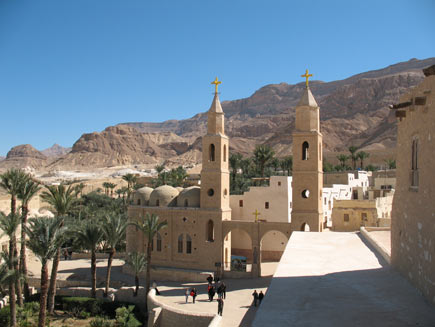
St Antony's Monastery
Inside the walls of the monastery there is a self-contained village that consists not only of churches, lodgings and the usual defensive keep but also orchards, fruit gardens, warehouses, a mill house and a library.
The spring here still provides thousands of gallons of drinking water each day.
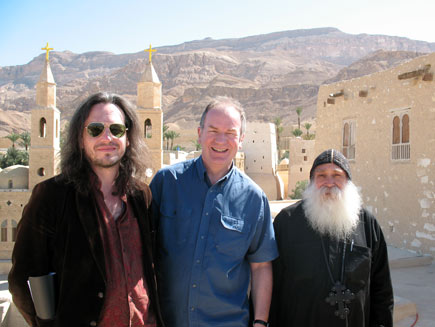
Nicholas Buxton, Stephen Shipley and Father Ruwais
(Left to right:) Sunday Worship presenter Nicholas Buxton and producer Stephen Shipley meet Father Ruwais at Saint Antony's Monastery.
Saint Antony's Monastery suffered attacks and plundering over many centuries, but in the 16th century, Syrian monks from Wadi al-Natrun settled there and restored it. Fr Ruwais talked to Nicholas Buxton about life in the desert. (3:08 mins)
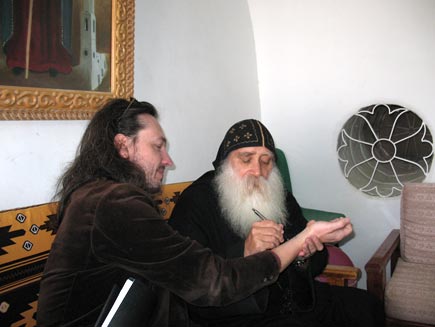
Father Ruwais draws St Antony on Nicholas's arm
Father Ruwais offered to draw a picture of Saint Antony on Nicholas's arm!
Antony was born in Coma in the Fayum region of Egypt. His parents were well off, but Antony gave away his inheritance and devoted himself to the religious life.
In those days ascetics lived on the outskirts of their home communities and did not withdraw entirely. Antony's decision to live in absolute solitude was unusual.
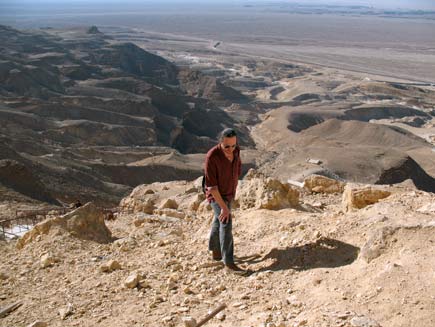
Climbing up to St Antony's Cave
Saint Antony was the founder of Christian monasticism.
It was around 270 CE that Antony (251-356) decided to follow his vocation and live in the desert. For forty years he lived in a cave 2000 feet up a mountain. A steep staircase, over a mile long, now links the monastery to the cave. Before leaving the UK, Nicholas asked Bishop Angaelos, General Bishop of the UK Coptic Orthodox Church, about the history of the Copts. (3:10 mins)
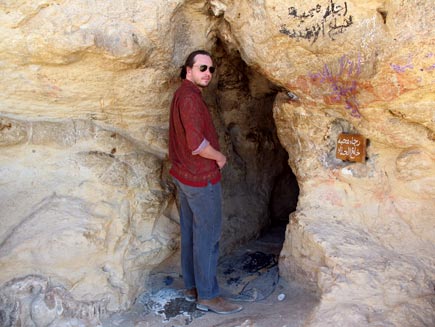
Entrance to St Antony's Cave
Nicholas stands at the entrance to the cave where Antony spent forty years in solitude.
The main source for information about Antony's life is a biography attributed to Saint Athanasius. The story tells of his battle with demons in the shape of wild beasts and later wading unharmed across a crocodile-filled river.
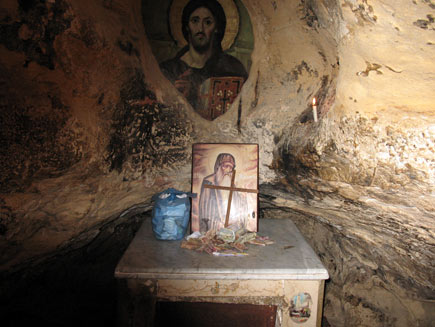
Altar in St Antony's Cave
A simple altar in Saint Antony's Cave supports an icon of Antony, a wooden cross and a collection of offerings left by visitors.
Coptic Christians are the largest and oldest Christian community in the Middle East. The word Copt is derived from the name Aegyptioi, Egypt, transcribed in the Arabic alphabet.
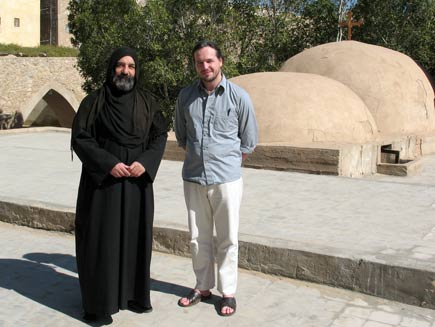
Father Irenaeus and Nicholas at St Macarius Monastery
Nicholas meets Father Irenaeus at the Monastery of Saint Macarius in the valley of Scetis, also called Wadi Natrun.
Coptic Christians particularly revere St Mark the Evangelist who, according to tradition, arrived in Alexandria, Egypt, around 48 CE and who made many converts among the population. Fr Irenaeus told Nicholas about daily life at the monastery. (4:09 mins)
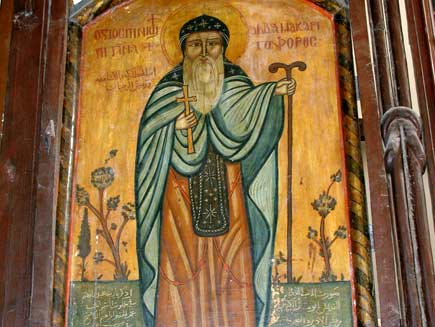
Icon of St Macarius
Saint Macarius the Elder, or Macarius the Egyptian (circa 300-390 CE), was a disciple of Antony and founded a monastic community that settled in the Nitrian and Scetic deserts. The community had thousands of members by the time of Macarius's death.
Alone in the desert
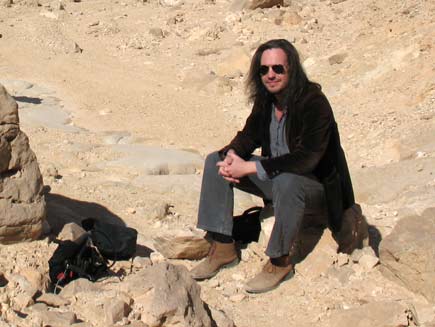
Nicholas enjoys some contemplative time.
Christianity, like other desert religions, has a long tradition of spending time in the wilderness. In this broadcast talk Jude Kelly, artistic director of London's Southbank Centre, meditates on what the wilderness means to us nowadays. (13:49 mins)


