BBC-Pair Dataset: A dataset for training and evaluating detection of ai-generated media
Paper 430: We believe that artificially generated content will have a measurably detrimental impact on the pursuit of facts and hence journalism.
Download


A few years ago, spotting a fake image was often as simple as counting fingers or squinting at blurry edges. Today, those tells are gone. AI-generated images are sharper, faster to produce, and increasingly indistinguishable from real photography - even to trained eyes.
For journalism, this creates a serious problem. Images aren’t just an illustration of a story; they can add trust. When that trust is undermined by synthetic or partially manipulated visuals, the damage spreads far beyond a single article.
So we’ve been asking a difficult question: how do we give journalists and researchers the tools they need to detect AI-generated images at the pace they now appear? One essential part of the answer is data, which is required to create and evaluate AI detection tools, and that’s where BBC PAIR comes in.

Most successful detection tools start the same way: with a shared benchmark dataset. ImageNet did this for object recognition. MNIST did it for handwritten digits. But for AI-generated imagery, no such standard has existed.
Instead, researchers have been working with:
Small, one-off datasets that can’t be reproduced,
Low-quality proxies that don’t reflect real-world use,
Images generated by outdated models that no longer represent the threat landscape.
Even more concerning for journalism, almost no datasets focused on partial image manipulation - cases where only part of a real photo is altered. These edits are far harder to spot, and far more dangerous when used to distort reality without rewriting it entirely.
We've created BBC PAIR to fill that gap: a dataset that reflects how AI image generation is actually being used today by focusing on the issues of image editing with AI models and not just focusing on fully generated AI images.
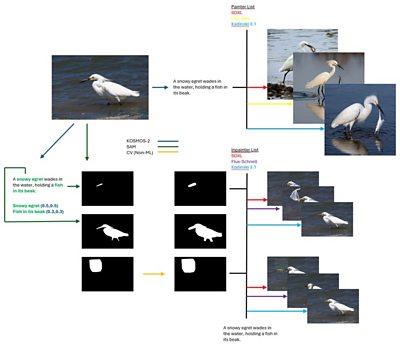
BBC PAIR - the BBC Paired Artificial Image Repository - pairs real images with both fully synthetic and partially edited versions, while preserving their semantic meaning.
At a high level, the dataset contains three kinds of images:
Base images - real photographs sourced from Google’s OpenV7 dataset,
Whole image generation - fully AI-generated images created from captions describing the base image,
Partial image generation (inpainting) - real images where specific objects are replaced or altered by AI.
To make this work at scale, we combined several AI systems:
KOSMOS 2 to generate detailed image captions and identify objects,
Segment Anything (SAM) to create precise object masks,
A wide range of diffusion-based generative models to produce both whole and inpainted images.
We designed BBC PAIR with expansion in mind: we provide the metadata and code scaffolding to create a larger version of the dataset, inpaint new objects, or add new image generation models.
Each real image is linked - via detailed metadata - to all of its generated counterparts. This allows researchers to train detection models that focus on meaningful differences, not superficial pixel artefacts. For instance, a FLUX based model might favour producing images of dachshunds when prompted with the word 'dog' whereas a Stable Diffusion model might favour Labradors. BBC PAIR hopes to allow researchers to use these distributional signals and hopefully many others that we are yet to discover.
Building BBC PAIR reinforced several important lessons, the most notable being that partial fakes are the hardest problem. Inpainted images, where only a single object changes, are far more challenging to detect than fully synthetic images - and far more likely to be used in misleading contexts.
Model diversity matters, every generative model leaves different pixel level traces and has its own idea of what the world is based on its training data. However training on every single image generator model is unfeasible due to time and money constraints. Therefore a robust detector must be able to generalise across architectures and not overfit to one image generator.
Finally, it is important to have rich, structured metadata. This makes it possible to evaluate detection methods rigorously and reproduce results across research teams, and build on the dataset.
This dataset has already proved useful by directly supporting a research collaboration with Oxford University: Towards Reliable Identification of Diffusion-based Image Manipulations which was published at NeurIPS 2025.
The final dataset includes:
15,200 base images,
Nine whole image generation models,
10 inpainting models,
Up to 440,000 paired images, stored losslessly.
Despite known shortcomings - such as occasional caption inaccuracies or minor mask biases - the dataset provides a strong, extensible foundation for real-world detection research.
The BBC PAIR dataset isn’t a finalised solution to AI-generated image detection. It’s a infrastructure provided such that the dataset can be expanded upon.
By releasing a large-scale, carefully paired dataset, we want to let the community develop better tools to verify visual evidence, and enable fair, reproducible comparisons between detection methods. We also want to encourage the research community to build, extend, and improve upon the dataset.
If you’re a researcher, journalist, or developer working in this space, we invite you to explore the dataset, request access, and contribute to its future.
White Paper copyright
© BBC. All rights reserved. Except as provided below, no part of a White Paper may be reproduced in any material form (including photocopying or storing it in any medium by electronic means) without the prior written permission of BBC Research except in accordance with the provisions of the (UK) Copyright, Designs and Patents Act 1988.
The BBC grants permission to individuals and organisations to make copies of any White Paper as a complete document (including the copyright notice) for their own internal use. No copies may be published, distributed or made available to third parties whether by paper, electronic or other means without the BBC's prior written permission.
Search by Tag:
- Tagged with Artificial Intelligence and Machine LearningArtificial Intelligence and Machine Learning
- Tagged with JournalismJournalism
- Tagged with PublicationsPublications
- Tagged with FeaturesFeatures
