
Enigma
Saturday 18/4/26, 3.00pm
Brangwyn Hall, Swansea
Sunday 19/4/26, 3.00pm
BBC Hoddinott Hall, Cardiff
Livestream


Grace Williams
Sea Sketches 18’
CamilleSaint-Saëns
Violin Concerto No. 3 in B minor 29’
INTERVAL: 15 minutes
Edward Elgar
‘Enigma’ Variations 31’
Jaime Martín conductor
Akiko Suwanai violin


BBC Hoddinott Hall is certified by EcoAudio and we’re proud to be supporting the BBC in becoming a more sustainable organisation. For more information on the BBC’s net-zero transition plan and sustainability strategy please visit https://www.bbc.co.uk/aboutthebbc/documents/bbc-net-zero-transition-plan-2024.pdf


The concert on 19 April is being broadcast live by BBC Radio 3 in Classical Live and live on BBC iPlayer and the BBC NOW website; it will be available for 30 days after broadcast via BBC Sounds, where you can also find podcasts and music mixes.
Introduction
A warm welcome to today’s concert, in which our Principal Guest Conductor Jaime Martín returns for a programme that begins close to home.
Grace Williams was in wartime London when she composed her Sea Sketches, but her longing for her hometown of Barry is apparent on every page. Aptly, the work was premiered by the strings of BBC Welsh Symphony Orchestra (forerunner of BBC NOW), conducted by Mansel Thomas.
Akiko Suwanai makes a welcome return to the orchestra for Saint-Saëns’s Third Violin Concerto – a piece in which he combines exuberant virtuosity (it was written for one of the greatest of all violinists, Pablo de Sarasate), gorgeous melodies and luscious orchestration.
To end, Elgar’s much-loved ‘Enigma’ Variations, in which he presents a portrait gallery of his friends and colleagues with a miraculous mix of affection and wit, majesty and wonder.
Enjoy!
Lisa Tregale
Director
Please respect your fellow audience members and those listening at home: mobile phones may be kept on but on silent and with the brightness turned down; other electronic devices should be switched off during the performance. Photography and recording are not permitted.
Grace Williams (1906–77)
Sea Sketches (1944)

1 High Wind
2 Sailing Song
3 Channel Sirens
4 Breakers
5 Calm Sea in Summer
Grace Williams worked as music mistress at the Camden School for Girls in London during the war and completed her Sea Sketches in August 1944. She dedicated the Suite to her ‘parents who had the good sense to set up home on the coast of Glamorganshire’, and the work was probably composed with memories of the sea views that could be seen from her family home in Barry. She often admitted to her London friends at this time that she dreamed of composing and living by the sea and, in 1947, returned home to live and work in Wales. Fittingly, her Sea Sketches were premiered in March of that year by the strings of BBC Welsh Symphony Orchestra, conducted by Mansel Thomas.
The piece opens with a brisk ‘High Wind’ movement (Allegro energico) in which a fanfare-like melody in high-lying violins is developed against whirring demisemiquaver figures that are tossed between upper and lower strings – like flecks of sea foam in a strong wind. A calmer sea is depicted in ‘Sailing Song’ (Allegretto), initially captured by the gently rocking melody in violas, and different string colours (trills and pizzicato)are used to chart the course of the boat as the movement unfolds.
A nocturnal seascape is evoked in ‘Channel Sirens’ (Lento misterioso), which begins with the sound of a distant foghorn in muted violas and cellos and suspended, pulsing chords in upper strings. As the movement unfolds, Williams makes imaginative use of string textures and timbres – including harmonics, glissandos, solo and tutti passages – to suggest an eerie scene of boats navigating through heavy fog at night. The Lento’s haunted mood is soon dispelled by ‘Breakers’ (Presto), a sunny, scherzo-like movement that teems with tumbling chromatic scales and arpeggiated themes, bringing to mind waves breaking on the shore. In contrast, the final sketch, ‘Calm Sea in Summer’, is an Andanteof slowly rocking, braided melodic lines. This movement contains some intensely impassioned arguments in the strings but ends quietly on a note of tranquillity in the warm summer sea.
Programme note © Rhiannon Mathias
Camille Saint-Saëns (1835–1921)
Violin Concerto No. 3 in B minor, Op. 61 (1880)
1 Allegro non troppo
2 Andantino quasi allegretto –
3 Molto moderato e maestoso
Akiko Suwanai violin
Saint-Saëns was not only a veritable polymath, with literature, fossils and astronomy among his sidelines, he also played a crucial role in the development of French music. After the country’s defeat in the Franco-Prussian War of 1870–1, he co-founded the Société Nationale de Musique to increase performance opportunities for new French works and encourage a style of composition freed from the overwhelming influence of Wagner. When the society voted to admit foreign works in 1886, Saint-Saëns resigned his presidency in fury.
The Violin Concerto No. 3 in B minor is dedicated to the great Spanish violinist and composer Pablo de Sarasate, who had trained at the Paris Conservatoire from the age of 12 and for whom Saint-Saëns had also written his Introduction and Rondo capriccioso. Saint-Saëns’s violin writing makes the utmost of both elements, and more: a boulevardier flair and predilection for display offer ample opportunities for an able soloist.
You would not guess from the music that its 44-year-old composer was struggling with a failing marriage at the time. Both his infant sons had died two years earlier in tragic circumstances; the following year, Saint-Saëns walked out on his wife while on holiday and did not return. But he was never one to pour out his heart in his music. He once wrote, famously: ‘Art is intended to create beauty and character. Feeling only comes afterwards and art can very well do without it. In fact, it is very much better off when it does.’ Sure enough, the Violin Concerto No. 3 displays the composer’s trademark qualities of concision, concentration, irresistible rhythms, high spirits, rhetorical drama and, not least, some fabulously memorable melodies.
The declamatory opening is a powerful statement on the soloist’s deepest string, including some wide intervals that can still make violinists blanch with fright. As the first movement progresses, it explores vivid contrasts of mood between the intensity of the B minor first subject and the heavenly sweetness evoked by the E major second theme.
The second movement, in B flat major, is a barcarolle-like song without words that casts a spell all of its own, its intimacy enhanced by the violin’s exchanges with various wind instruments. The arpeggios in harmonics near the end exploit Sarasate’s fondness for this technique. A transition with the character of a recitative leads into the sizeable finale: an exhilarating ride through a light, fiery tarantella, a contrasting, broader second subject and a chorale that appears quietly at first, but later rises to greater heights, propelling the work towards its triumphant conclusion.
Programme note © Jessica Duchen
INTERVAL: 15 minutes
Edward Elgar (1857–1934)
Variations on an Original Theme (‘Enigma’), Op. 36 (1898–9)
Theme (‘Enigma’)
1 C.A.E.
2 H.D.S.-P.
3 R.B.T.
4 W.M.B.
5 R.P.A.
6 Ysobel
7 Troyte
8 W.N.
9 Nimrod
10 Dorabella
11 G.R.S.
12 B.G.N.
13 * * * (Romanza)
14 Finale: E.D.U.
‘The Enigma I will not explain,’ wrote Elgar, ‘its “dark saying” must be left unguessed … further, through and over the whole set another and larger theme “goes”, but is not played.’ Several ingenious attempts have been made to find that ‘larger theme’. Could ‘Auld Lang Syne’, or even ‘Rule Britannia’, be half-concealed in the music somewhere? Or is it something more – well – enigmatic? Elgar loved puns and double meanings, so is it possible that something else, something broader is implied by the word ‘theme’?
A clue to that is provided by his description of how the ‘Enigma’ theme originally came to him. Tired from a day’s teaching, Elgar was improvising at the piano, when suddenly his wife, Alice, interrupted him:
‘Edward, that’s a good tune.’ I awoke from the dream: ‘Eh! Tune, what tune?’ And she said, ‘Play it again, I like that tune.’ I played and strummed, and played, and then she exclaimed: ‘That’s the tune.’
In another version of the story, Alice asks Elgar what he’s playing: ‘Nothing,’ he says, ‘but something might be made of it.’ The more one knows about this ambitious but profoundly insecure composer, the more that sounds like a description of Elgar himself at that time. Though he was already in his forties, he was still far from established on the British cultural scene, and was feeling thwarted and isolated. Years later he told the critic Ernest Newman that the ‘Enigma’ theme ‘expressed when written (in 1898) my sense of the loneliness of the artist … and to me, it still embodies that sense’.
So is the ‘larger theme’ that runs through the ‘Enigma’ Variations Elgar himself, lonely and pensive at first, but revealing other aspects of his complex character as the 14 variations progress? The theme remains more or less clearly identifiable, but it goes through rich and ingenious transformations as it encounters each of the ‘friends’ Elgar tells us are ‘pictured within’. It becomes impassioned in the company of Alice (Var. 1), playful and flirtatious in the company of ‘Dorabella’ (Var. 10), profoundly melancholic when unburdening itself to the cellist Basil Nevinson (Var. 12) and noble in the famous ‘Nimrod’ (Var. 9), which records how his publisher friend August Jaeger encouraged him to aspire for the most sublime heights. Then, in the finale (Var. 14), Elgar himself emerges like the butterfly from the chrysalis, wings magnificently outspread. If Elgar the artist is the ‘larger theme’ that ‘goes’ through the ‘Enigma’ Variations, then in this magnificent apotheosis he says to each of those friends, ‘See what you have made of me!’
Programme note © Stephen Johnson
Help Us Improve Our Online Programmes.
Please take this 5-minute survey and let us know what you think of these notes.
Programme Survey
You may also like:
If you’ve enjoyed the concert today, bring friends and family and come along to this forthcoming concert. As an existing audience member, you can buy tickets for it for £7 using promotion code NOWYOU when buying online.
Death & Transfiguration
Thursday 14/5/26, 7.30pm
BBC Hoddinott Hall, Cardiff
Friday 15/5/26, 7.30pm
Brangwyn Hall, Swansea
Beethoven Violin Concerto
SirGeorge Benjamin Concerto for Orchestra
R. Strauss Tod und Verklärung (Death and Transfiguration
Alexandre Bloch conductor
Veronika Eberle violin
EXPRESSIVE | DYNAMIC | REVERENTIAL
Beethoven’s ever‑popular Violin Concerto unfolds with expansive elegance, from its distinctive opening drum taps to a radiant set of variations and a buoyant, high‑spirited Rondo. The inimitable Veronika Eberle brings warmth, poise and brilliance to this timeless masterpiece.
Sir George Benjamin’s Concerto for Orchestra is a vibrant tribute to Oliver Knussen, bursting with colour, wit and energy as each orchestral voice steps into the spotlight, before Strauss’s Death and Transfiguration carries us from earthly struggle to luminous transcendence. Award‑winning French conductor Alexandre Bloch returns to the podium for this powerful programme.
Book tickets for just £7 using promotion code NOWYOU https://www.bbc.co.uk/events/evr6gw
Biographies
Jaime Martín conductor

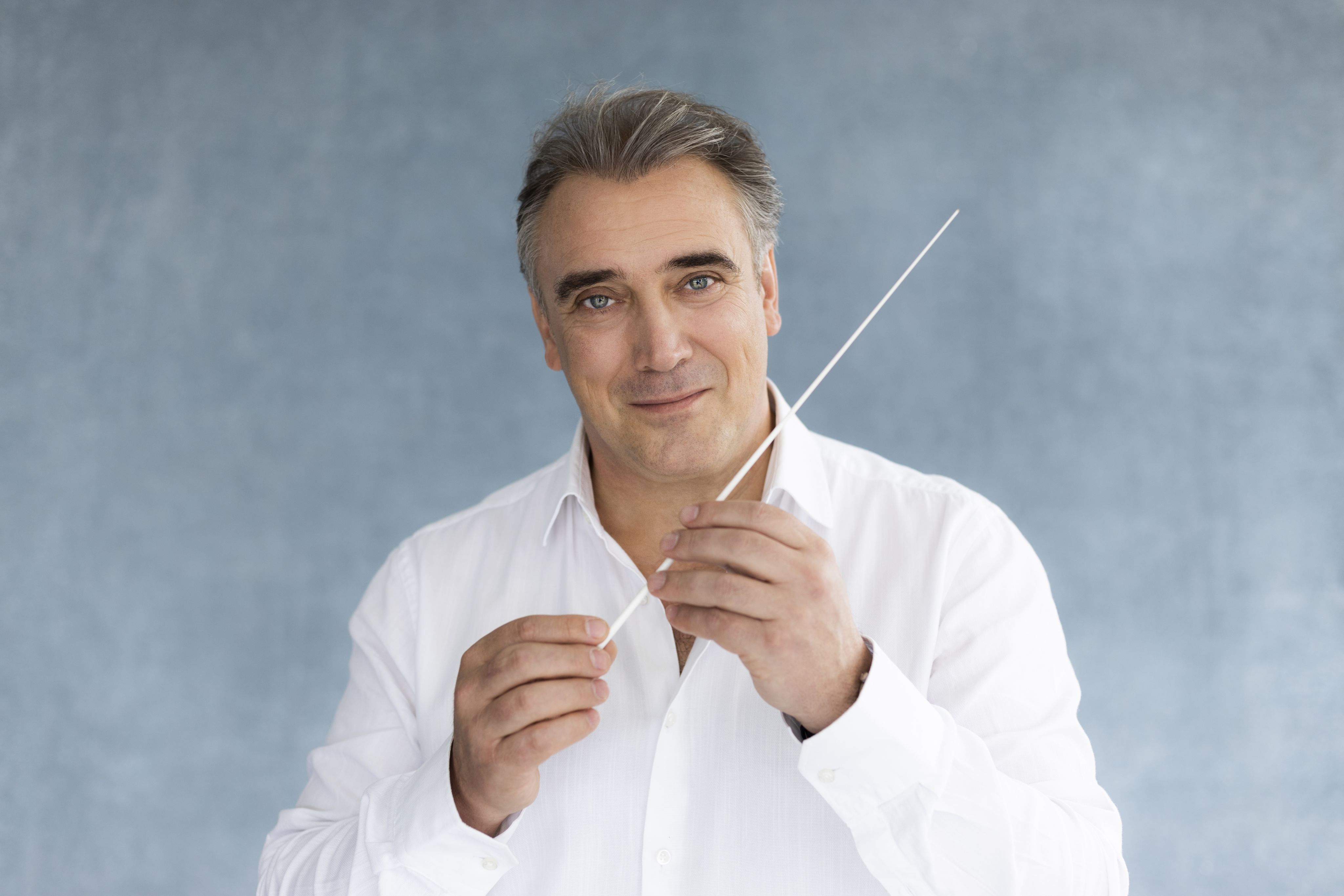
Paul Marc Mitchell
Paul Marc Mitchell
Spanish conductor Jaime Martín is currently Music Director of the Los Angeles Chamber Orchestra, Chief Conductor of the Melbourne Symphony Orchestra and Principal Guest Conductor of the BBC National Orchestra of Wales. He has also held the positions of Chief Conductor of the National Symphony Orchestra of Ireland (2019–24), Principal Guest Conductor of the Spanish National Orchestra (2022–24) and Artistic Director and Principal Conductor of Gävle Symphony Orchestra (2013–22).
Having spent many years as a highly regarded flautist, he turned to conducting full-time in 2013 and quickly became sought after at the highest level.
Highlights of the last season have included an 11-day Beethoven Festival with the Melbourne Symphony Orchestra, conducting all nine symphonies. He also returned to conduct orchestras in Spain, the UK and Australia and undertook a UK and European tour with the Melbourne SO that included appearances at the BBC Proms and the Edinburgh International Festival.
In the 2025/26 season he conducts the Aalborg, Colorado, Euskadi, Gothenburg, New Zealand and Queensland Symphony orchestras, Budapest Festival Orchestra, George Enescu and Strasbourg Philharmonic orchestras, Berlin Radio Symphony Orchestra and RTVE Madrid.
His extensive discography includes recordings with the Barcelona, Gävle and Melbourne Symphony orchestras, Cadaqués Orchestra and London Philharmonic Orchestra.
Jaime Martín is Artistic Advisor and former Artistic Director of the Santander Festival and a Fellow of the Royal College of Music, where he was a flute professor.
Akiko Suwanaiviolin

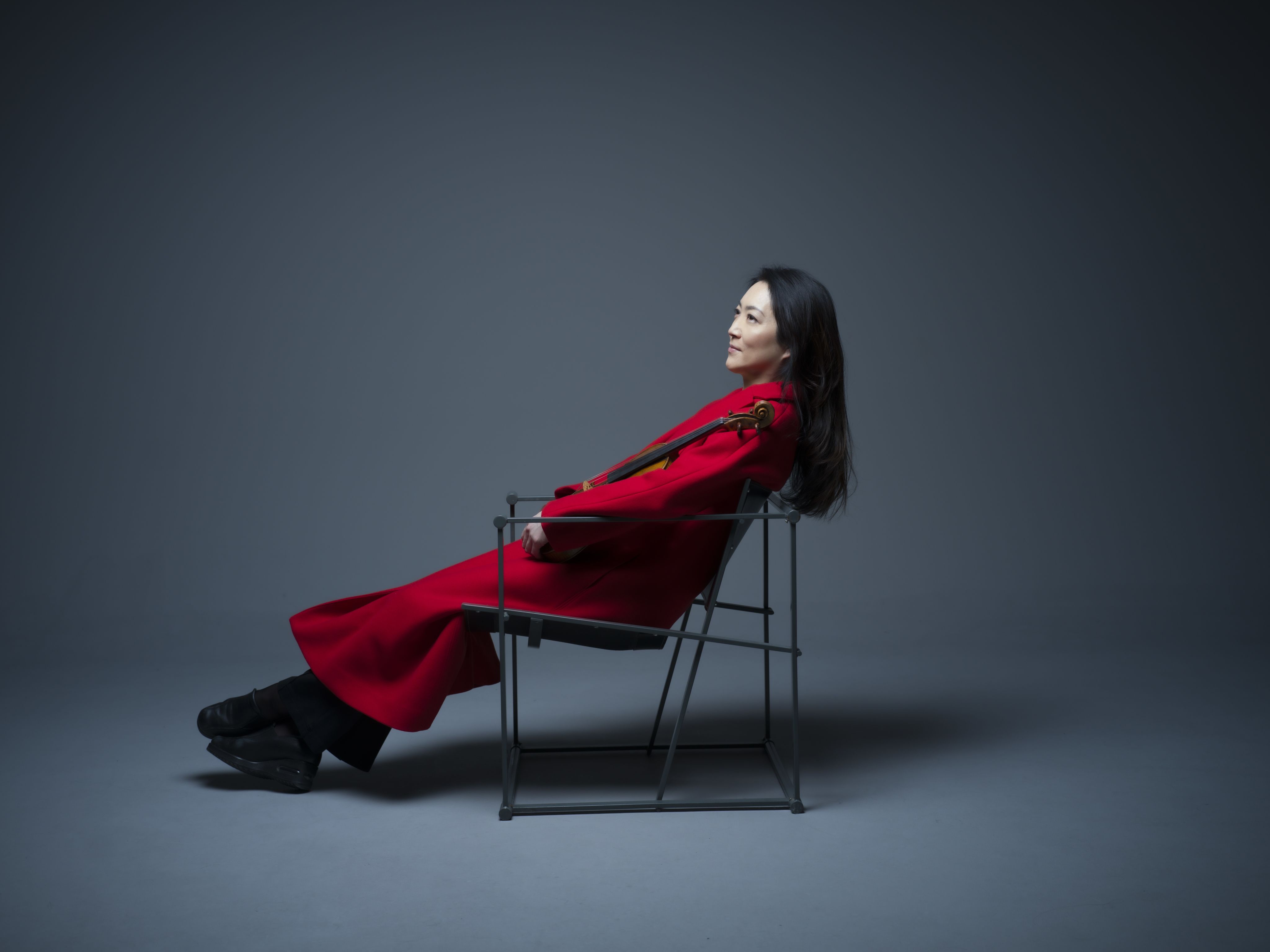
Marco Borggreve
Marco Borggreve
Japanese violinist Akiko Suwanai is a musician of considerable versatility and breadth of repertoire. Since winning the International Tchaikovsky Competition in 1990 she has enjoyed a flourishing career, performing internationally in chamber music and recital and appearing with the world’s leading orchestras and conductors.
She began this season with returns to the Lucerne Symphony Orchestra and Duncan Ward and the Budapest Festival Orchestra and Jaime Martín and made her debut with the Salzburg Mozarteum Orchestra and Andrey Boreyko. The season also sees concerts with the Hallé Orchestra and Principal Conductor Kahchun Wong on tour in China, as well as in Manchester and Sheffield; as well as appearances with the Nice Philharmonic and Lionel Bringuier, Lahti Symphony Orchestra and Christian Schumann, Belgian National Orchestra and Antony Hermus and the Macao Orchestra and Lio Kuokman.
She is known for her breadth of repertoire and passion for new music, and in February gave the world premiere of Misato Mochizuki’s Violin Concerto with the Yomiuri Nippon Symphony Orchestra and Mario Venzago. In previous seasons she has premiered Dai Fujikura’s Double Concerto for flute and violin and Peter Eötvös’s Seven. She has also given the Asian premieres of important new violin concertos by Sir James MacMillan, Esa-Pekka Salonen and Krzysztof Penderecki. Other notable performances of new works include Toshio Hosokawa’s Genesis and Guillaume Connesson’s Lost Horizons.
She has an exclusive recording contract and recent additions to her acclaimed discography include Brahms’s Violin Sonatas (2024) and Bach’s Sonatas and Partitas for Solo Violin (2022).
In 2012 she launched the Nagoya- and Tokyo-based International Music Festival NIPPON, of which she is Artistic Director. This biennial festival presents a variety of guest orchestras and chamber concerts and commissions new works and world premieres by Japanese and international composers. At the festival she has premiered new works such as Karol Beffa’s Violin Concerto and Dai Fujikura’s Pitter-Patter.
Akiko Suwanai performs on the ‘Charles Reade’ Guarneri del Gesù violin (1732), generously loaned to her by Ryuji Ueno, a Japanese-American collector and philanthropist.
BBC National Orchestra of Wales
For over 90 years, the BBC National Orchestra of Wales, the only professional symphony orchestra in Wales, has played an integral part in the cultural landscape of the country, occupying a distinctive role as both a broadcast and national orchestra, and serving as an ambassador of Welsh culture, regularly performing music created in Wales and championing Welsh composers and artists.
Part of BBC Cymru Wales and supported by the Arts Council of Wales, BBC NOW performs a busy schedule of concerts and broadcasts, working with acclaimed conductors and soloists from across the world, including its Principal Conductor, the award-winning Ryan Bancroft.
The orchestra is committed to working in partnership with community groups and charities, taking music out of the concert hall and into settings such as schools and hospitals to enable others to experience and be empowered by music. It undertakes workshops, concerts and side-by-side performances to inspire and encourage the next generation of performers, composers and arts leaders, and welcomes thousands of young people and community members annually through its outreach and education projects.
BBC NOW performs annually at the BBC Proms and biennially at the BBC Cardiff Singer of the World competition, and its concerts can be heard regularly across the BBC – on Radio 3, Radio Wales and Radio Cymru. On screen, music performed by BBC NOW can be heard widely across the BBC and other global channels, including the soundtrack and theme tune for Doctor Who, Planet Earth III, Prehistoric Planet, The Pact and Children in Need.
Based at BBC Hoddinott Hall, Cardiff Bay, BBC NOW utilises a state-of-the-art recording studio with a camera system for livestreams and TV broadcasts to bring BBC NOW’s music to a broader audience across Wales and the world. For more information about BBC NOW please visit bbc.co.uk/now
BBC National Orchestra of Wales
Patron
HM King Charles III KG KT PC GCB
Principal Conductor
Ryan Bancroft
PrincipalGuest Conductor
Jaime Martín
Composer-in-Association
Gavin Higgins
First Violins
Mira Marton
Martin Gwilym-Jones sub-leader
Gwenllian Hâf MacDonald
Terry Porteus
Suzanne Casey
Carmel Barber
Anna Cleworth
Ruth Heney **
Žanete Uškāne
Alejandro Trigo
Zhivko Georgiev
Grace Shepherd
Claudia Fuller
Second Violins
Anna Smith *
Kirsty Lovie #
Sheila Smith
Beverley Wescott
Vickie Ringguth
Joseph Williams
Lydia Caines **
Michael Topping
Roussanka Karatchivieva
Jane Sinclair
Katherine Miller
Jane Sinclair
Violas
Alex Thorndike #
Tetsuumi Nagata
Peter Taylor
Catherine Palmer
Anna Growns
Lydia Abell
Laura Sinnerton
Robert Gibbons
Nancy Johnson
Cellos
Leo Popplewell
Jessica Feaver
Sandy Bartai
Rachel Ford
Carolyn Hewitt
Keith Hewitt
Alistair Howes
Kathryn Graham
Double Basses
David Stark *
Mark O’Leary
Emma Prince
Christopher Wescott
Phoebe Clarke
Thea Sayer
Flutes
Matthew Featherstone *
Lindsey Ellis
Piccolo
Oboes
Clarinets
Nicholas Carpenter *
Bass Clarinet
Lenny Sayers †+**
Bassoons
Contrabassoon
David Buckland †
Horns
Meilyr Hughes
Alex Willett
Flora Bain
Tom Taffinder
Trumpets
Philippe Schartz *
Corey Morris †
Tim Barber
Trombones
Fernando Martin
Bass Trombone
Tuba
Timpani
Percussion
Elliott Gaston-Ross
Phil Girling
Andrea Porter
* Section Principal
The list of players was correct at the time of publication
Director Lisa Tregale
+ Green Team member
Keep up to date with BBC National Orchestra of Wales
Listen to our BBC Radio 3 broadcasts via the BBC Sounds app. Visit our website and follow us on Facebook and Instagram
To help us improve our online concert programmes, please take this 5-minute survey
Produced by BBC Proms Publications