How Football Conquered Britain - And Then The World
In Here for the History on BBC Sounds, Alice Loxton and Ben Henderson reveal some of the surprising moments and origin stories behind the traditions, customs and objects all around us.
How did football, following its humble beginnings in the UK, become the most popular sport on the planet? How did it achieve cult status?
The historians explore the remarkably religious origins of the sport, the class war that turned it into the people’s game and how footy became the unavoidable global phenomenon it is today.
![]()
Listen to why Brits are so obsessed with Football - Here For The History
Alice Loxton and Ben Henderson explore the origins of football, how the game transformed from a gentleman’s hobby to the people’s game, and then how it became the most popular cultural phenomenon in the world.
1. The Birth of football was hundreds of years ago
“Human beings have been enjoying kicking around ball-shaped objects as part of games for absolutely centuries,” states Ben.
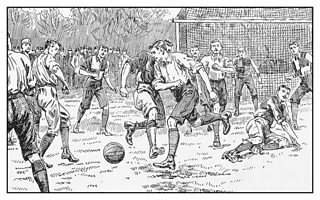
In Britain, they were calling it football from at least as early as the 1300s.
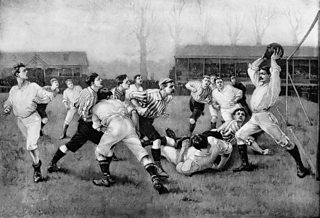
As the centuries passed, there were no widely-agreed rules to football: you could pick the ball up, there was no limit to the number of players, and games – often resembling scrums between villages – were known for being incredibly violent.
2. The Industrial Revolution propelled the popularity of football and other sports
In the mid-1800s, the Industrial Revolution, and religion, had a huge role to play in the genesis of modern football.
“There's a series of moral panics that are gripping society,” states Ben.
As the middle classes grew, there was concern that men were going soft, not getting their hands dirty. The mass immigration of rural workers to urban factories created city slums riddled by disease, which led to anxiety about the health of the working classes. And at the top of society, there was panic over the boarding school elite engaging in “self-pollution” (Victorian code for masturbation)!
One of the solutions proposed, to improve the nation’s health and toughen up the male population, was Muscular Christianity. “This idea that to be a good Christian, a good pious Christian, you also need to take care of your body,” explains Alice. “Healthy mind, healthy body.”
Organised sports became increasingly popular: cricket, boxing and – especially in public schools like Eton and Rugby – football.
3. Some early football clubs encouraged kicking in the shins
In the 1850s, ex-public-school boys were setting up football clubs across England. There were no set rules, with each club playing their own version of the game. At Rugby school in Warwickshire, for example, players would pick the ball up and charge with it. Some teams encouraged hacking – deliberately kicking opponents in the shins.
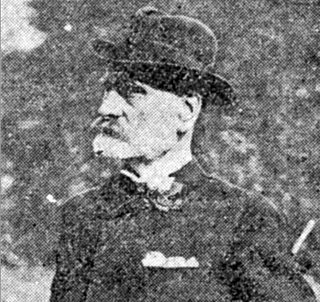
When Ebenezer Cobb Morley, the lawyer son of a church minister from Hull, moved to London he decided to join them and set up Barnes football club. When he was nearly garrotted, playing against Blackheath F.C., he decided to tackle the problem of lawlessness on the pitch himself.
“What he does next changes the course of sporting history,” says Ben.
Morley proposed setting up a Football Association to lay down some national rules. Representatives from clubs around London, many former public schoolboys, met at a tavern in Lincoln’s Inn Fields and, in December 1863, 13 laws of the game are agreed on, drafted by Morley himself.
Charging with the ball and hacking are outlawed, which leads Blackheath F.C. and others from Rugby School to break away and create their own sport – the game we know today as rugby. Or officially, rugby football.
4. The term soccer began as a very British nickname
The new brand of the sport that was settled by the Football Association became known as Association Football. This became affectionately referred to as “soccer” by boys at Oxford University – much like rugby became “rugger”.
Today, soccer is considered an American term, but it was actually a very English nickname, widespread in Britain until well into the 1900s.
5. The first FA Cup final attracted thousands of spectators
Association Football started as a hobby mostly for the middle and upper classes, but a new knockout tournament founded in 1871 marked the start of football’s transition from casual kick-abouts to competitive sport. All teams in the Football Association were invited to take part in the inaugural FA Cup. In 1872, the first cup final drew in around 2,000 spectators.
During this period, wages for factory workers grew and they had more money to spend on leisure. Workers also started to get Saturday afternoons off and, increasingly, many turned to football to fill that spot. Football’s popularity was on the rise…
6. Before 1885, paying players was banned by the FA
Clubs were banned from paying players. This didn’t worry the rich elite, but did affect the working-class clubs where players had to prioritise paid work over football.
William Sudell, the successful manager at Preston North End F.C., who was drawing in big crowds and under pressure to get results, hatched a plan. In 1883, he secretly recruited a few superstar Scottish players and promised them a wage. He cleverly disguised this by giving them “work” in his cotton mill.
When the FA got wind of this, Preston was banned from the FA Cup for a year. But other working-class clubs rallied behind Preston. A power struggle followed between the largely northern, mainly working-class clubs and the southern, gentleman amateur clubs. In 1885, the FA finally legalised paying players.
“This changes football forever,” says Ben.
The FA Cup is never again won by a gentleman amateur team; it’s the professional working-class clubs who are victorious.
7. A new Football League turned the sport into the people’s game
William Sudell teamed up with the director of Aston Villa Football Club, William McGregor, to come up with a new concept: the Football League.
“It was very innovative and it gives clubs a set schedule for their competitive fixtures,” explains Ben.
They could now predict their income and a weekly competition also amped up fan loyalty.
The first Football League season in the 1880s was watched by about 600,000 people. By the outbreak of World War I in 1914, the top division was watched by a whopping 9 million people. Football had become the national sport.
“That growth is absolutely phenomenal in such a short period of time,” adds Ben.
8. Many famous football teams across the world were founded by Brits
When football was being established, all sorts of British workers – traders, teachers, diplomats – were going abroad and taking the sport with them. Brits set up the first football clubs in Brazil, Argentina and many European countries.
AC Milan, one of the most successful teams in European history, was founded by British expats. It’s still called Milan – rather than the Italian Milano – as a homage to its original British roots.
9. Within a decade, the Premier League became the most popular football league in the world
In 1992, the top division of the Football League broke away and formed what we now call the Premier League. It secured a huge TV deal with Sky, and was marketed brilliantly across the globe. Within ten years, the Premier League had grown into the most popular league in the world.

“Football in England especially was injected with absolutely phenomenal amounts of cash,” states Ben.
This monetisation produces a great product on the pitch – expensive players creating beautiful football – but is also now a barrier to ordinary people. Whereas the Victorian commercialisation of football helped bring in a lot of working-class participation, stadium ticket prices are now prohibitively expensive; even watching on TV almost always requires a subscription.
Despite this, football remains as popular as ever. With its roots so deeply woven into working-class, urban, civic identity, when people follow football it’s about more than just the game. They are buying into a rich culture and history.
“It gives them a sense of belonging and identity,” says Ben.