Nine things we learned from Hannah Fry’s Desert Island Discs
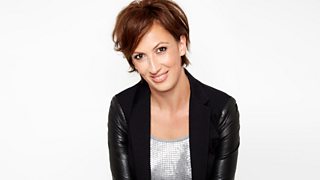
Professor Hannah Fry has a knack for explaining the most complex mathematical ideas in the most accessible and entertaining ways. Whether she is flapping a car door to demonstrate fluid dynamics or using statistics to find love, millions of people have engaged with documentaries like The Secret Genius of Modern Life, podcasts like Curious Cases and The Rest is Science, and her viral social media videos.
Fresh from a stint on Celebrity Traitors, where she went to the castle armed with spreadsheets, she joins Lauren Laverne to discuss her life, her love of maths, and the music that means the most to her.
Here are nine things we learned from her Desert Island Discs…

1. She thinks maths could be taught better at schools

Hannah is not a fan of the way that maths is often taught in school. “I don't think people are just scared,” she explains to presenter Lauren Laverne, “I think they're traumatised”. She likens it to “learning scales without ever getting to listen to music”. For Hannah, “it just sucks all of the joy out of it, so that you end up with people believing that this subject is something that exists in a dusty textbook that's got nothing to do with people's lives.”
Instead, Hannah sees maths as a “totally glorious, joyous, insightful view of the world that has so much to offer”. She tries to give people a reason to care. In a TEDx Talk about the maths of love, she used her own dating life to show how mathematical strategies might improve her chances. Although, she adds with a laugh, “I’m now divorced”.
2. Her dad was a genius with scrap metal
Hannah’s dad left school without qualifications after having polio as a child. He was out of the house by six in the morning to fit hydraulic lifts on lorries, working to support Hannah, her mum and her sisters.
He did not consider himself clever, Hannah explains, but “he was smarter than half of the professors that I’ve ever met. He would come up with these ideas, build these creations, with amazing engineering skills. He could make things out of whatever scrap metal he found lying around.” Although he was quiet, whenever he did offer a thought, “it would be so insightful”.
3. Even a bishop couldn’t out-Catholic her mum
Hannah’s mum came over from Ireland to look for work and met Hannah’s dad at a dance. She describes her mum as the most Catholic person she’s ever met. “I’ve met a bishop as well,” says Hannah. “She trumps them by a long way.”
I felt like I just didn't fit in anywhere because there was no pocket of woman-ness that matched who I was.Hannah on her early passion for F1 and engineering.
Her mum was always helping other people, and is “a really, really good human” – but she is also “deeply, deeply suspicious of any sort of fun or enjoyment”, which meant a strict childhood for Hannah and her sisters.
“She made it so that the only men that we had any contact with were my dad and the Catholic priests.” For a girl interested in car racing and engineering, “I felt like I just didn't fit in anywhere because there was no pocket of woman-ness that matched who I was.”
4. Her maths skills developed during one long summer holiday
One school holiday, when Hannah was about 10 or 11, her mum got hold of a maths textbook. “She decided that I should do a page of this every day before I was allowed out into the garden,” she says. “Obviously I hated it.”
But when she returned to school, suddenly the work was easy. “I’d seen it all before. I’d been practising this whole time.” These days, she sees much the same thing at work among her fellow mathematicians. “They're no smarter than anybody else, really. They're just people who are really, really obsessed with the subject. The more they practice, the more enjoyable it becomes and the more enjoyable it becomes, the more they want to practice.”
5. Her Formula One dream lasted six weeks
After gaining a PhD in fluid dynamics, Hannah got a dream job working in a world she’d always loved: Formula One. But the work turned out to be dull – “running code and picking the picture with the least amount of blue in it” – and she was the only woman. “When I was in the building, the disabled toilet became the girls' toilet,” she explains.
“It's not that women aren't good enough. It's not that working-class people can't do these big, grand ideas. I think that there is talent everywhere, but if you design an environment for one particular type of person, it's such an uphill battle for anybody else.”
6. A short stand-up comedy set put her on the road to broadcasting
When Hannah was invited by a friend to perform some maths-related stand-up, she thought, ‘why not?’

If I come across a weird, crazy way to see this world, of course I want to share it. And if you do that enough times, eventually you end up in Celebrity Traitors.Hannah's love of maths has led to unexpected results.
“I always think the hardest thing is the decision to say ‘yes’, and then you’ll work out a way to do it from there.” She worked incredibly hard on her set, and it paid off. “I really did manage to find something very good there,” she reflects.
Although she’d been quite happy with the prospect of being “a normal bog-standard academic in a windowless room with a chalkboard”, comedy set her on the path to broadcasting and communicating her love of maths. “It’s like when you've got a really good bit of gossip, you just desperately want to tell someone. If I come across a weird, crazy way to see this world, of course I want to share it. And if you do that enough times, eventually you end up in Celebrity Traitors,” she laughs.
7. She's still processing her experience on Celebrity Traitors
“There've been a few times where people have been like, ‘are you a celebrity?’” she tells Lauren. “I think it's a little bit like the question, ‘are you asleep?’ You can never answer ‘yes’ to it.” Taking part in Celebrity Traitors, she remembers looking around the room. “It’s like, pop stars there, movie stars there, megastars there… and she's a mathematician in the corner. It makes no sense to me.”
8. The music she played during cancer treatment still makes her cry
During the Covid lockdown in 2020, Hannah was diagnosed with cervical cancer. She underwent extensive surgery and was not allowed visitors when she was recovering. “I was in this hospital bed on my own with nothing but the sheer terrifying drop of the end of my existence in front of me. It was horrific.” She asked her then-husband to “set up FaceTime in the corner of the room like I was CCTV” so she could watch her two young daughters play without them having to see her.
During that time, she listened repeatedly to Part of Spring, from Vivaldi’s Four Seasons, recomposed by Max Richter, which she chooses as her sixth disc. “I can’t hear it without crying,” she says. “It’s like the ecstasy of what being alive should feel like.” Hannah has now been cancer-free for five years.
9. The only thing she’s certain about is uncertainty
The future may look uncertain in many ways, but for Hannah that is something to embrace. “People are very bad at accepting the amount of uncertainty there is. And I think that we can confuse confidence with certainty, and we can end up going down routes that are not good because we are denying the uncertainty. In a lot of ways science is actually the ultimate engine of uncertainty. It's only by having doubt and using that as a way to continually test your own assumptions that progress really happens.”